

Listen to the article
This audio is auto-generated. Please let us know if you have feedback.
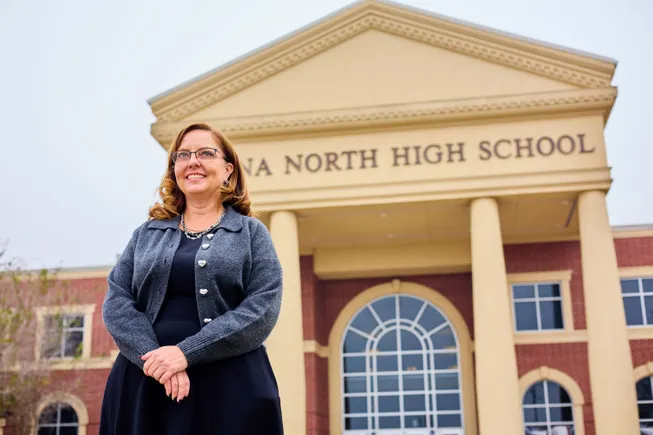
Donna Independent School District, located in South Texas just north of the U.S.-Mexico border, has seen declining enrollment for years — and an even sharper than expected drop this school year.
The district’s enrollment peaked at almost 15,500 students around 2015 and has since fallen to 12,500 for the 2025-26 school year, said Superintendent Angela Dominguez. A majority, 95%, of the student population comes from economically disadvantaged backgrounds, and 56% are English learners.
This school year saw a higher than expected drop in enrollment due to heightened immigration enforcement, she said. Donna ISD had projected 300 fewer students but actual enrollment fell by 487 students.
The downward trend has also been driven by falling birthrates and competition from local charter schools, Dominguez said.
If Donna ISD’s Board of Trustees had not approved a plan in early 2025 to close two elementary schools, the budget fallout would have been worse, Dominguez said.
The district expects to save at least $2.6 million annually from the school consolidations, according to Dominguez. Donna ISD retained all the staff impacted by the move, but will not replace those roles if there is attrition. During the 2024-25 school year, the district had a roughly $3 million budget shortfall.
“It would have been an even greater financial hit this year if we hadn’t already been taking many of those measures and planning for the future,” Dominguez said.
Public school closures and consolidations are becoming more common in districts nationwide as enrollment declines lead to difficult budget decisions. Those decisions can in turn cause tense relations between a district and communities that push back against proposals to shutter their local schools.
But the night Donna ISD’s Board of Trustees approved its school consolidation plan, Dominguez said, the boardroom was empty and there was no community pushback.
Dominguez credits the fairly smooth sailing to her school board’s full support of the school consolidation plan that she proposed and the district’s transparency throughout the process.
Addressing the ‘heart’ of a school community
While Donna ISD weighed consolidating schools, Dominguez regularly met with her mentor, Art Cavazos, a retired superintendent from Harlingen Consolidated Independent School District in Texas. Cavazos worked closely with Dominguez and in partnership with The Holdsworth Center, an Austin, Texas-based nonprofit that works to support and develop K-12 leaders.
Cavazos, a superintendent in residence at The Holdsworth Center, said he encouraged Dominguez to shift the typical deficit mindset around school closures into a positive opportunity that would align well with Donna ISD’s priorities.
When superintendents communicate the need and process for school closures to the community, Cavazos said, they should not solely focus on the budget reasoning.
“Your typical superintendent will talk about closing schools because we need to balance the budget,” Cavazos said. But that doesn’t speak to the “heart” of a school community, he said. “That’s not an emotional charge for me, other than a negative one.”
Instead, he said, it’s especially important for superintendents to be a district’s “chief inspiration leader” — in addition to chief communicator and strategist.
When district leaders face a challenge like school closures, coaches at The Holdsworth Center push them to think of their role as one that ensures investing in the community and building up school culture even in difficult times, Cavazos said. Board relations are a critical component to that as well, he said.
At the same time Donna ISD was exploring consolidation options, it also wanted to develop innovative campuses to offer students better opportunities, Dominguez said. Taking Cavazos’ advice, the district formed a committee of teachers, parents and some community members to explore those innovative options, she said.
While the district finalized its consolidation plans, it was able to announce the rollout of three new specialized academies for preschool and elementary levels — focusing on arts as well as science and sports — to launch in the 2025-26 school year. The district, with 17 total schools, had already offered four specialized academies at preschool to grade 8 levels.
Closing the two elementary schools gave Donna ISD more resources to help launch the academies, Dominguez said. The district spent $50,000 in local funds and used federal funds for staff training and development for the new academies, she added.
The academies will have more access to course offerings, Dominguez said. At the new arts academy, for example, students can choose from five electives such as theater and folklórico dance instead of the district’s typical two elective offerings of physical education and music.
Parents and students felt closely connected to the two schools that were closing, Dominguez said, often because generations of their families attended them. But announcing the new academies “helped soften the blow,” she said.
“I wanted to tell parents, ‘Look, your school’s closing and I know this is heartbreaking,’” Dominguez said. “‘But now your child’s going to be able to have a fine arts education at our fine arts academy that we were never able to offer before, and they’re going to get these extended electives and enrichment courses and after-school opportunities.’”
Learning from other districts’ missteps
Another key lesson Cavazos taught Dominguez was to learn from other districts’ missteps in closing schools, she said. As Donna ISD developed its FAQ website page, Dominguez said, they noticed what other districts had missed in their communications and the public pushback they received.
Learning from others’ mistakes also helped Dominguez to proactively think about and address what might upset her community about the closures, she said.
A crucial first step in any school closure process is to educate the board, who then can speak to concerned community members, Dominguez added.
Although she said the consolidation process went as smoothly as it could have, she acknowledged it’s still “tough on a community.” And it may not be over: Given the state of public education and ongoing enrollment declines, the district may have to go through another round of closures again, she said.
As districts like Donna ISD continue to face enrollment challenges, Dominguez stressed the need for public schools to innovate. For instance, Donna ISD plans to roll out a virtual school option in the 2026-27 school year, she said.
For public education, “if we don’t learn to innovate, we’re going to become obsolete. We’ve got to keep up with the competitive times,” Dominguez said. “Because I don’t see our birthrates getting any better.”
