

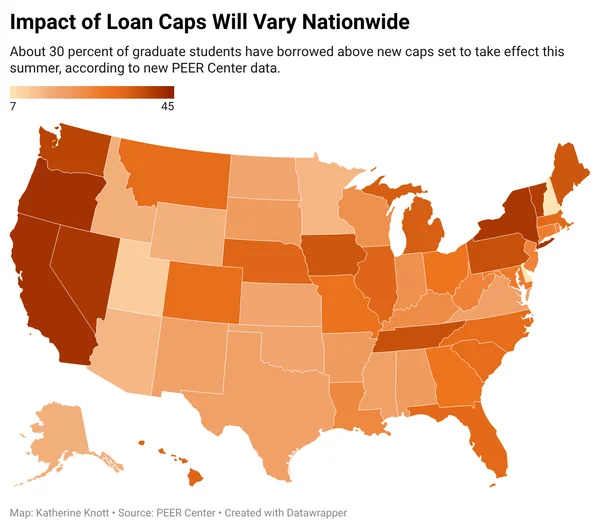
An estimated 30 percent of graduate students would hit their student loan limits if new borrowing caps take effect this summer.
That’s according to new research from the Postsecondary Education & Economics Research Center at American University that breaks down how the loan limits will affect states, institutions, programs and students. The caps, put in place by Congress last summer, are expected to significantly change how students pay for college and could force some institutions to close programs. To prepare, institutions are offering their own lending options, partnering with private lenders or helping to get students grandfathered into the current system. One state has launched its own loan program to help fill the gap for graduate students.
Researchers at PEER previously found that about a quarter of borrowers nationally took out loans that exceed the caps and graduate students with low credit scores could struggle to find financing for their schooling.
“There is definitely a gap in everyone’s understanding and ability to anticipate how this is gonna play out for specific fields and institutions,” said Meredith Welch, a postdoctoral fellow at PEER.
To help close that gap, Welch and others at the PEER Center used Education Department data from January 2025 to estimate how many borrowers exceed the new loan limits as well as the share of loan volume that’s over the cap. They pulled the data for students attending from 2020 to 2023 and then broke down that data at the state, institution and program level. You can explore all the data here via an online tool.
Welch cautioned that the data is an estimate because of limitations in the underlying data and how researchers addressed those gaps.
“The process definitely involves error and, especially for particular programs or particular institutions, you should definitely view these as estimates rather than, like, a definitive number,” she said.
For years, graduate students have been able to borrow loans up to the cost of attendance under a program known as Grad PLUS. But last year Congress ended that program and limited how much students can take out in federal loans for graduate programs. Students in the 11 programs labeled “professional” can borrow up to $50,000 per year or $200,000 in their lifetime. Students in all other graduate programs are capped at $20,500 in federal loans a year or $100,000 in their lifetime.
The graduate loan caps are part of a broader effort to rein in the ballooning federal student loan portfolio; graduate loans make up nearly half of all outstanding loans. However, critics worry that the caps could hinder access to graduate education and exacerbate shortages of health-care professionals, teachers and other professions for which some form of postbaccalaureate education is necessary.
A key point of contention with the caps is which programs get access to the higher loan limits.
The Education Department’s proposed regulations would designate as professional the following fields of study: medicine (M.D.), pharmacy (Pharm.D.), dentistry (D.D.S. or D.M.D.), optometry (O.D.), law (L.L.B. or J.D.), veterinary medicine (D.V.M.), osteopathic medicine (D.O.), podiatry (D.P.M., D.P. or Pod.D.), chiropractic (D.C. or D.C.M.), theology (M.Div. or M.H.L.) and clinical psychology (Psy.D. or Ph.D.)
But representatives from other fields such as nursing and social work have argued for a more expansive definition. ED has yet to finalize the regulations.
Among the top programs in terms of loan volume, the picture is more nuanced when the data is broken down by institution type. For instance, 89 percent of borrowers in dentistry programs at private nonprofits exceed the caps, compared to 71 percent of those in dentistry programs at public universities.
