

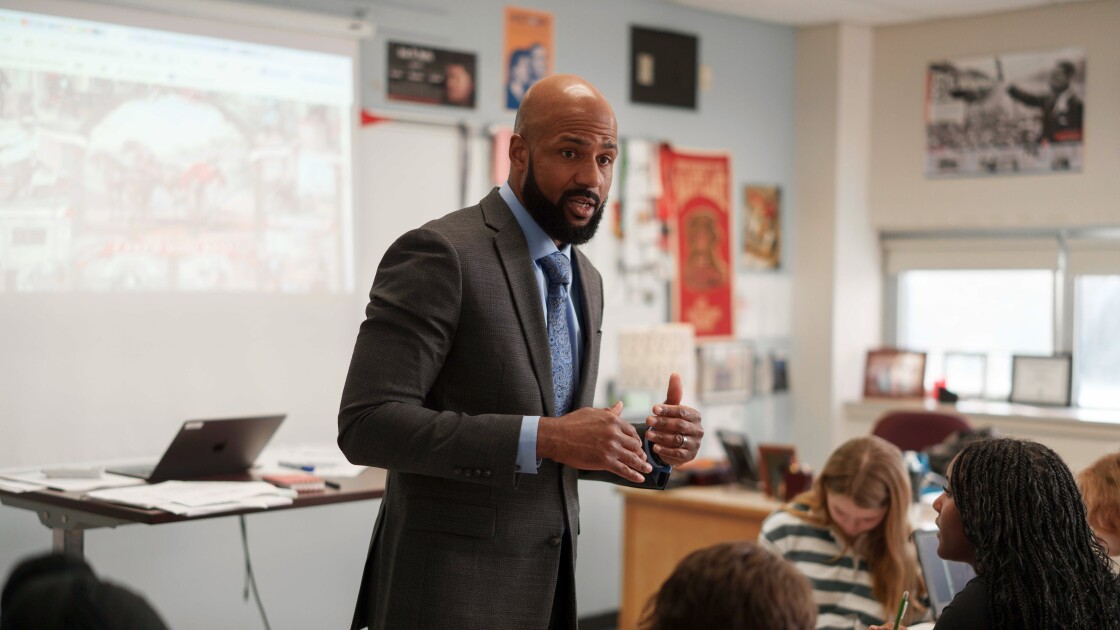
The same skills that help students to engage in challenging classroom conversations productively—like listening and considering a variety of perspectives—also help prepare them for an increasingly diverse and divisive world.
That’s why Leon Smith, the 2026 National Teacher of the Year, builds students’ sense of community in the classroom and encourages them to see new sides of well-known historical events and debates.
“We constantly work on and reflect on strategies to make sure that our conversations allow all voices to be heard,” Smith said. “These are the behaviors that are going to allow the students to be global citizens, to get into the workplace and really do an excellent job.”
The NTOY program is run by the Council of Chief State School Officers. An independent selection committee, which includes representatives of national K-12 education organizations, chose Smith from the five finalists among the 56 teachers of the year, who hail from the 50 states, the District of Columbia, the Department of Defense Education Activity schools, and U.S. territories.
The choice of Smith, an Advanced Placement U.S. History instructor, for the nation’s top teaching honor sends support for educators addressing challenging topics of diversity and civic engagement amid federal and state pushes to eliminate school diversity, equity, and inclusion initiatives and restrict coverage of race in curricul.
“He is a strong voice for his school community and models the profession we want our students to enter tomorrow,” the NTOY Selection Committee said in a statement.
Smith developed the first AP African American Studies course at his school, Haverford High School in Pennsylvania, and his civics students regularly meet with local legislators and community scholars on advocacy and the role of government. (The course became a national flashpoint in the discourse about race and teaching in 2023, when Florida refused to allow a pilot version of it to be taught.)
In Smith’s favorite lesson, 9th grade students develop a capstone project based on unexpected perspectives on well-known historic events, such as how school desegregation reduced teacher diversity in the years after the U.S. Supreme Court’s 1954 ruling in Brown v. Board of Education of Topeka.
“When the students come in, I mean, there’s so much buzz,” he said. As part of the captone, students develop a podcast, video, trifold display, or other media to present on an unusual historic perspective as part of an end-of-year presentation to the school and parents. “It’s just the power of student voice and choice,” he said.
Smith is the second top teacher in a row hailing from a Keystone State high school. The 2025 Teacher of the Year, Ashley Crosson, teaches English/language arts inrural Mifflin County, Pa., in the state’s central valley. Smith teaches in a densely populated Philadelphia suburb.
The new Teacher of the Year will take a sabbatical to advocate for teachers
Smith will take a sabbatical over the 2026-27 school year to visit classrooms nationwide and serve as an ambassador for the profession, which he said needs to “think creatively and innovatively” about how new teachers are trained. He thinks preservice programs should include more classroom practice and application of topics like the science of reading and AI use in the classroom.
“Certainly it’s important to learn about the foundational psychologists at the heart of a lot of our pedagogy,” Smith said, “but that does not always prepare you for day one when you step into the classroom. Really, that only comes through experience and mentorship.”
But building strong relationships with students remains the most critical teaching skill for Smith, a veteran educator and basketball coach for more than 20 years.
“If you talk to someone who graduated this year, last year, 20 years ago, 30 years ago, one of the things that resonates with them is how that teacher made them feel: The teacher believing in them, breathing a light into them,” Smith said.
The National Teacher of the Year was announced Tuesday morning on the TV show CBS Mornings. From its first award in 1952, winners traditionally have been honored by the White House, but CCSSO hasn’t announced plans yet to do so this year.
