

By: Danish Kurani
From the first day of kindergarten to the day we complete high school, we spend approximately fifteen thousand hours in school. The only place we might spend more time during this period is at home, which means schools are one of the most important environments for our growth and development. They’re where our children are raised to become who they will ultimately be for the world.
Unfortunately, the typical school building fails to deliver on this promise. Because of generations of compounding safety concerns, walking into a school building means passing fences around the campus perimeter, gates and guards, and body scanners. It feels more like you’re walking into a prison than a place to learn. With so much security, schools are hardly pillars for their communities. In fact, in recent years, there’s been a growing effort to further separate schools from their communities because elected officials have thought this would make schools safer and protect kids
With such an emphasis on controlling who comes and goes, our schools are greatly underutilized. The average school building in America is used only one-fifth of the time, meaning the current situation leaves schools wasting four-fifths of their opportunity to serve us.
While the education system continues to try to shake its factory model origins, the spaces have generally remained fixed, making these ambitions elusive if not altogether unreachable. If we want kids to be critical thinkers, why are they forced to sit in rows and obediently face forward? If we want them to be creative, why are their spaces so uninspiring and lifeless? If we say they are individuals with different strengths and needs, why aren’t school spaces differentiated, providing various environments for students to choose from?
The truth is at odds with the design. The more schools are open to the community, the better they serve kids. This permeable wall creates opportunities for community-connected projects, real-world learning and more.
Preparing for a Baaham School
Baaham means two things working in tandem. For example, there’s reciprocity between us and our environment. We shape it; it shapes us. That’s what Baaham is describing—two things mutually influencing one another.
Designing a Baaham school begins with giving special consideration to its location. That means zooming out to see what the neighborhood has to offer and what it needs. We want to expand the opportunities available to children—not just what their teachers can offer, but what the entire community can offer and teach. What surrounds the school will determine which kinds of spaces are included in the school’s design, so we ask: What learning experiences can local businesses and organizations provide for students? What kinds of facilities (e.g., medical laboratories, large 3-D printers, performance spaces, etc.) can students access to deepen their learning? What public amenities and infrastructure are available, such as libraries and parks, for students to enjoy? By answering these questions (and not assuming we must build something new), we avoid creating redundant facilities that already exist nearby and can be used by the school.
We involve many different groups along the way: students, teachers, faculty, administrators, and parents. Each group has a unique stake in the learning experience that the school delivers, and we want to understand and solve the important problems these groups face. In this process, the teachers, faculty, and administrators are encouraged not to look at or copy what other schools have done or what they see online. Rather, they’re asked to reflect deeply on the kinds of experiences they want to create for their students. They’re also taken on a tour of other learning spaces, such as libraries, colleges, and vocational training centers, so they can experience them firsthand, in action, and so they’re prompted to think more deeply about what will work best for their students and what they’d rather leave behind.
By observing and listening to students and teachers, we identify obstacles to learning and can then design an environment that will make the most desirable behaviors the easiest ones to perform. By default, the design will help teachers teach and learners learn. As we begin to imagine how the school itself will be designed, we pay close attention to how well the structure can adapt over time. Education methods are constantly evolving, and the school itself needs to be able to keep up. Modifications must be easy.
Along the way, instead of discussing how well the school colors (which are often arbitrary) can be applied on the hallway walls, lockers, chairs, and signage, we engage our stakeholders in a discussion about the emotional ergonomics of the school’s spaces and how to create the right atmosphere for students and teachers.
As various designers on the team explore these details, they coordinate with one another to make sure no decision is made in isolation and could accidentally interfere with another person’s design. This includes the architect, interior designer, lighting designer, furniture designer, audiovisual designer, engineers, and more. Not all these people join the project at the beginning, so the architect and educators work together to create a master list of all the criteria that matter. This is a unifying document that gets shared with every designer, engineer, and consultant on the project so that everyone is working to hit the same set of targets.
All of this is part of the Baaham process. (You’ll notice we haven’t discussed any actual design specs yet.) In spaces as complex as schools, where there are dozens of rooms and places for all kinds of activities and where the stakes of getting the overall design right are so high, it’s vital that we consider why we’re building before we think about what to build and how to build it.
Baaham schools are fundamentally different from traditionally designed schools in this way. They challenge the assumption that schools must be concrete boxes nested within larger boxes and joined by straight lines for efficient processing of students. When we challenge these assumptions and design with a process that includes more perspectives and relevant factors, all of which affect how well students learn, we design schools that transform the educational experience.
A Vision for Baaham Schools
At heart, a school should be a pillar of its community.
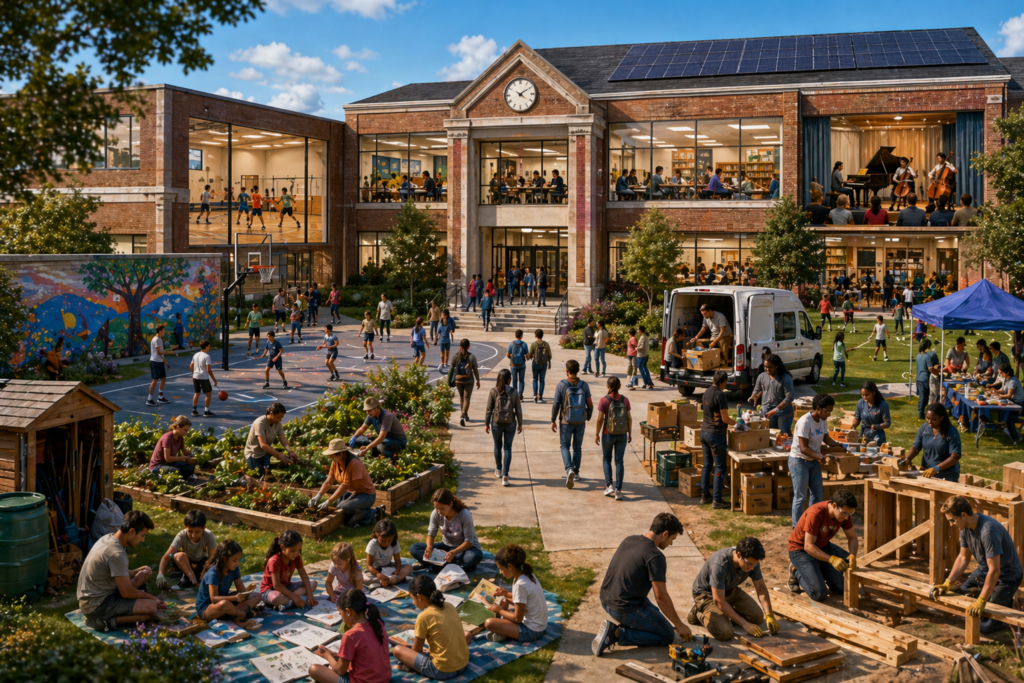
Maybe that’s a neighborhood that spans a few city blocks. Or it could be a well-populated suburb on the outskirts of an urban core. Or a rural town in the countryside. One of the hallmarks of a Baaham school, especially at the scale of its location within a community, is how well it integrates with that community. Students can walk to restaurants to eat lunch, research at the local library, practice at the town’s aquatic center, intern at a local company, and use a nearby science laboratory for their projects. The learning opportunities are not just on campus. The entire neighborhood becomes a place where students can learn.
Baaham schools also have amenities that serve local community members based on what people need, such as tech skills training and résumé workshops for career development. These encourage more adults to come on campus and potentially get involved with the school either as a mentor or volunteer. At the very least, they might take an interest in the education process, eventually becoming champions and supporters of the school who can advocate for teachers and students.
Especially ambitious designers and educators may provide housing for senior citizens on the school’s campus. In this vision of a Baaham school, senior residents can access the school’s amenities and services, and students can volunteer at the senior residence to gain skills in nursing and caretaking, along with administration and operations. As the two groups spend more time together, intergenerational learning begins to take place. Young people learn from community elders and develop greater reverence for past generations, while community elders enjoy longer and healthier lives because they are socializing and cared for. Both seniors and students develop stronger relationships, leading to increased happiness.
This is just one example of Baaham’s recognition that academics aren’t the only important part of an education. Quality relationships lead to happiness, so Baaham schools feature places for people to hang out, socialize, take breaks, and play. This includes outdoor pavilions and gazebos, fountains and water features, gardens with benches, and game rooms.
Students and teachers can use these facilities to build stronger relationships, especially with people they don’t see regularly in class.
To promote wellness within the larger community, Baaham schools are designed so that much of the campus can be accessed after school hours by local residents who wish to use the sports facilities for recreation, the learning spaces for adult education, and the outdoor spaces for movies and local events. Baaham schools may even include “wraparound” services, such as health clinics and food pantries, so that busy parents can run errands in the same spot where they pick up their children. Beyond the logistical benefits, parents who spend more time on campus will feel more inclined to stay involved with the school and their child’s education. When schools are reimagined to serve these functions, it’s not just students and teachers who benefit, but anyone who wants to feel closer to their community.
These are just a couple of examples of how a Baaham school integrates with its community. There are many more specific design details that education leaders may use to fit their needs and goals.
For example, schools that want to instill entrepreneurial mindsets may consider creating office spaces on campus to host young companies and start-ups. Each week, students can spend a few hours working alongside these professionals, learning about entrepreneurship and helping with various functions of the business, including operations, product design, sales, marketing, and finance. The benefits are symbiotic: While the company receives subsidized (or free) office space for offering this good to the community, the students get hands-on experience learning about business.
A Baaham school can also teach kids how to live ecologically. In this conception, the school itself is built with reclaimed and upcycled materials and highlights these features on walls and furniture so students get in the mindset of reusing things. The school also includes a system for rainwater collection that uses the collected gray water for flushing toilets, for landscaping irrigation, and for watering vegetable gardens that supply produce to the cafeteria.
Along with preserving water, such a Baaham school can compost scraps from leftover food. More advanced design features might include building a butterfly and bee garden, where students can learn about the symbiotic connection between flowers, bees, and butterflies in nature and can produce their own natural products, such as bath or skincare supplies, candles, and other goods from the flowers and honey.
Around the school, sensors for lighting and temperature show how the school consumes and even produces energy. Each of these is in plain view so they can become didactic: By seeing and interacting with these ecological features every day, students come to understand how the building works and start thinking about how to live more ecologically.
However a school decides to situate itself within the larger community, Baaham doesn’t judge what’s right or wrong. Every community, and every school, is different. What matters is the harmony created between the two so that students are supported in learning what matters most. Even the structure of the school itself is designed to uphold the school as a pillar within its community. Enough care is given so that the outside of the building has visual details that people appreciate, allowing the building to become beloved by locals. Even if one day it’s no longer needed as a school, the community will want to keep the beautiful building and reuse it for something else.
While each school may adopt a unique vision for how it connects with its local community, Baaham schools have at least two traits in common within their walls, which remain true no matter the school’s size, location, or learning method.
Variety
First, Baaham doesn’t assume that classrooms are the default elements that make a school. While they have their benefits for certain kinds of instruction, they don’t accommodate other visions of education that may require more creativity, flexibility, and collaboration. Plus, creating variety in the kinds of learning spaces changes how the spaces feel. Kids and teachers won’t feel like they’re in the same environment all day, and the variations from space to space will make the day less mundane and more fun and will even keep people alert because of the changing stimuli. As students travel between classes, they won’t take straight-line pathways, which can make school feel like a grind. Instead, they will have the freedom to take a more meandering path from A to B, which gives them agency over how they travel. Or perhaps they will circulate through larger common areas, where they are free to roam and socialize with other students.
Entering the learning space, the design clearly acknowledges that students learn in all different ways. They each have different preferences for how they learn, how they relax, and how they socialize. That’s why, as students settle in to learn, they will encounter a variety of arrangements, atmospheres, and tools. If a child prefers to work alone at times, he can. If another child works best on the floor, she can. Whether the children prefer to work using analog or digital tools, artistically or analytically, while moving their bodies or sitting still, with visuals or auditorily, they can. If they are gregarious and love to socialize, there are social arenas where they’ll thrive. For the ones who keep their circles tight, there are nooks and crannies in which they can feel at ease. The design never forces kids to conform to a single image of how a student should learn.
Wellness
Elsewhere, we see how Baaham can promote a healthier experience while students and teachers are at school. Dining areas aren’t built as enormous cafeterias with dozens of tables, which can turn them from places to eat lunch into arenas that reinforce unhelpful social hierarchies. Instead, they’re divided into smaller, connected rooms that kids don’t feel nervous walking into and that give students the freedom to find their own cozy nooks or groups where they feel comfortable. Within these dining areas, each food item is displayed with nutritional information that nudges people toward healthier choices. Nourishing the students and staff physically allows them to perform better mentally.
Back in the learning environment, students are treated to far more natural light than traditional schools typically provide. Windows are large to avoid an overreliance on artificial lighting, and they are positioned such that students can give their eyes a break by looking out to faraway views of nature. When that’s not possible, the spaces are designed with skylights that bathe the interior with warm sunlight and courtyards and gardens that people can enjoy and rooms can look onto. The windows in these rooms are smart enough to recognize when there is a buildup of carbon dioxide, which makes students drowsy, and open automatically in good weather. The learning environment within Baaham schools is always designed to keep students’ minds and bodies working well.
Overall, from outside to in, large to small, Baaham schools are built around people’s needs. At every moment, the biological preferences and rhythms of the occupants are considered, and spaces are designed to accommodate how students learn best, how teachers teach best, and how administrators lead best with an uncanny ability to adapt and grow right alongside the school.
Imagine if our children could go to a school like this. How much happier might they be? What would it feel like to drop them off at school and see the light in their eyes from the excitement of knowing a great day lies ahead? Every child deserves this experience, and we can give it to them.
Instead of feeling like a number, students can feel like valued members of their communities. Instead of feeling doubtful or afraid, they can feel confident, curious, and able to take risks. And instead of holding them back, their learning environments can push them forward.
Our children deserve this gift. As a society, it may be the greatest one we can give.
Danish Kurani is an architect, designer, and the author of The Spaces That Make Us: Why Design is Broken and How We Can Create a Happier, Healthier World. This article is an abridged excerpt from that book.
