

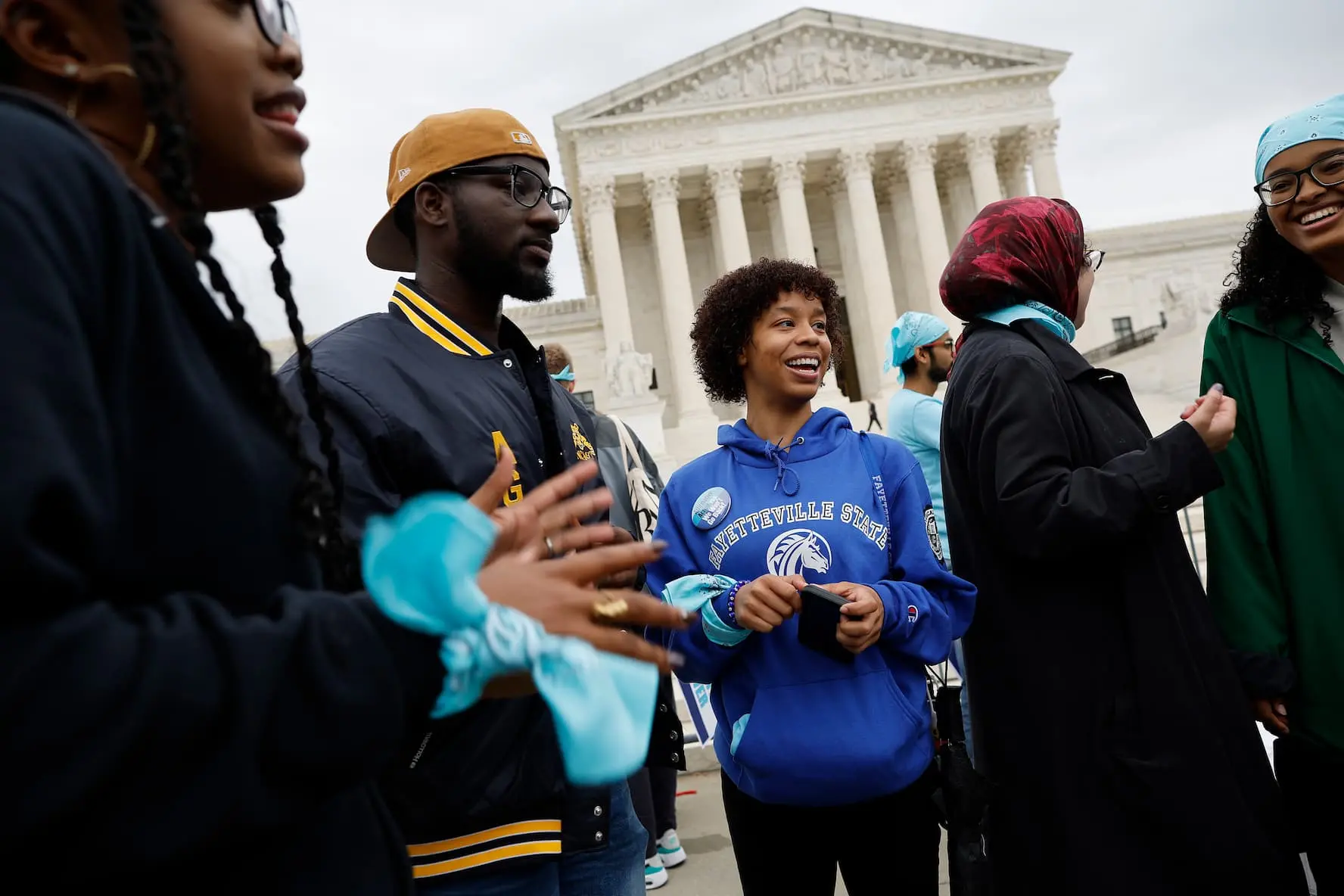
Following the U.S. Supreme Court’s 2023 decision in Students for Fair Admissions v. Harvard (SFFA), racial/ethnic diversity is down at elite institutions across the country. In addition to the ruling, developments like the Trump administration’s crackdown on diversity, equity, and inclusion and swings in standardized testing policy are all contributing to a tumultuous higher education admissions landscape.
In this piece, I argue that diversity continues to be consequential for students and the colleges striving to serve them. I then highlight three key post-SFFA enrollment trends to track, which include: the ruling’s impact on both higher- and lower-selectivity institutions, the ruling’s particularly negative impact on Black student enrollment at elite institutions, and the intersecting influence of testing policy on enrollment outcomes. My hope is that these insights can help researchers and policymakers as they seek to understand the landscape following SFFA.
SFFA and why racial/ethnic diversity matters for higher education
Legal questions around the acceptable use of affirmative action in contexts ranging from higher education to employment have been percolating for decades. In earlier cases, the Supreme Court repeatedly affirmed the ability of institutions of higher education to consider race in a limited manner during the admissions process. Institutions could see a student’s race/ethnicity and consider how it might influence their context for opportunity and potential contributions to the campus community. In SFFA and prior cases, institutions argued that racial/ethnic diversity in student bodies was vital to facilitate deeper and more complex levels of student learning, highlighting the educational benefits of diversity. Moreover, the benefits of affirmative action extend beyond the university campus, facilitating social mobility for underrepresented racially minoritized students (URM), and supporting a diverse, competitive workforce, from medicine to the military.
While some states banned race-conscious admissions before 2023, the SFFA ruling marks the first time private institutions nationwide are prohibited from considering race or ethnicity in the admissions process. Following SFFA, institutions can still consider how race is relevant to students’ experiences if a student discusses it in their application. As such, in my new book on admissions after SFFA, I refer to race-conscious admissions as being restricted, but not dead. While class-based affirmative action can result in some level of racial diversity, policies that facilitate economic diversity do not always result in racial diversity. The ruling in SFFA therefore marks a considerable setback for efforts to advance diversity, equity, and inclusion in higher education.
SFFA’s system-wide impact
While the most directly observable impact of the SFFA ruling on Black and Latino enrollment is at highly selective, private institutions that have historically considered race in admissions decisions, there is also an expected “cascade effect” affecting enrollment at less-selective institutions. In this sequence, URM students turned away from elite institutions are expected to cascade to the next level of selectivity, like a state flagship school. In turn, students who would have ordinarily attended the flagship are turned away due to the inability of institutions to consider race as a demographic category during the admissions process. These students then cascade toward less-selective options, such as regional, community, or for-profit colleges.
The first drop in the cascade remains greatly concerning. While students can still receive a strong education at a state flagship, for better or worse, elite institutions are a key gateway to opportunity and social networks. Drops in Black enrollment are precipitous at institutions like Harvard (from 18% in 2023 to 11.5% in 2025), Princeton (9% in 2023 to 5% in 2025), and Amherst (11% in 2023 to 6% in 2025).
Consistent with the cascade effect, in fall 2024, the large majority of public state flagship institutions (83% ) reported gains in URM enrollment in their initial enrollment figures post-SFFA. About a dozen state flagships are informally considered “public Ivies” and maintain selective admissions standards comparable to those of top-tier elite schools; this includes UNC-Chapel Hill, which was part of the SFFA case. Many of the state flagships where URM enrollment declined post-SFFA were part of this group. There is also considerable variation in how SFFA is affecting the racial/ethnic composition of admitted students to both elite and public flagships (discussed more below).
The secondary wave of the cascade effect is occurring in two main ways at public institutions, though both are easy to overlook, as I noted in the Hechinger Report. At some public institutions, demographic shifts are modest because the movement of URM students to other lower-selectivity institutions (e.g., community or regional college) offsets gains of URM students from the elite sector.
However, URM enrollment gains are larger at some institutions that stopped using race-conscious admissions before 2023, either due to a state ban, litigation, or choice. These institutions already lost sizable numbers of URM students when they stopped using race-conscious admissions years earlier: Since the SFFA ruling began displacing URM applicants from top-tier institutions, these public flagships have seen notable gains, adding Black and Latino students without the usual attrition. Their ranks were already thinned when they stopped using race-conscious admissions, or they never had them to begin with.
Both waves of the cascade effect are greatly concerning. Black and Latino students experience uniquely large payoffs from attending more selective institutions. A study by economist Zachary Bleemer found that URM students had stronger graduation rates, better grades, and higher salaries when they attended a more selective institution versus a less selective college, showing how URM students stand to lose when attending less selective or non-selective institutions. Less-selective institutions often offer lower levels of institutional aid and may cost low-income students more, which could deter some high-achieving students from enrolling in college at all. While community colleges play a vital role in supporting students, URM students have troublingly low transfer rates. When some states stopped considering race in admissions prior to 2023, more URM students ended up at for-profit institutions, which are known for predatory practices.
The big hit on Black enrollment
The Supreme Court ruling is particularly disastrous for Black student enrollment. Out of 29 elite institutions that reported fall 2025 enrollment data, only two still maintain Black enrollment of at least 10%, while 11 reported levels of 5% or lower. Before the SFFA ruling, nine of those institutions had Black enrollment of 10% or higher, and only four were at or below 5%. In contrast, 22 of the 29 institutions reported Latino enrollment of more than 10% post-ruling. Although Latino enrollment dropped at 17 of these same schools when comparing data from 2022-2023 and 2025, overall enrollment levels remain higher than those for Black students. Among the 51 state flagships, enrollment for both Latino and Black students increased at most schools in fall 2024, though the total gain for Black students (1,269) was less than half that of Latino students (2,794). Furthermore, 16 public flagships saw a net loss of Black students, while only eight saw a decrease in Latino enrollment.
The ruling is bad news for both groups, and my intent is not to pit them against each other. However, addressing reality requires acknowledging the variation that exists within underrepresented categories.
Although class-based affirmative action is often presented as an alternative to race-conscious admissions to increase racial diversity, it is not enough to prevent major regressions in Black enrollment in many contexts due to population dynamics. There are more low-income Latino and white students who can benefit from class-based policies, relative to Black students. Latino youth outnumber Black youth almost 2-to-1 in the general population. Post-SFFA, institutions lack tools to attract middle-class Black students, many of whom still experience the adverse effects of educational and residential segregation. The combined result is a precipitous drop in Black enrollment at numerous institutions. Additional research is also needed to understand the impact of the ruling in Native/Indigenous and Southeast Asian American communities.
The uneven impact of testing policy may be context dependent
Overall, Black students are at a certain disadvantage at institutions that have returned to required testing, as I note in my book. Latino students who score a 1400 or higher on the SAT outnumber Black students basically 4-to-1. Interestingly, when Ivy League institutions went back to required testing, discussion on the potential impact on Black enrollment was scant.
On one hand, remaining test-optional has not been enough to prevent noted drops in Black enrollment at institutions like Amherst, Johns Hopkins, and Columbia. However, test-optional policies are linked with increased Black enrollment in at least moderately selective institutions.
The increase in underrepresented students at many state flagships may be linked to test-optional policies working in tandem with the SFFA cascade effect. Evidence suggests the impact of test-optional policies on diversity can exceed that of percent plans and holistic review.
Some of the drops in Black enrollment between fall 2024 and fall 2025 may be tied to the return of required testing at certain elite institutions. Caltech’s Black enrollment stood steady at 5% during fall 2024, the first post-SFFA admissions cycle, but it experienced a significant drop down to 1.6% in fall 2025, the first cycle after it went back to test-required admissions. While Harvard and Stanford experienced their most notable drops in Black enrollment in the first year following the ruling; both experienced additional drops in 2025, after they resumed test-required admissions. Yale’s “test-flexible” policy for fall 2024 applicants allowed the submission of Advanced Placement or International Baccalaureate scores in lieu of the SAT or ACT. Fluctuations in minority enrollment appear less dramatic than at peer institutions that returned to requiring only standardized tests.
Currently, we are only two admissions cycles removed from the Supreme Court ruling. Data from 2024 and 2025 indicate that, overall, the Supreme Court ruling has been disastrous for racial and ethnic diversity within much of the elite sector—particularly regarding Black student enrollment. While the negative impact of SFFA is most obvious in the elite sector, there are negative repercussions across the broader higher education ecosystem. Over time, more URM—particularly Black students—will likely end up in institutions where they are more vulnerable to adverse outcomes. The current political climate of fear and repressive legalism is also making it difficult for institutions to address the problem effectively, as even race-neutral methods to advance diversity are scrutinized under the Trump administration.
Overall, researchers and policymakers should keep a close eye on the three phenomena I have identified: the system-wide impact of the cascade effect, the particular effect of the ruling on Black student enrollment (and correspondingly, how intersections between race and class shape access), and the testing policy. Other developments in need of tracking include the role of financial aid, as well as the impact of interventions adopted by institutions.
The Supreme Court ruling has thrown the higher education community into a state of disarray. Variation in the system means that there is no singular way to address the impact of SFFA. Instead, policymakers must develop targeted, multi-layered responses tailored to the specific dynamics affecting different institutions.
The Brookings Institution is committed to quality, independence, and impact.
We are supported by a diverse array of funders. In line with our values and policies, each Brookings publication represents the sole views of its author(s).
