

Get stories like this delivered straight to your inbox. Sign up for The 74 Newsletter
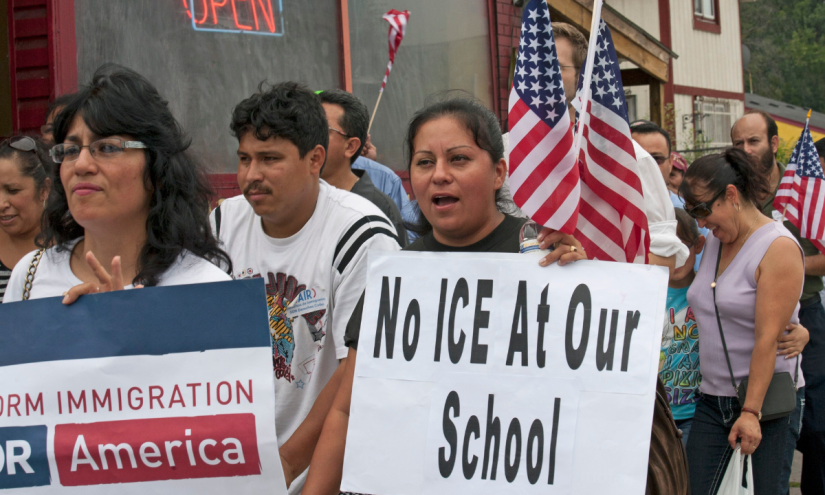
With no end in sight to the Trump administration’s campaign to curb illegal immigration, emerging evidence shows that the policy is causing school attendance to fall significantly for the students most exposed to its effects.
A study circulated by researchers at Brown University revealed that, following a spate of immigration raids and arrests that began with Trump’s inauguration in January 2025, absences among foreign-born students in one northeastern school district rose by almost 40 percent. Notably, the trend took the form of a lasting negative impact in day-to-day attendance rather than a temporary drop in the wake of particular enforcement actions.
Andrew Camp
Andrew Camp, a research associate at Brown’s Annenberg Institute and the paper’s lead author, said he was surprised to discover that the consequences of political change were so durable, extending through the end of the 2024–25 academic year. The lingering increase in absenteeism would likely require more work from educators and administrators to draw children back to schools, he added.
“If this just happens the day after an event, you might say, ‘Well, there’s nothing we can do, and throw up your hands,’” Camp said. “But if it happens even when there’s nothing going on in the community, that indicates that it might be a more persistent problem that requires a more considered outreach effort.”
The results dovetail with those of other recent research, each pointing to clear and immediate downward pressure on attendance resulting from the Trump-led surge in immigration enforcement. That push has seen personnel from U.S. Customs and Border Protection and Immigration and Customs Enforcement generally refrain from entering school buildings, though they have detained family members near their vicinity.
As ICE Actions Ramp Up, Study Cites 81K Lost School Days After California Raids
A study released last summer pointed to similar developments in California’s Central Valley, where deportations have soared over the past year. The author, Stanford University economist Thomas Dee, said the observations of the Brown team support his own findings and underscore “the serious academic harm that ongoing immigration raids inflict on students and schools.”
“Obviously, increased absenteeism implies lost learning time,” Dee wrote in an email. “However, I also view the impact of immigration raids on student attendance as a leading indicator for other downstream effects, such as lost learning and stress-induced mental-health challenges.”
Thomas Dee
The mid-sized urban setting examined in Camp’s work (pseudonymized as “Liberty City” to preserve the privacy of residents and district employees) differs from the agricultural region Dee focused on, but mirrors some of its demographic features. Approximately 40 percent of the community’s population was born outside the United States, and roughly two-thirds identify as Hispanic or Latino.
The authors employed an unusual strategy to conduct their study, collaborating closely with both the Liberty City school system and a local immigrant advocacy organization. From the former, they received information on thousands of students’ birthplaces that was originally collected when they enrolled in school; from the latter, a detailed log of immigration enforcement actions, including arrests, recorded in the community beginning last January.
Camp argued that using countries of origin to track students potentially targeted by immigration sweeps was less “blunt” than other methods. Some foreign-born pupils may not perceive much risk from increased enforcement activity, he acknowledged, either because they live in the U.S. legally or they feel their families are likely to evade the scrutiny of federal authorities. But alternative proxies for immigration status, such as English Learner status, are themselves imperfect measures of vulnerability — earlier research has repeatedly shown that a large majority of English Learners around the country are U.S. citizens.
In the Push to End Plyler, a Blurring of the Truth About English Learners
Comparing attendance figures from 2024–25 to the same numbers from the previous school year, Camp and his colleagues found that Liberty City students born outside the U.S. became much more likely to miss school once President Trump took office. While foreign-born students were, somewhat surprisingly, slightly more likely to be marked “present” than their U.S.-born classmates in 2023–24, that gap disappears from the data the next year. In total, foreign-born students’ likelihood of being absent on any given school day rose by over one-third, from 5.9 percent to 8.1 percent.
Two further nuances stood out from the overall picture. First, attendance declined to a considerably lesser extent among the youngest learners: The effects on children enrolled in pre-kindergarten and elementary school largely fell below the benchmark of statistical significance, but the absence rate of high school juniors jumped by six points on average. The contrast indicates that older, more independent students may have started skipping school on their own initiative, even as parents largely continued dropping their kids off.
Additionally, the team observed that the attendance phenomenon was not primarily driven by “acute” reactions to enforcement actions like raids. Absences ticked upward by only 0.6 percentage points on days when such events took place within Liberty City, and they were not significantly higher the next day. In other words, the baseline level of school attendance was consistently lower throughout the winter and spring, not just when fears of imminent actions were triggered.
What’s more, the 37 percent boost to absences was seen in a jurisdiction that is broadly welcoming to immigrant families. Liberty City officials convened public meetings to allay residents’ fears after Trump was reelected in November 2024, and the district does not share information on students’ immigration status with ICE. That implies that attendance could deteriorate further in less supportive environments.
“As these events are ongoing, the district is being so active about calling home and communicating, ‘We know there’s been an arrest in the community, but it’s not a raid, and they’re not going after you or your kids,’” Camp said. “So if anything, I would guess these effects are a bit of an understatement of effects that we might see in Nebraska or Arkansas.”
Viri Carrizales, founder and CEO of the advocacy group ImmSchools, remarked the paper’s findings are in line with what she has heard from districts and charter networks, some of which have reported attendance drops of 20 percent. To reverse the damage, she said in an email, school leaders needed to establish “protocols and policies that clearly protect students’ constitutional rights.”
“Protecting access to education is not optional; it is a legal and moral responsibility that schools must uphold for every child,” Carrizales wrote. “A school can no longer be a school when its classrooms are filled with empty seats.”
Did you use this article in your work?
We’d love to hear how The 74’s reporting is helping educators, researchers, and policymakers. Tell us how
