

Get stories like this delivered straight to your inbox. Sign up for The 74 Newsletter
The Supreme Court has turned down a third case from parents challenging school district policies related to students’ gender identity.
On Monday, the justices rejected a Florida case in which parents Jeff and January Littlejohn alleged that a Leon County middle school violated their rights by supporting their child’s gender transition from female to male without their knowledge. The decision comes after the justices declined to hear two similar cases, one from Massachusetts last week and another from Maine in March.
For now, their decision means that the court might end its term without taking up one of the most contentious issues in education — the debate over whether state and district policies that aim to protect the privacy of LGBTQ students violate parents’ rights to direct the upbringing of their children.
In March, the conservative majority sided with California parents who argued that districts should proactively inform parents if their child wants to change their gender identity. But in that case, they only reinstated a lower court decision to temporarily block schools from keeping such information private. They have yet to address the substance of the arguments on either side of the issue.
“This does require a full briefing and a full decision on the merits,” said Katie Cosgrove, counsel at the Liberty Justice Center, a conservative law firm representing a California school district that recently asked the Supreme Court to hear another case related to parental notification. “The court needs to make some clear clarifications on this parental rights issue.”
Supreme Court Sides with California Parents in Gender Identity Case
The court’s decision comes as the House is expected to vote this week on a bill that would require schools to alert parents if students ask to change their preferred names or pronouns as well as the sex-based facilities they use. Those in favor of parental notification say districts have kept parents locked out of one of the most consequential decisions in their children’s lives.
But advocates for LGBTQ students, like GLAAD, say students questioning their gender identity face serious risks of violence, poor mental health and unstable housing if they’re not ready to be open with their families.
In her dissent in Mirabelli v. Bonta, the other California case, Justice Lynn Kagan, one of the three liberals on the court, also argued that the justices should have let the lawsuit run its course in the Ninth Circuit. The conservative majority, she wrote, was “impatient.”
“The court resolves the issues raised through shortcut procedures on the emergency
docket even though it has had — for months now — the option of doing so the regular way, on our merits docket,” she wrote.
The newest case on that list is the Rocklin Unified School District’s lawsuit against California’s Public Employment Relations Board. In 2023, the district, north of Sacramento, began requiring schools to notify parents if their child wants to use a name or pronoun for facilities that doesn’t align with their sex at birth.
The board, on behalf of the teachers union, filed an unfair labor charge against the district, saying that the policy essentially changed the terms of teachers’ employment and should have been negotiated. The union won in a state appeals court and the California Supreme Court declined to hear the case. That’s when Liberty Justice Center asked the U.S. Supreme Court to step in.
Cosgrove called the lawsuit a “a super interesting intersection of parental rights and the union and administrative board overstepping its authority.”
The California Mom at the Center of Trump’s Crackdown on School Gender Policies
‘They sought to help the child’
But most of these cases have been brought by parents.
It took the court several months to decide whether to take the Littlejohns’ case. The justices rescheduled it for their conference days 10 times after initial briefs were submitted last fall.
The dispute with Florida’s Leon County district, which encompasses Tallahassee, began in 2020. The Littlejohns told Deerlake Middle School that their child, A.G., was being treated by a therapist for gender confusion, and to continue treating the student as a girl. But A.G. asked the school counselor to use the name “J” and “them” pronouns. The lawsuit states that school officials continued to support A.G.’s social transition, including holding a meeting to create a “support plan,” without the Littlejohns’ knowledge.
In multiple filings in the case, the district says that once the Littlejohns objected, school officials gave them the plan and invited them to be present at all future meetings with the student.
The parents sued the district in 2021, but lower courts ruled for the district and dismissed the case. Last year, the U.S. Court of Appeals for the 11th Circuit, considered one of the most conservative circuits in the federal court system, said the educators’ actions did not “shock the conscience,” in a legal sense.
“Defendants did not act with intent to injure,” the court said. “To the contrary, they sought to help the child.”
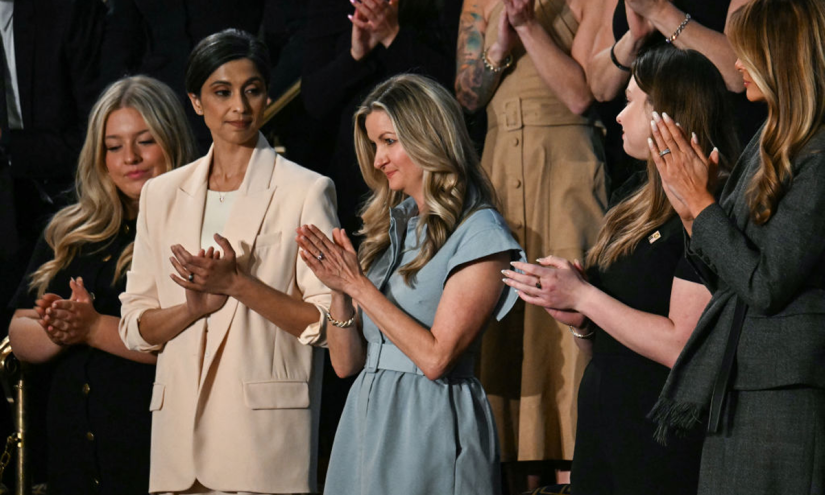
Meanwhile, for the Trump administration, January Littlejohn became a symbol of the fight against such district policies. She was among President Donald Trump’s special guests when he addressed Congress in 2025, and she’s a parent advocate at Do No Harm, a nonprofit that opposes gender-affirming healthcare, including puberty blockers, cross-sex hormones and surgery.
The district argued that the case was moot.
Since the Littlejohns sued, Florida, like many red states, passed a parental rights bill that says schools can’t “infringe” on parents’ fundamental rights. As a result, the district revised its policy to say that school staff can’t “intentionally withhold information from parents unless a reasonably prudent person would believe that disclosure would result in abuse, abandonment, or neglect.”
Brian Dittmeier, director of LGBTQI+ Equality at the National Women’s Law Center, said that because of the Florida law, a similar dispute probably wouldn’t happen today. He added, however, that “these issues have to be sorted out at the local level.”
“A single federal standard,” he said “is not going to resolve the tension that we see between some families and schools on this issue.”
Did you use this article in your work?
We’d love to hear how The 74’s reporting is helping educators, researchers, and policymakers. Tell us how
