

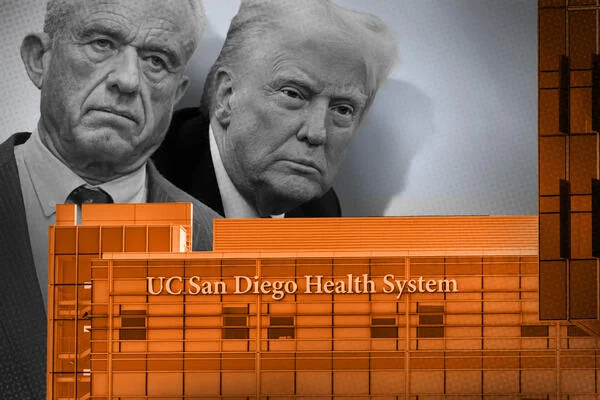
When the Department of Justice demanded years of admissions data to identify possible racial discrimination at three top medical schools in late March, one official called the federal government’s latest efforts to dismantle diversity, equity and inclusion in higher education “another day in paradise.”
But experts say those and other moves by the second Trump administration to assert control over the nation’s medical education system—including terminating billions in grants and coercing changes to accreditation and curricular standards—have felt more like an inferno fueled by growing public mistrust of scientists and doctors in the aftermath of the pandemic.
“I’m not aware of there ever being such a wholesale attack on medical schools,” said David Seres, retired director of medical nutrition and professor of medicine in the Institute of Human Nutrition at Columbia University Medical Center. “Funding from the government is often impacted by politics, and it’s not as if medical schools have always been immune. But [the Trump administration’s actions] are so out of proportion to any of that impact. This has been an overt, politicized attempt to reshape medicine by people who are not experts in medicine.”
And while it won’t happen overnight, such political interference into medical schools could have long-term implications for the future of public health, research and higher education, Seres and others warn.
“The best and brightest are going to be less likely to apply to medical schools and medical care will suffer as a result,” he said. “People go into medicine with the idea that they can explore their own ideas in a supportive environment, as opposed to one where Big Brother is breathing down their neck.”
The DOJ’s inquest into the admissions policies of physician training programs at Stanford University, Ohio State University and the University of California, San Diego, is only the most recent example of Republican-led scrutiny of medical schools.
Last year, congressional Republicans introduced now-stalled legislation to ban DEI in medical schools and cut off federal funding for those that don’t comply; over the past decade, many medical schools have committed to diversifying the physician pipeline and adopted equity-focused frameworks in the name of improving patient outcomes.
“Medical schools should be in the business of training our future doctors to save lives—not indoctrinating students with anti-American DEI ideology,” said Sen. John Kennedy of Louisiana, who co-sponsored the bill. “The EDUCATE Act would make sure the government isn’t wasting your money on woke struggle sessions and blatant discrimination in medical schools.”
In addition to targeting once-popular DEI initiatives, Health and Human Services Secretary Robert F. Kennedy Jr.—who regularly espouses false claims about vaccines and nutrition—has also pressured medical schools into requiring more nutrition education in support of his Make America Healthy Again agenda. So far, 53 of the nation’s roughly 200 medical schools have agreed.
State-level Republicans have even joined in on the medical school attacks to advance a political agenda. In February, the politically appointed leader of public universities in Florida pressed the Liaison Committee on Medical Education, which accredits most medical schools, including eight in Florida, to justify its standards on gender-affirming care—which the state has banned for minors.
‘Blow to Medical Authority’
And medical schools aren’t in a position to ignore such political pressures, which often carry the threat of losing federal funding. In addition to receiving billions each year in federal student loans, medical schools also received more than $19 billion in grants from the National Institutes of Health in 2024.
For example, despite calls from the American Association of University Professors to resist the DOJ’s data probe into the medical schools at UC San Diego, Ohio State and Stanford, both Ohio State and UC San Diego confirmed to Inside Higher Ed last week that they are following the government’s orders; not doing so could result in a loss of federal funding. Although Stanford didn’t respond to Inside Higher Ed’s questions, over the past month it has scrubbed its web pages of mentions of “diversity.” In one instance, it rebranded the Office of Diversity in Medical Education as the Office of Community Health and Engagement.
“Medical schools are vulnerable to financial pressures,” said Laura Hirshbein, a psychiatrist and professor of the history of medicine at the University of Michigan. “They depend on federal money in a profound sense. It’s been quite effective for the federal government to threaten that funding to get medical schools to say, ‘OK, we’ll do whatever you want.’”
That’s also what happened last year, right after President Donald Trump took office and unilaterally froze billions in funding for medical schools at some of the nation’s wealthiest universities, including Columbia and Duke Universities and the University of Pennsylvania.
The Trump administration targeted grants related to vaccines and health outcomes for women, minorities and transgender people, insisting they didn’t hold scientific value despite vehement objections from the scientific community. In several cases, the government leveraged those freezes to strong-arm universities into adopting policies aligned with the president’s ideological priorities. Many got their money back after agreeing to a flurry of ideologically driven demands, such as banning gender-affirming care for minors at university hospitals, turning over race-related admissions data, prohibiting DEI initiatives and adopting the Trump administration’s approved definition of male and female.
“It’s been a blow to medical authority,” Hirshbein said. “The conversation about how to make better doctors and how to have a healthier population is taking a hit with the Trump administration because health and illness has become so caricatured. It’s also reinforcing the idea that medical expertise and medical authority are arbitrary and can be dictated … by the federal government.”
Attacking medical schools also helps to advance Trump’s broader goal of controlling higher education more broadly, added Kim Scheppele, a sociology professor at Princeton University with expertise in the rise of authoritarian governments.
“Part of this is an effort to create a civil war within universities between the more right-leaning faculty, who tend to do science, and the more left-leaning faculty, who tend to be humanists and social sciences,” she said. “While scientists themselves tend not to be political activists and aren’t the ones that immediately come to mind as political opponents, causing huge financial pain to the natural sciences—because that’s where the government’s leverage is—will force the universities to crack down on the humanists who are the ones causing trouble for the administration.”
Another one of Trump’s early hits to medical schools—which are often intertwined with big-budget university hospital systems—came in the form of the NIH’s now-abandoned proposal to cap universities’ indirect research cost reimbursement rates at 15 percent, for an estimated savings of $4 billion. Higher education and patient advocates decried the plan as “shortsighted and dangerous,” warning that such cuts would destabilize their budgets and stymie lifesaving medical research. Although it faced legal challenges and didn’t come to fruition, some universities enacted campuswide hiring freezes and spending cuts in anticipation.
Going after such a critical source of funding follows the “playbook” of Hungary’s authoritarian former prime minister Viktor Orbán, which calls for “analyzing the national budget, looking at all the places where the budget harms the people who are likely to be opposed to you, and cutting all of it overnight,” Scheppele added. In the United States, “the science grants happened to be the largest line item in the budget,” she said. “And in the opening salvo [of Trump’s higher education overhaul], medical schools got hit the hardest.”
Toward ‘Deprofessionalization’
The Trump administration isn’t exactly thrilled with all of the content medical schools are teaching future doctors, either. And although medical education experts have spent the past decade advocating for more equity-focused frameworks, many of the medical curriculum decision-makers have rushed to address the Trump administration’s recent criticisms of those practices.
Under the pressure of an executive order to investigate the Liaison Committee on Medical Education, which accredits medical schools, the LCME voted to drop its DEI standards last summer. Earlier this year, it also agreed to dilute its recently adopted curricular standards on structural competency, which teaches future doctors about how political, economic and social issues influence health outcomes.
But even if making changes to medical school curricula, accreditation standards and research inquiries may ease immediate political pressure, it could lead to the “deprofessionalization“ of medicine in the long run, said Kenneth Ludmerer, an internist and professor of the history of medicine at Washington University in St. Louis.
“Internal professional standards should define education and work to serve the public interests,” he said. But if politicians continue on the path of dictating what and whom medical schools teach, it will raise the question of “what type of individual will be attracted to medical careers if medicine itself is changing in these nonprofessional ways.”
Most likely, he added, the field would draw “a less motivated type of individual who works for the clock and the needs of the employer rather than for the best interest of the patient.”
