

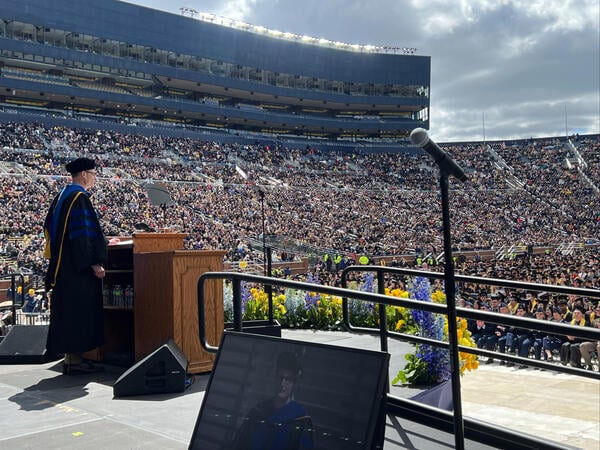
Derek Peterson spoke as chair of the Faculty Senate—a commencement speaker spot that chairs have filled since 2014, he said.
As part of a commencement speech Saturday praising University of Michigan student activists throughout history, African studies and history professor Derek Peterson tipped his hat to pro-Palestinian protesters who over the past two years “opened our hearts to the injustice and inhumanity of Israel’s war in Gaza.”
The remark received loud and long applause, but—as is true of many professors’ public praise for pro-Palestinian activists—it also sparked immediate political backlash against Peterson and university leaders. Republican officials and some Jewish groups criticized the speech as antisemitic and unnecessarily political. University of Michigan president Domenico Grasso publicly apologized for Peterson’s remarks on Saturday afternoon, calling them “hurtful and insensitive to many members of our community.” Others—including faculty, students and staff members—have leaped to Peterson’s defense and urged the university to publicly support him.
Peterson opened his five-minute speech with a story about Sarah Burger, a suffragist who organized a dozen women to apply for admission to the University of Michigan in 1858—when only men were allowed to attend—and paved the way for co-ed integration a year later. Peterson asked graduates to remember Burger when they sing Michigan’s fight song “(Hail to) The Victors,” as well as “thousands of other students who have dedicated themselves to the pursuit of social justice over the course of centuries.”
“Sing for Moritz Levi, the first Jewish professor at the University of Michigan,” he continued. “Appointed professor of French in 1896, he was to open the doors of this great university to generations of Jewish students who found in Ann Arbor a safe haven from the antisemitism of East Coast universities. Sing for the students of the Black Action Movement, whose members demanded curricula that would reflect the experience and identity of Black people in this country. Sing for the pro-Palestinian student activists, who have over these past two years opened our hearts to the injustice and inhumanity of Israel’s war in Gaza.”
Peterson spoke as chair of the Faculty Senate—a commencement speaker spot that chairs have filled since 2014, he said. The university streamed the ceremony on YouTube. The ensuing online pandemonium from all sides of the political spectrum came as a surprise, Peterson said.
“I had the idea that it would be kind of controversial, but … it shouldn’t be controversial to say that you should have an open heart toward people who are suffering in Gaza or anywhere else,” he told Inside Higher Ed. “So my surprise is at the quickness with which this relatively innocuous argument was made to seem as though it were virulently antisemitic. That, I did not expect.”
Rebukes, Threats and Support
On Sunday, two Republican candidates for the university Board of Regents—Michael Schostak and Lena Epstein—said they were “deeply troubled” that Peterson was chosen as a commencement speaker. On X, Schostak called for university officials to put Peterson on leave without pay, strip him of administrative support and cut his expense budget, “among other” potential consequences. Sitting regent Sarah Hubbard also criticized Peterson’s speech, calling it “incredibly troubling and disappointing.”
“It is very difficult to execute meaningful consequences on tenured faculty but as a leader I can help set the tone and expectations for their conduct. His conduct was unbecoming for a leader of the greatest university in the world,” Hubbard wrote on X. “As the Board of the university we have an opportunity to make lasting changes that will change the course of this conduct.”
Michigan Hillel, a Jewish student organization, also criticized Peterson’s remarks and suggested the speech alienated members of the Jewish community.
In a public letter posted after the commencement ceremony, Grasso said Peterson deviated from the remarks he shared with university officials prior to the ceremony. When asked for comment, university spokespeople pointed Inside Higher Ed to Grasso’s letter.
Peterson said university officials knew he would mention pro-Palestinian protests during his speech. While drafting it, he incorporated feedback from officials to remove the word “genocide” in order to make it less provocative.
“Even though the United Nations uses that phrase, and even though it’s a scholarly descriptor, I left it out because I didn’t wish to provoke anger and unnecessary bad feelings,” Peterson said.
Since the speech, Peterson said he’s received nearly 500 angry emails to his university email address, many of which contain violent threats. He’s also received 20 threatening calls to his office phone. The university’s department of public safety is helping Peterson ensure his personal safety, but he has otherwise been offered “no support whatsoever” from university leaders, he said.
Faculty, staff, alumni and students, however, have rallied to Peterson’s side. More than 1,100 University of Michigan affiliates have signed a letter calling on Grasso to apologize for his apology.
“By using the University’s highest-level perch to criticize a faculty member for offering views on a public issue, President Grasso’s statement violates the University’s stated [neutrality] policy,” the letter states. “It also reinforces the well warranted concern among many faculty that the University’s professed commitment to institutional neutrality has not been, and will not be, implemented in a neutral way.”
Beyond denouncing Peterson’s comments about Palestinian protesters, some, including Schostak and Epstein, have criticized his speech as unnecessarily political. To that, Peterson said, “What kind of school do [they] think Michigan is?”
“We’re not a school made up of people who are wilting flowers and pearl clutchers who are offended at the slightest provocation,” he said. To say, “‘Don’t talk about politics. Talk only about sentiment and about nostalgia, make it a happy and uncontroversial occasion’—that’s just a forfeiture of the duty of a public [institution].”
