

Listen to the article
This audio is auto-generated. Please let us know if you have feedback.
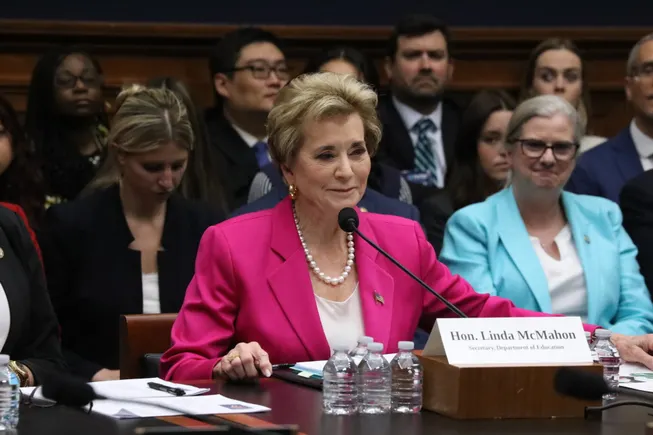
WASHINGTON – U.S. Education Secretary Linda McMahon, during a House hearing on Thursday, touted federal K-12 initiatives such as state block grants for reading and math achievement, even as Democrats pushed back on her agency’s record to date.
“We’ve cut unproductive program funding and redirected those resources to revitalize literacy, invigorate workforce development and support our most vulnerable students,” McMahon told lawmakers on the House Education and Workforce Committee.
But McMahon faced criticism and tough questions from Democratic members about efforts to cut funding and programs from the U.S. Education Department, as well as the agency’s slow responses to discrimination complaints.
“Today’s hearing has made clear that this administration is amending the Department of Education without regard to the consequences for students and families,” said ranking member Bobby Scott, D-Va.
McMahon discussed with the committee the Education Department’s policies, priorities and fiscal year 2027 budget proposal, which calls for a 3% cut from FY26 funding of $79 billion. The proposal would level-fund Title I at $18.4 billion and increase special education funding by $539 million to a total of $16 billion. It also proposes consolidating several education grant programs into block grants.
During the nearly four-hour hearing, McMahon also faced a wide ranging array of questions on everything from school segregation to funding for a new White House ballroom. Here are three takeaways on the education components.
Reducing the Education Department’s footprint
Several Democratic lawmakers called the Education Department’s use of interagency agreements to transfer some of the agency’s responsibilities to other federal agencies “illegal,” while Republican committee members praised what they said are moves to create more efficiencies and reduce the agency’s footprint.
The Education Department has entered into 10 interagency agreements with five other federal agencies, moving over management of programs that oversee K-12 academic supports and career and technical education, for example.
McMahon told the committee that the first interagency agreement the department made — with the U. S. Department of Labor to manage CTE activities — is already resulting in efficiencies.
But Rep. Suzanne Bonamici, D-Ore., called the arrangements “bureaucracy expansion agreements” that are “illegal” or “unconstitutional.”
When Bonamici asked whether the Education Department plans to outsource special education, McMahon said that possibility is still under consideration.
Committee Chair Tim Walberg, R-Mich., praised McMahon’s efforts to downsize the Education Department. “I appreciate the fact that you are finding creative ways, I believe, totally legal ways, to run your department… with creativity, austerity, with transparency, and with the ability to say we’re going to get the job done,” he said.
Addressing civil rights investigations
Several lawmakers pressed McMahon about the Education Department’s progress in addressing a backlog of civil rights complaints.
At a hearing last month before the Senate Appropriations Subcommittee on Labor, Health and Human Services, Education and Related Agencies, McMahon said the agency was rehiring many of the Office for Civil Rights lawyers targeted for layoffs last year.
OCR had about 19,000 outstanding civil rights complaints on file at the beginning of 2025, and the department has addressed 4,000 of those so far, McMahon said.
A recent report from the office of Sen. Bernie Sanders, I-Vt., found OCR had reached agreements in only 1% of pending cases in 2025 over discrimination complaints against schools and colleges.
Rep. Mark Takano, D-Calif., asked the secretary why, if the department had such a backlog of cases, it laid off OCR employees. “You came into office unprepared and didn’t know the importance of OCR, did you?” Takano said. “You didn’t rescind this decision until 10 months later.”
McMahon replied, “I know the importance of OCR.”
When Takano asked McMahon why the Education Department’s FY27 proposed budget recommends reducing staffing from 530 in FY 25 to 271 in FY 27, McMahon said that figure represents a “floor for hiring.”
McMahon said OCR is “moving expeditiously” to resolve cases.
Factoring in school choice
Several Republican lawmakers praised the first nationally available federal private school choice program — set to begin in January — saying it will empower families to choose the best school for their children.
Nearly 30 states have already indicated they want to opt-into the program, according to the IRS. The program will allow Individual taxpayers to make charitable donations for families to spend on K-12 services, including private school tuition and extra public school expenses like tutoring.
McMahon called the tax incentive program “an opportunity for students and for parents to be able to make sure that their children are not in failing schools.”
When Rep. John Mannion, D-N.Y., asked McMahon if the federal school choice program would include scholarships dedicated to low-income families, minority families or public institutions, she said states would be able to set rules for the scholarship-granting organizations that will manage programs in those states.
