

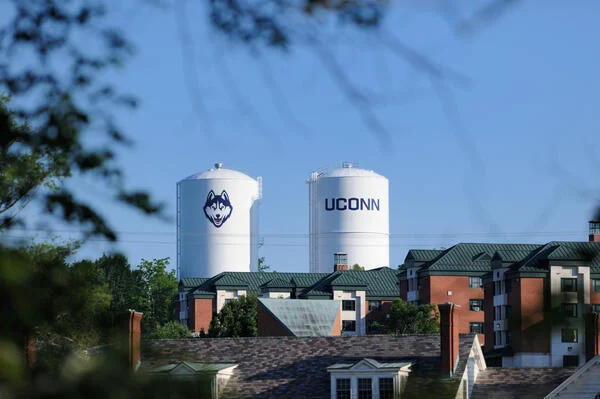
After the Trump administration cut $95 million in research funding to the University of Connecticut and its affiliated hospital system, the state is stepping in to help fill the gap.
Gov. Ned Lamont announced plans last week to appropriate $35 million in state funding for research programs at UConn and UConn Health, CT Insider reported. The money will come from a $500 million contingency fund the state set up last year in support of human service programs imperiled by the Trump administration’s sweeping cuts to federal funding.
“I am just terrified of what’s going on in our country right now, the idea that we’re cutting back on research and development,” Lamont said at a news conference Thursday at UConn’s flagship campus in Storrs. “I know what the work you’re doing means to our state, I know what it means to our country, and I know what it means to the world.”
Since taking office in January 2025, President Donald Trump has overseen billions in cuts to grant funding that universities receive from the National Institutes of Health, the National Science Foundation, the Department of Energy and numerous other federal agencies. Many of the targeted grants focused on topics that the Trump administration has deemed unworthy of serious scientific inquiry, such as health outcomes for women, racial minorities and the LGBTQ+ community.
Higher education and research advocates have decried these moves as harmful to university budgets, patients and the future of scientific discovery in the United States.
“It would be quite the understatement to say that the last 15 months have been challenging for research, science and higher education,” Lindsay DiStefano, interim vice president for research, innovation and entrepreneurship at UConn, said at the news conference. “We’ve had to navigate new policies and priorities at unprecedented levels, unexpected terminations of some of our most vital programs, and near daily threats of disruption to our academic and research enterprise.”
Although the award from the state is less than half of what the university has lost in federal funding over the past year-plus, Nathan Alder, a biology professor at UConn, nonetheless called it “a vital lifeline to help ensure the survival and the integrity of this research that goes on at UConn and UConn Health.”
