

By: Michael Ham & Beth Holland
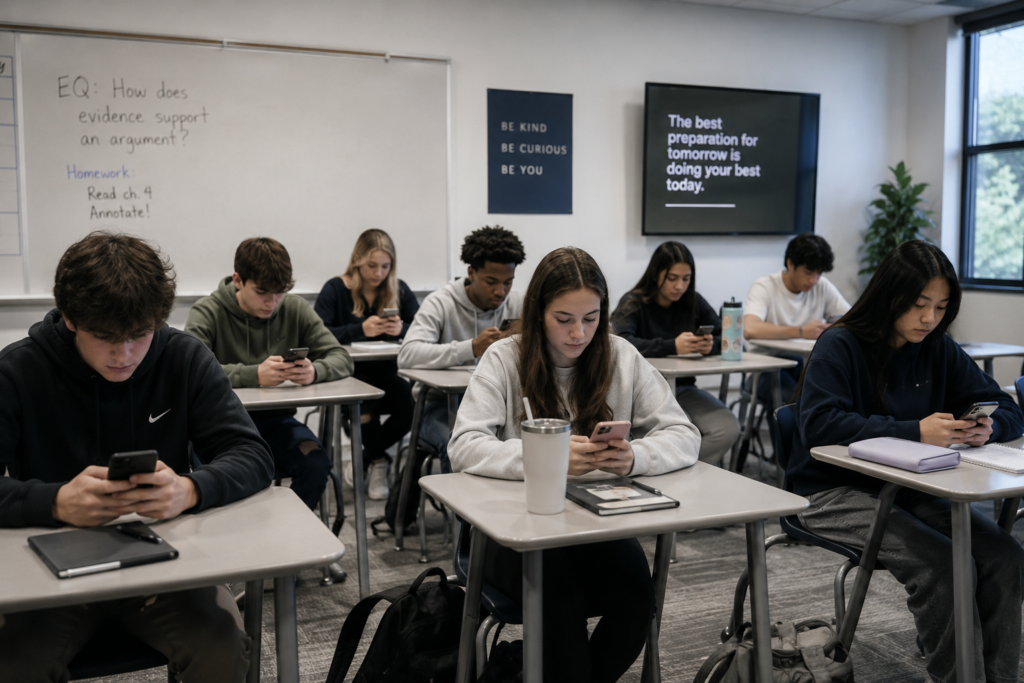
Recently, Los Angeles Unified School District (LAUSD) has not been the only major school district to dominate education headlines by announcing a decision to significantly restrict students’ use of laptops and tablets during the school day. Across states and districts, new policies include grade-level limits on screen time, the potential elimination of device use for early learners, and constraints on how digital tools can be used.
On the surface, this decision is about “screen time.” More accurately, it reflects a growing set of worries bundled under a single label, including concerns about student attention, mental health, instructional quality, and the rapid emergence of AI. In reality, what appears to be a conversation about devices is actually a much broader response to uncertainty about the role of technology in learning.
The field now finds itself at a critical moment. As technology advances, longstanding structural challenges related to how tools are selected and implemented become increasingly visible. Students, educators, families, and system leaders are publicly responding with deeply felt, valid, emotional reactions about what is being gained, lost, and placed at risk. These responses reflect an education system grappling with a perceived threat. However, if the current debates over “screen time” and AI are driven only by fear, we risk turning back the clock on decades of progress in using technology to expand access and prepare students for life beyond school.
Moving forward requires more than reacting to urgency. It necessitates identifying and understanding the problem to solve, the tenets at risk, and what bold moves like LAUSD’s intend to protect. This moment demands that the field honor both the structural challenges at the heart of this debate and the potential of technology to support equitable, powerful learning.
Screen Time Is the Newest Threat to the “Grammar of Schooling”
The current debate over screen time may feel uniquely urgent, but the underlying tension is not new. For decades, emerging technologies have repeatedly challenged the fundamental structures and assumptions that define modern schooling.
The grammar of schooling refers to the deeply embedded structures that shape common conceptions of school: age-graded classrooms, fixed schedules, subject-based instruction, and a teacher positioned as the primary source of knowledge. These features have remained remarkably durable over time, making them feel natural and inevitable rather than designed.
New technologies do not simply introduce new tools into schools. They challenge the grammar of schooling itself. As Collins and Halverson argued in Rethinking Education in the Age of Technology, digital technologies expand access to knowledge, redistribute expertise, and shift where and how learning occurs. In doing so, they place pressure on systems built around standardized pacing, centralized control, and scarcity of information.
This pattern has surfaced repeatedly. From early computing to the internet to 1:1 devices to generative AI, each wave of technological change has raised similar questions about the role of the teacher, the structure of the classroom, and the purpose of school itself. What makes this moment feel different is not the existence of the tension, but its speed, visibility, and scale.
The combination of AI and nearly ubiquitous personal devices has made the impact of technology in classrooms more immediate and visible to students, educators, and families alike. Especially following emergency remote learning during the pandemic, concerns about distraction, mental health, academic integrity, instructional quality, and social development, all of which are now experienced publicly and simultaneously across systems.
As a result, what was once a gradual structural tension has become an acutely felt pain. The current debate over screen time is not simply about devices. It reflects a deeper struggle over how schooling is organized, what learning should look like, and how systems respond when longstanding assumptions no longer hold as firmly as they once did.
A Sector Responding to Threat
When longstanding structures begin to feel unstable, systems respond defensively. As technology places increasing pressure on the grammar of schooling, the education sector is exhibiting a set of familiar threat responses that shape how schools navigate screen time, AI, and broader technological change.
Some systems fight. They attempt to block, restrict, or tightly control emerging technologies through device bans, platform limitations, or stricter screen time policies. These responses are grounded in real concerns about student well-being, attention, and instructional quality. However, when control becomes the primary strategy, systems enter cycles of enforcement and workaround as students push back, educators navigate around constraints, and underlying tensions remain unresolved.
Others take flight. Families exit toward private schools, microschools, homeschooling, or alternative models that feel more aligned to their values and concerns. Some move toward innovation. Others towards more traditional structures. While these decisions may create immediate alignment for individuals, they also contribute to a more fragmented educational landscape where responses to shared challenges become increasingly disconnected.
Some systems freeze. Leaders delay decisions, wait for clearer guidance, or monitor the landscape before acting. In rapidly evolving environments, this can feel responsible and measured. Over time, though, prolonged hesitation can limit a system’s ability to build the capacity needed to act effectively. As technologies continue to evolve, the gap between early experimentation and later adoption becomes harder and more expensive to close.
Finally, others fawn over rapid adoption. They quickly embrace new tools in an effort to keep pace with change or signal innovation. However, without a clear instructional strategy or coherent implementation plan, systems accumulate tools faster than they build the practices and conditions needed to use them well. Innovation occurs, but without alignment, and complexity increases with uneven impact on teaching and learning.
Each of these responses represents an attempt to regain stability in the face of uncertainty. None address the deeper structural tension underneath them.
Moving from Reaction to Regulation
Fight, flight, freeze, and fawn may create temporary stability, but they do not resolve the underlying problem. Restricting devices does not answer deeper questions about instructional quality and student engagement. Exiting the system does not address the structural pressures reshaping learning. Waiting does not prepare schools for change. Rapid adoption without coherence does not produce meaningful transformation.
The deeper challenge is not screen time itself. It is the growing tension between emerging technologies and long-standing assumptions about teaching, learning, expertise, and the purpose of school.
Each stakeholder group experiences that tension differently. For some, the concern is student well-being and attention. For others, it is academic integrity, instructional quality, or the role of human relationships in learning. For many educators and system leaders, the uncertainty runs deeper, touching professional identity, authority, and what it means to teach and learn in a world where access to information and automation is rapidly changing.
Without clarity about what is actually at risk, systems respond to symptoms instead of causes. Decisions become reactive rather than coherent, producing cycles of restriction, hesitation, fragmentation, and overcorrection without resolving the underlying tension driving them.
The work ahead is more deliberate. It requires naming what matters, aligning around shared purpose, and designing approaches that hold together across classrooms, schools, and systems.
This moment will shape the future of schooling. The question is whether the field continues reacting to technological change or begins designing forward through it.
Michael Ham is a Policy Partner at FullScale. He collaborates with sector leaders nationwide to create the conditions that foster equity-driven innovation in K-12 institutions and drive collective movement toward a world where every child has access to transformative learning.
