

Get stories like this delivered straight to your inbox. Sign up for The 74 Newsletter
While reform around reading instruction continues to gain momentum, about a third of teachers are using “discredited” methods to teach kids how to read and aren’t fully committed to the science of reading, a new report found.
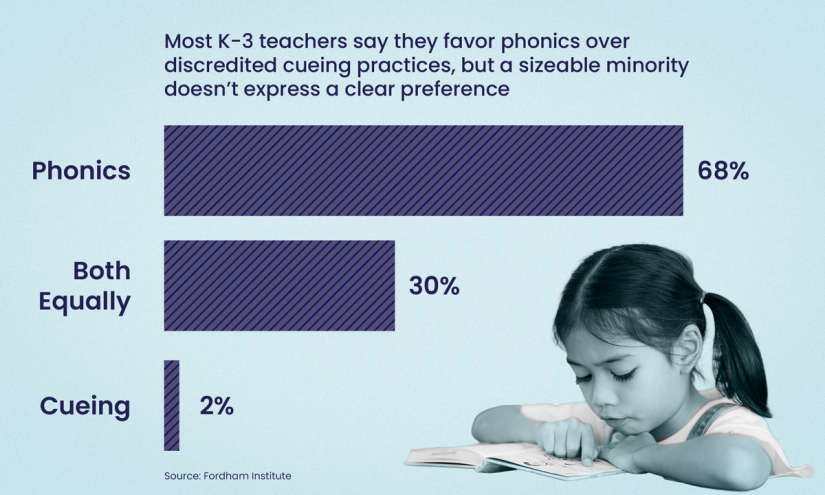
In a survey of more than 1,200 K-3 educators in the fall of 2025, researchers at the Fordham Institute, an education reform nonprofit, found 30% of teachers don’t “favor phonics,” a major pillar in the science of reading that teaches students how letters represent sounds and how to blend those sounds together.
The number of teachers “less informed and committed” to the science of reading is even greater in high poverty schools, according to the From the Teacher’s Desk: A Science of Reading Progress Report.
“Despite everything that has been said and written in the past few years, nearly a third of teachers still put phonics and cueing on equal footing,” the report said, also finding “progress that has been made in some teachers in high-poverty, majority-nonwhite schools are still, on average, less informed about and committed to basic principles of the [science of reading] than teachers in whiter and/or more affluent settings.”
About half of all surveyed K-3 teachers said they teach with a “structured approach” which includes a mix of “instruction in phonics, decoding, and related skills,” the report said, adding nearly one in three teachers use a “balanced approach,” where students are asked to figure out unfamiliar words through context clues or pictures – a practice known as cueing, which has been banned in some states.
Thirty percent of teachers reported favoring both phonics and cueing for reading instruction and 2% said they preferred cueing over phonics, according to the report.
The report also found teacher belief and use of the science of reading is between nine to 15 percentage points lower in low-income schools compared to those in higher-resourced schools.
Source: From the Teacher’s Desk: A Science of Reading Progress Report, Thomas B. Fordham Institute
Researchers recognized schools have experienced “significant bumps, detours, and even ‘reading wars,’” around the best way to teach kids to read for decades, which in part accounts for teacher hesitancy and/or inexperience with parts of the science of reading.
As of late March, 42 states, and Washington D.C. have implemented laws around the science of reading, according to EdWeek. But even with these initiatives, some teachers expressed concerns that the “pendulum swings too far to one side and we need balance.”
“While I support our current emphasis on phonics, I worry that kids are going to lose out with less comprehension and vocabulary instruction,” one teacher said in the report, with another adding “the pendulum swings like political winds. Let us teach. Please!”
Others felt the shift toward the science of reading has led to “far more non-fiction texts” at the “expense of rich literature” and that “guided reading … is out, phonics-based small groups are in.”
For educators more positive about the science of reading, said the growing emphasis around phonics has “drastically changed how quickly students are able to learn to read,” according to the report.
“They are happier learners because they aren’t as frustrated with reading,” one teacher said. Another added: “the shift to the science of reading has been huge … and has profound effects on teaching kids to read.”
Report: In Some Urban Districts, Science of Reading Limits ‘Robust Comprehension’
The science of reading is rooted in five pillars: phonemic awareness, phonics, fluency, vocabulary and comprehension, but most of the conversation around the evidence-based approach has centered on phonics.
Hesitancy around the science of reading is concerning to researchers, said David Griffith, one of the report’s co-authors.
“Almost every literate person I’ve ever met remembers getting phonics,” Griffith said. “There is abundant evidence that phonics is successful, and what the research shows is that you need to know how to decode words in order to learn how to read. … If kids don’t learn to do this, then they won’t learn to read, and if they don’t learn to read, they won’t learn much else.”
Griffith acknowledged teacher concerns about the trade-off of incorporating more phonics-based instruction and feeling students would miss out on comprehension, “but I would push back… that there is some sort of balance that we need to strike in terms of helping kids learn to decode,” he said. “Kids need to learn to decode, and then once they’ve done that, there are many other things that we can start doing.”
New Book Helps Teachers Implement Science of Reading in Their Classrooms
Griffith also argued having more non-fiction texts in K-3 could level the playing field for students who may not have exposure to certain background knowledge or vocabulary that would make them successful early readers. Lacking this kind of curriculum and instruction has created disparities and affected skills like finding the main idea or inferring for many children, he said.
“A weak reader who knows about baseball will outperform a strong reader who doesn’t know anything about baseball,” Griffith said. “Your ability to draw inferences is entirely dependent on whether you understand what the passage is talking about and whether you have the right vocabulary.”
The report found more than 40% of teachers hadn’t “fully internalized the importance of knowledge and vocabulary to reading comprehension.”
The report found teacher knowledge around the science of reading is inconsistent.
Griffith said “the chaotic information environment that the typical teacher is subject to,” has been the biggest thing hindering implementation now.
“An older teacher tells you one thing. Your curriculum tells you something else,” he said. “You read an article online written by some think tank and it tells you a third thing. Teachers want to do the right thing, … [but there’s a] lack of clarity … about points that really should be clear.”
From the Teacher’s Desk: A Science of Reading Progress Report
Teachers in higher-resourced schools scored slightly higher than average in their science of reading knowledge and commitment (in the 54th percentile), while those in low-resourced schools scored below average in the 44th percentile.
The report called it a “substantial difference that will have dire consequences for poor students should it persist,” that shows “the fragmented nature of curriculum adoption and the complexity of translating exposure to science of reading–aligned training into better practice.”
Griffith added that teacher turnover in those environments likely play a role.
“Teaching is just harder in high-poverty schools. There is less time to think, there’s less time to do research on the science of reading or anything else. There is probably not a long tradition of veteran teachers building strong curricula over multiple years,” he said.
Across the country, most K-3 teachers have received some type of professional development in the science of reading, the report also found. Those who have completed those courses have a better understanding of the evidence-based approach than those who rely on what they were taught in higher education and teacher preparation programs.
From the Teacher’s Desk: A Science of Reading Progress Report
Even though most educators receive professional development, researchers said teachers’ knowledge of the science of reading declined as the grade level increased, with kindergarten teachers “exhibiting the deepest knowledge and third-grade teachers exhibiting the least understanding.”
“These differences may reflect the fact that science of reading–aligned trainings and curricula often disproportionately target kindergarten, where a focus on decoding is particularly crucial. Still, given the number of third graders who are still struggling with decoding — and the continuing need to build knowledge and vocabulary in higher grades — the mediocre performance of teachers in higher grade levels is grounds for concern,” the report said.
Other findings from the report included how 93% of teachers use multiple reading curricula, some which still use practices like cueing. And that many teachers reported “limited insight into the needs of English learners and students with dyslexia.”
The Impact Science of Reading Has in Ohio Classrooms, College Campuses
“If we could somehow improve the quality of pre-service preparation, we would really be making progress, because it is hard to change the practices of teachers who have been teaching for 15 to 20 years,” Griffith said. “It would be enormously helpful if teachers got the right message at the start of their careers.”
Fordham researchers called for colleges of education to require instruction aligned to the science of reading.
The report also found teachers in states with reading-aligned licensure tests had a deeper understanding of the evidence-based reading model, which became another recommendation for better implementation. Other suggestions included mandates around K-3 teacher training to be completed within their first three years in the classroom and a push for states to establish approved curriculum lists.
Did you use this article in your work?
We’d love to hear how The 74’s reporting is helping educators, researchers, and policymakers. Tell us how
