

Key points:
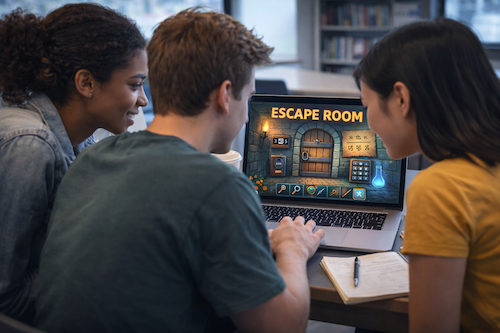
Have you ever been to an escape room? For those unfamiliar with the term, an escape room is a structured, problem-solving experience where participants are locked in a room and must use their wits, tenacity, and deductive skills to find a way out. The challenge is thrilling, but also surprisingly edifying too. Participants are required to adjust the way they think, and the solution only becomes visible by exercising curiosity, creativity, and critical thinking–the very skills that make also make for a successful classroom.
Naturally, this has led some educators to pose an interesting question: “What if teachers could match the engagement of an escape room with the content of their classroom?”
This idea isn’t exactly new, but it’s proven difficult to implement. Designing an escape room that meaningfully engages students while delivering the required depth of learning is far from easy. Online tools can sometimes help, but they often struggle to meet the rigorous learning standards and frequently devolve into games rather than full-fledged learning activities.
Instead, teachers should meet this challenge by going back to the basics and building something that’s uniquely tailored to their students. For my part, I’ve found the best way to design a student escape room that’s memorable, meaningful, and fun is by using both the Engineering Design Process and Process of Scientific Inquiry as a template.
Regardless of what the activity ultimately looks like, try to build your escape room around these five keys:
- Key 1: Question: What do you notice about your surroundings? Where do you see patterns? What can you interact with? In science, this aligns with the idea of messing about. The purpose isn’t for students to immediately begin solving problems, but simply to observe their surroundings and notice things. This should be the easiest sequence, inviting plenty of thought and feedback.
- Key 2: Prediction: What should be investigated? What should be collected? What do we need to find the answer? Now it’s time to collect evidence and point students toward an objective. It should encourage students to make hypotheses and consider what they want to pursue.
- Key 3: investigation: This is where the challenge should really build momentum. Have students design their own investigation plan or provide one for them to work out. Ideally, this section should introduce constraints and highlight specific data points that students need to uncover. For example, students could be tasked with determining drop height, straw force, material type, or anything else that can be found through experimentation and observation.
- Key 4: Data and analysis: Nowthat students have collected their information, it’s time for them to consider what it tells them. Which variable had the biggest impact? How can they apply this data to the problem at hand? This should be the explanation phase of the activity, helping students to connect the dots of their investigation.
- Key 5: Explanation and application: This is the final act of the story. Students take what they have learned and apply their solution to the escape room (usually, this involves determining a code for a lock). With this, the full scope of the investigation is now in view and the knowledge they have acquired is reaffirmed!
Escape rooms are so valuable because they teach students how to ask thoughtful questions, dig for answers, and persevere through challenges–just like real scientists and engineers do every day.
When teachers connect these exercises to the Engineering Design Process or the Process of Scientific Inquiry, escape rooms become more than just fun activities, they turn into powerful tools for growth, collaboration, and creative problem-solving. Lessons like these don’t just make learning memorable; they help spark a lasting curiosity that can inspire students long after they have left the classroom.
Michael Grieb, Van Andel Institute for Education
Latest posts by eSchool Media Contributors (see all)
