

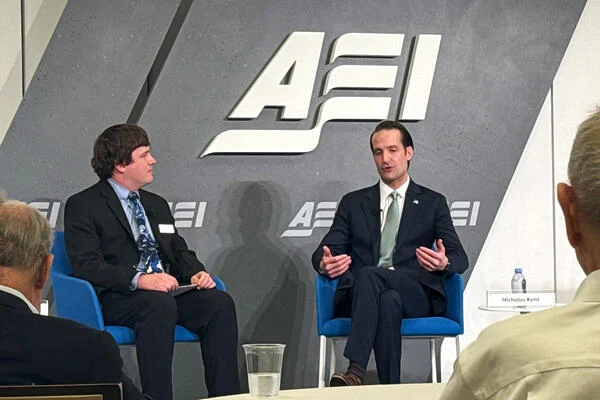
To Education Under Secretary Nicholas Kent, transferring the management of America’s $1.7 trillion student loan portfolio to the Treasury Department is about more than reviving student debt collection on the back end. It’s also meant to provide stronger support for borrowers at the start, in the hopes of preventing delinquent payments.
The processes and responsibilities associated with taking out a loan need to be clearly communicated and enforced, Kent said Thursday at a fireside chat hosted by the American Enterprise Institute. And “there’s no better partner in the world” than the Department of Treasury to make that happen, he said.
Whether it’s providing prospective students with earnings data while they are filling out the Free Application for Federal Student Aid, clearly advertising when loan repayments will resume for those who have been under forbearance or using artificial intelligence tools to “automate” the loan-rehabilitation application process, the Trump administration is looking to overhaul a “Frankenstein” portfolio that “isn’t working and the Education Department hasn’t managed well,” Kent said.
“Millions of students and millions of family members were lied to by the previous administration. Many thought that they were going to have their debt wiped away, and the Supreme Court was very clear that that was unlawful,” he said during the conversation with AEI senior fellow Preston Cooper. “What we have been trying to do [in partnership with Treasury] is explain to borrowers that loan forgiveness is not happening and they have a variety of tools to use to be able to get back into current repayment.”
The transition, first announced in March, will be conducted without congressional approval through a written contract known as an interagency agreement. While such agreements were originally intended as a way for departments to share resources and promote mutual goals, the Trump administration has used 10 IAA contracts to effectively dismantle the Department of Education, largely by relocating its programs to other agencies.
Critics say the Trump administration is using the tactic as a loophole to bypass the legislative approval required to dismantle ED, creating more—not less—bureaucracy. But Kent and others argue that not only is the move legal, but it will also improve the efficiency of operations, providing Congress with a proof of concept that hopefully will lead to the permanent shuttering of ED.
Working with Treasury “gives us a blank state to re-envision what is working well, what is not and what can we do better? And that’s a lot,” the under secretary said, adding that the financial agency has “better talent” and “better systems” than the Education Department.
The interagency agreement’s transfer plan includes three phases, the first of which entails shifting all responsibilities related to defaulted loans; that means collecting involuntary loan payments through Social Security, tax returns and other government benefits as well as helping borrowers get out of default through rehabilitation. Currently, about a quarter of all borrowers are in default, and that number is expected to climb as borrowers whose payments were paused during the COVID-19 pandemic are forced to resume.
In stage two, ED plans to hand off the remainder of the loan portfolio, and in the third stage, it will transfer management of all other student aid, including the Pell Grant and the FAFSA.
Officials have released few details about the latter two phases. When asked for more information, Kent said he was “not going to commit to any particular timeline with regard to either phase two or phase three.”
But Kent did note that Treasury staff won’t manage the ED programs on their own. The loan-focused Education Department staff who remain after last year’s significant reduction in force will be detailed to the Department of Treasury, while some Treasury staff will head to ED to learn about the loan portfolio.
“It’s very complex, and you can’t just pick it up one day and run it. Treasury has been an incredibly intentional, great partner about learning about the history and the shortcomings of the federal student aid program,” he said. “We can show Congress and the American people that not only can this partnership work, but it can work a whole lot better than what the Department of Education is doing alone.”
