

Get stories like this delivered straight to your inbox. Sign up for The 74 Newsletter
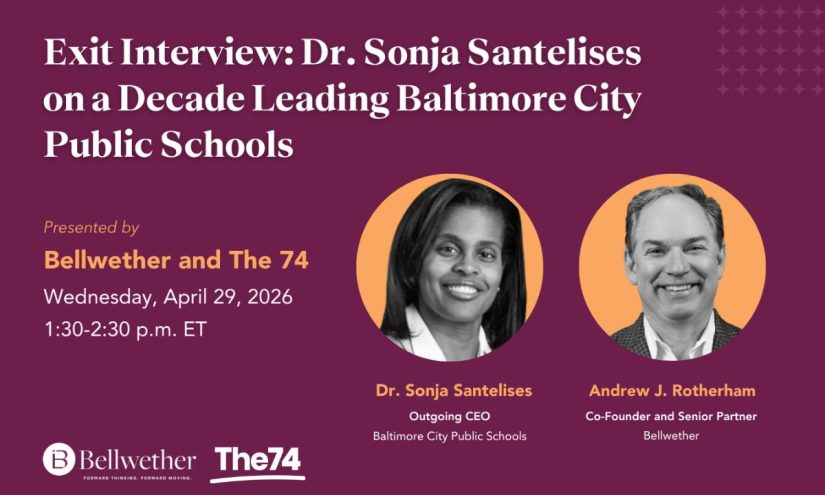
What does it take to run one of the largest urban public school districts in the nation? Dr. Sonja Santelises, longtime CEO of Baltimore City Public Schools, sat down April 29 for a frank and memorable exit conversation with Bellwether Co-Founder (and 74 Board Member) Andrew Rotherham, reflecting on her 10-year tenure leading the system. Watch the full interview, and read the transcript, below:
Andrew Rotherham: I want to thank everyone for joining us today. For those who are new to Bellwether, we’re a national nonprofit that works with a range of organizations — school districts, state education departments, charter school networks, policy advocates, nonprofits, private sector entities and others — to help them solve challenges and create better educational experiences for young people. If you go to our website, bellwether.org, you can see the kinds of outfacing and field-facing published reports and resources that we publish. We also host conversations like this to help people make sense of the most pressing challenges, and what’s going on in the sector.
We’re very excited to partner on today’s event with The 74, which is a fantastic education media outlet. I’m biased — I’m on the board — but it really is fantastic. You should check out the range of work they do.
I am super excited to have Santelises here with us today for so many reasons. And again, just to get all the bias on the table — she’s a friend as well as a colleague, just a fantastic person in the sector. Sonja, we’ll get to your full bio as we go through the conversation.
But I want to start with this: I was poking around and it seems like you’re the longest-serving superintendent in Baltimore City Schools since 1946.
Ten years as an urban superintendent is a lot in any context. How did you do it?
Dr. Sonja Santelises: First I will say it’s an honor to have served for 10 years. Baltimore is a great city. It’s been very good to both me and my family. And I do think that matters, right? It matters that I feel a connection to the city. My children are Baltimoreans — despite, Andy, what we might think about New England roots, they do root for Baltimore teams, not the teams you and I root for.
Rotherham: The Orioles army — they’re not making it easy for you so far.
Santelises: No, they’re not. They’re not at all. But I think a lot of it has to do first with having an amazing team. And I’m not just saying that to say that — I’m saying it because there is no way that one single individual, particularly in an urban setting, can manage all that comes with leading a major urban school district where you actually want to see change. And so having a fabulous team, just at the senior level, has been wonderful, and we’ve had a lot of stability on that team.
Second — which you know intimately well as a former board member — my school board has been, I would say for the overwhelming majority of the time, very focused, very supportive. It doesn’t mean they agreed with me on everything. It doesn’t mean we didn’t have some internal factions, and I’d say with one major exception, we really have had a decade of stability and focus. And for the most part, real strong board leadership has really helped. And you know, you can be as gifted an educator as any one individual could be, but if you don’t have a team around you and you don’t have nine bosses who see what the larger picture is, you’re not going to last. I don’t care who you might be as an individual.
Rotherham: But nine bosses — that’s a lot. That’s like eight more than most people want, right? So there’s a lot of politics there. And I’m not giving away any state secrets by saying you were in the running for Secretary of Education in 2020. A lot of people hoped you would get that post, myself included, as Biden was coming in. And the unions — you were not their favorite, which I think says more about them than it says about you, because, again, you made it 10 years, you were able to work with a union in Baltimore and you were able to work with nine bosses. And this is also through the pandemic — a very disruptive time. So you obviously have a strong team that you credited, but you obviously also have some deft skills and ability to navigate complicated issues.
Santelises: Yeah. And what’s so funny about it, Andy, is one of the things someone said to me — someone whom I still have great respect for — was, “We’re not sure you’re going to be able to do this job as CEO because we’re not sure you have the political acumen to be able to do it.” And I now laugh at that. Because a lot of what people call political acumen I really believe is grounded in relationships and being forthright and knowing where people stand. And even when you don’t fully know where they stand, you develop a cadence of transparency, of telling people the real deal. And when you build that around excellence, I do think that helps.
The former president of the union, Marietta English, and Loretta Johnson — formerly of the American Federation of Teachers, and who I actually gave an award a couple of months ago — we would banter like all the time publicly. Negotiations were crazy. But I will tell you, and she won’t mind me telling you this, she was very active in the National Union for a long time, right next to Randi. But I knew with Loretta Johnson, when we closed the door and we had conversations, she cared about the communities of Baltimore. And she was actually the one — and I’m not afraid to say this — who I called during the pandemic, even though she wasn’t in the role anymore. And I said, “Loretta, what is it going to take to get people back to schools? I need you to tell me.” You know, our current president was new at the time, and I knew Loretta had the capital and the knowledge. And again, ultimately, because she believed that kids needed to be back in schools, it was real problem-solving with her, which she did behind the scenes.
The same thing happened, by the way, with a former Republican senator — which you know in Maryland politics you might say, “Why were you talking to that person, Sonja?” But Frank Kelly Sr. was amazing, and he knew kids needed to be back in school. And so again, behind the scenes, the people that you can call when you put aside the sometimes-artificial but sometimes real distinguishing characteristics that might seem lightning-rod-like — you know, former union president, former Republican senator — those borders go down and you actually start an interest-based conversation. And when you’re straight with people and people know you as an ethical player, you can get things done.
But those are names I’ve never said when people ask, “How did you make it through the pandemic?” because those are people nobody would believe as collaborators or supporters. Loretta was the one who said to me, “These are the things you’ve got to do and teachers will go back into schools for you.” And it was Frank Kelly Sr., who said, “These are the kinds of things that you need to do in terms of setting up the case for going back.” And then we had people like Senator Cory McCray, a Democratic leader. A lot of Democratic leaders did not want to stand for going back to school. And Cory McCray, who has three or four kids in our system, said, “I see at home that we’ve got to go back.” And he was one of the people who stood up with me. And people don’t know about those coalitions that are very much interest-based, and I think that’s part of what’s made it work.
Rotherham: I want to back out in a minute and get a little bit more of your backstory. But since we’re on it, let’s just do one more question on the pandemic. That was such a formative experience for so many people in so many different ways, and it broke trust with public education in a lot of places, and I think we’re still feeling the effects of a lot of that. But what did you learn from your experience leading through that — 2020, during the actual pandemic itself and people trying to figure out what was going on with this new virus and having to respond to it, then 2021 with schools, and then the learning loss after that? What did you learn from that experience?
Santelises: Wow. I don’t want to take the whole time on everything that I’ve learned because we could just stay on that. So, on the positive side I learned that when you make an appeal for what is good for children, there will be people who respond. And so those teachers who were in the early days — and that fall — you remember, Andy, Maryland was one of the last states to open. I mean, we felt like we wouldn’t open for five years at one point.
Rotherham: And then we had Virginia say, “Hold our beer.”
Santelises: That’s right. That’s exactly right. This is why I always love talking with you.
But yes, we had people who understood that. For instance, we had families who had to go to work, who were first responders. And so those first teachers who went back when nobody knew what going back meant — those are the people who understood. And I learned that, when you model courage, there are always people who will step up as well. And that was fabulous learning.
I also learned — and it cemented my belief, as controversial as it might be — that we are expecting schools to do too much. My sister is my balance, and she always says, “Well, Sonja, people didn’t know at the time (of the early pandemic). It was really scary.” And I said, “Yeah, but we knew that kids needed to be in school.” And I think in places it just wasn’t important enough, Andy. I know we say it was fear. We have multigenerational families in many of our students’ homes. You know the concentrated poverty rates in Baltimore City. But I don’t think we tried hard enough. I think we thought school was a nice-to-have and not a must-have, and that was an unfortunate learning.
And then the third thing I learned is: Don’t assume title equals courage. The fact that — and I’m still burned about it — that we were asking public school educators and leaders to make health decisions because our health leaders would not lead, quite frankly, is still a burr in my saddle. The fact that people were like, “Oh, well, you can open if you want to.” And I’m sitting here looking like — I mean, I consider myself decently smart, but Andy, I don’t have a health degree. I don’t know about communicable diseases, even though I know far more now, by the way, than I did then about these things. And so again, this idea that schools are supposed to be all things to all people — we’re supposed to find housing for kids. We’re supposed to feed kids. And I think that we’ve got to take a step back and really say what is reasonable for schools to do.
I know that schools should do a lot of these things, or should be at least the hubs for these things, when you serve large numbers of students in poverty. But that’s my other learning — that I just stepped back and realized — Just because you have the title, that doesn’t mean you’re actually going to wade in and make a hard decision. You’re going to pass the hard decision to me because you don’t want to make the hard decision. And that’s kind of the flip side. I learned a lot that was great, but I also learned a lot that could have made me very bitter if I wanted it to. It didn’t. But it was amazing to see how people moved and who was willing to lead and who was not.
Rotherham: Yeah. Two big ahas from that. One was — parents, if people said the schools were safe to open, their views on opening schools would change. They trusted public authorities that if schools were closed, there must be a good reason, and if they were open, it would be safe. So they were shifting responsibility back onto people around the country who didn’t always live up to that responsibility. And then the health community. David Zweig has this book called Abundance of Caution that really just traces step-by-step how political it got. Particularly once Donald Trump — he was still president in 2020, in his first term — said we should reopen the schools. Suddenly the politics of that changed really rapidly, and it became a political flash point, rather than what he was saying, which was actually fairly obvious: we did need to get schools open and now we’re paying a price.
Let’s talk about your backstory. So you mentioned Massachusetts — you grew up in Peabody, am I right?
Santelises: Yeah. Very good.
Rotherham: But your parents are from the South. They’re from the pre-Civil Rights Act South. So talk about your upbringing. You worked in the Boston schools early in your career as well. Talk a little bit about your backstory and then what got you to Baltimore.
Santelises: Yeah. So my backstory is that my parents were part of a wave of Black professionals who were being recruited in the ’60s to come to the Boston area, north of Boston. My mom was a social worker, which was a big deal coming from Jim Crow Georgia. And my dad was a chemist — or got a job as a chemist. It’s interesting. It says a lot about our content now. He got a job as a chemist because he had enough chemistry credits, but actually was a biology major first. But he was recruited to be one of the first wave of Black folks to try to integrate companies like Kodak, Eastman and others. They were on the North Shore. They lived through the integration of housing, which was painful for them, and there are stories written about it that we have hanging up in our house. So they were some of the first Black families on the North Shore, and I grew up in the north-of-Boston suburbs.
So when all of the busing was happening, I was in it but not really in it. I remember my grandfather calling my mother when some of the pictures of the protests against busing in Boston occurred, and he thought that I was in danger. And my mom was trying to let him know, “Well, actually she’s not in that because we’re north of the city.” But it was very much part of my growing up. My parents were with Muriel and Otto Snowden — for those Bostonians who know — who founded Freedom House. My dad was very active in the NAACP, and all of those legacy organizations. And I grew up in a home that was very clear about the importance of education.
Boston’s Better Busing Experiment: METCO Makes Huge Educational Impact
My dad was very proud that growing up in rural Mississippi, he was from one of the only Black families that got the regular newspaper, and they all had to read the newspaper every week. My grandfather drove the bus — the one yellow school bus for Black students in the rural area they grew up in, probably about 50 miles west of Montgomery. And I played on that bus in summers but didn’t realize the significance of it until much later.
And so, you know, one of the things I like to say — and I’ve said over the years — is that I didn’t realize Black people weren’t supposed to be smart until I got further along in high school, and maybe college. Because all the Black people I knew growing up, even in a majority-white neighborhood, were all really smart. And at that time, there was a wave of Black professionals coming to the North Shore. And so we were a small collection, but I went to school with Wayne Budd and his daughter, who went on to be one of the first Black female judges at the Supreme Court level in Massachusetts. I grew up with people who went on to work in banking in Europe, and they came from humble means — like, we weren’t part of some Black rich whatever, but we were just part of a community of Black families who saw education as the way out.
So for me, there was this belief that — why is Black academic performance somehow in question? I just didn’t get it for a long time, and it’s driven a lot of my work. Before then, I thought I was going to be Condi Rice when I grew up. I was all set to do international relations. Even now, I love listening to Condoleezza Rice — like she was talking about the whole Russia-Ukraine thing the other day and my husband was like, “What are you listening to?” And I was like, “Sh, listening to Condi Rice talk about XYZ, because I was going to be her.” But I fell in love with education. And I have been very focused and driven by that. And it’s why — and you know this, Andy — it’s why I believe a lot of the things I believe about what education should look like for all kids, whether it’s immigrant children, whether it’s first-gen, whether it’s poor white kids in West Virginia, or frankly nowadays in Northern U.K. That upbringing for me was absolutely formative. And so it also lends to my intolerance of the low level of expectations that we’ve talked about in education for a long time.
Rotherham: You referenced “north of Boston” a few times, which is a fantastic subtle Boston/New England callout. I don’t want to put words in your mouth, but it sounds like this became like your north star, just because of what you were steeped in — this idea of achievement and excellence for all kids regardless of their background or what they look like.
Santelises: Oh, without a doubt.
Rotherham: And that just sort of steeped me and became like a north star. Which, tying back to our earlier conversation — I think you have almost a unique ratio. You are able to navigate politically, you’re able to do those things, but you also have an extremely high — in my view — sort of intolerant-of-nonsense stance for our sector. But you balance that with a deft touch, which may explain why we’re having a 10-year exit interview. So talk about when you arrived in Baltimore. What were the big pressing issues? I want to talk about reading and math and absenteeism, but first just start with when you arrived in 2016 — what was the scene? What were the big priorities that you saw?
Santelises: Yeah. So I was actually entering back into the district, having worked at Education Trust — shout out to my folks there. They’re about to celebrate a big anniversary.
Rotherham: Yes, they are.
Santelises: And Denise, if you’re watching, yes, I did get my RSVP, so I’m good to go. But I left — I was chief academic officer for three years, went to work for EdTrust, and then it was really like coming back. And when I came back, you know, the city was still reeling from the response to Freddie Gray, right? So that was there. Which is why when the country went through its convulsions a couple of years after that, Baltimore City was like, “Yeah, we’ve done this right recently.”
Rotherham: And Freddie Gray — I think most people know, but it’s been a few years — he was a young man who was killed by police in Baltimore.
Santelises: And a lot of the uprising in response to that led to the kind of conflict we’ve come to know in a lot of these situations. And so the city was still doing a lot of reflection. I entered during that time — this combination of this horrible incident that then leads to discussions about what in the history of Baltimore has changed or not changed.
There was also instability, which was interesting, because my former boss Andrés Alonso had been CEO for six years. There was this feeling of transition when I left, and then the intermittent years from the time Andrés left to when I was asked to come back — there was a feeling of instability, lack of direction. It doesn’t mean nothing good happened in those years. I actually think some of the arts work we continued happened during that time. But there really was that sense. It was also because of the push for site-based autonomy at that time. Site-based autonomy combined with unstable district leadership and lack of direction feels like chaos to a regular classroom teacher. Right? So what is it I’m supposed to be doing? And so when I talked to teachers at that time — they may say something different now — but at that time, they were just like, “Which curriculum am I supposed to be following? What’s optional? What’s not?”
And that led to the work that we did very early that’s now called quality instructional materials and PD, and the focus on literacy that came as part of the entry. And so we started that work before these things became national focal points, but a lot of it was because people were asking for them. And then just putting structures back in place. And this is the piece that’s frightening to me — I will be honest, Andy, I did not believe when I left the district three years prior that things like systems of getting folks paid, financial projection, legal cases — although the legal piece was okay, generally speaking — but just the infrastructure, like human capital, those systems like soak up your time. And then to walk into a $30-to-$40 million budget deficit in October when you’ve just come on board July 1 — you’re like, “OK, this can’t be true. Why is this gap here?”
And then a year later — and you’ll chuckle at this — I had said to my chief of staff when we were going through areas in those first three months, “Well, we can put operations off for a bit. I think that’s going fairly well.” And then 80 schools in Baltimore go down without heat. The pictures were seen around the globe. Like literally, I had cousins who were deployed in places like Germany who were sending me emails like, “What’s going on with your heat?” And they’re in Germany, and I was like, “How are you hearing this in Germany? This is crazy.” Or like, you know, my auntie in rural Georgia — “Girl, what happened up there to your heat? You can’t heat the schools?” So I immediately had to actually lean into finances and operations as an academic. And all those people who were like, “Well, we know she can do academics, but can she do the other stuff?” — immediately that was squelched, Andy. Like, people were like, “Oh, I guess she can.” But it’s that infrastructure piece that we take for granted, and it’s the behind-the-scenes piece that the public rightly should assume is going well. But it’s not, right? It’s not going well. And so you’ve got to piece that together.
Baltimore Students Wear Blankets, Coats to Class in High School With No Heat for 2 Weeks
Rotherham: Was that the normal — I shouldn’t say normal, we’ve normalized — the deferred maintenance? Or was this just previous inattention? What was it like? Because it sounds like you were inheriting a lot of stuff that was sort of adrift.
Santelises: Yes. I would say on the operations front, it was the convergence of multiple things. It was deferred maintenance, but it was deferred maintenance because of a long-term underinvestment. And the state said that was on them — the state came out with a report that said Baltimore City has been shorted $360 million a year for the past 8 to 10 years, and it’s led to this state of horrible buildings. And on top of that, very forthrightly, we also did not have systems and processes in place that needed to be there. Because the shift in resources to the classroom — which is a good thing, right, there’s nothing wrong with that — meant that we had borrowed from operations. And so we had to build those systems back in.
I tell a funny story that’s not really funny. When we realized we couldn’t tell centrally what the temperatures were in all of the buildings, I charged the chief operating officer: “We’ve got to get some way of reading the temp now, before we get a full system.” And Andy, they came back with a meat thermometer. And I went, “A meat thermometer? We’re just going to get a meat thermometer for every classroom in the district?” Needless to say, that person doesn’t work here anymore. But that’s the state of where the systems were — we’re using meat thermometers to tell the room temperatures.
Rotherham: Was it even a digital one or was it one of the really old ones?
Santelises: It was a digital thing. I think you should feel good to know it was digital. But being a cook, I was like — I don’t know HVAC as well. I know HVAC much more now. But I do know what that’s used for, and it’s not for room temperature.
Rotherham: All right. So you come in — if I have this right, reading scores in Baltimore are up 12 points over your tenure, which is faster than they’ve been growing in the state. You talked about the high-quality — you were sort of an early adopter of and proponent of curriculum, given your academic background. Talk about that piece. Then we’ll come back and talk about math separately. So, literacy — what worked? How did you get those gains?
The Maryland School District ‘Doing the Improbable’ in Teaching Kids to Read
Santelises: I think what worked was not just the high-quality instructional materials — which a lot of people have adopted — but also the shifts of focus around literacy and the alignment of systems around that focus on literacy. And that took longer than I would have wanted it to take, but I will happily say I know that we learned from that. We got a new chief academic officer six years ago, Joan Dabrowski, who is amazing. And I will tell you, if you look at the impact of our secondary literacy rollout of HQIM and the support — we learned from the elementary experience. If you look at our gains last year, we had the highest single-year gains in literacy since I’ve been in Baltimore, and that includes as chief academic officer. So that’s almost the last 20 years. And a lot of it was we learned from what went well with elementary literacy and what didn’t go so well.
My mantra has always been that it’s about growth, but it’s also about how to accelerate growth. So you know, the first year you take 1 or 2% when the state is stagnant or declining — you celebrate it, but you know you haven’t seen the lift yet. But each year, what started happening — and this is where the pandemic messed a lot of folks up, including us, I think in math — the systems we had in place were leading us to the point that the growth was increasing every year. And so even some of the thoughtful critics of the work in Baltimore City had to say, “Yes, that’s true — you are increasing the rate.” And so the hope is that now we can do that in other areas with the new leadership.
Math was harder, frankly, because we had a lot of focus on literacy for a while and had to bring math on board. All of the challenges everyone everywhere has in math were there, but what exacerbated it was that our students took a bigger hit because they had less protective tissue. But I can tell you — and I’ve told this story — my nephew is an engineering student at Cornell, and the Cornell folks will tell you that the pandemic-year babies in math — their kites in the kite festival didn’t look as advanced, even at Cornell, as they had the years before. So, you know, that’s what we’re now talking about with math. And Maryland is low in math overall.
Maryland District Sheds Remedial High School Math Courses, Sees Students Soar
Rotherham: Yeah. But double-click on that. I mean, why has that proven so stubborn?
Santelises: I do think we need to have a “science of math” moment the way we’ve had a “science of reading” moment. There is too much negotiation. There is not enough clarity. So that is one — and that’s more recent. Two, we have never really fully grappled with the lack of math knowledge and support of math teachers in the lower grades. And that’s true across the board — in those early years, we still have not figured out how to at scale really raise that level. I think the U.K. has done some fabulous work in this and we really need to look, because the U.K. story in math is a fabulous story in terms of where London and other jurisdictions were and where they are now. And again, it’s what a lot of people are writing about — and in my Substack, Andy, it’s not sexy. And so when we pull away the sexy things — like people want there to be one form of software that’s going to do it all, or we get this one piece of math curriculum and that’s going to solve it — but in the U.K., they were systematic, unapologetic. It doesn’t look sexy and they did it and the outcomes — no one can argue with those outcomes.
And I will tell you, visiting some of those classrooms with folks from the United States, where we want everything to be engaging and kids to just be laughing as they do now — they’re not tripping over that in the U.K. And their students of color are outperforming large numbers of other students, particularly in their urban centers, because they went deep on those foundational pieces. And we still leave things up to negotiation. Nick Gibb, who was the minister who led a lot of that work, has written a book about it. He’s out and about, and so that’s something if people are interested in, they can go deeper on.
Rotherham: Talk about chronic absenteeism. Obviously the pandemic exacerbated that, but getting kids into school is always a challenge. So talk about what’s worked and the work that still remains to be done there.
Santelises: There’s a lot of work that still remains to be done, and I’ve said this to Dr. Dawson, who’s the incoming CEO.
Rotherham: He’s coming out of Philadelphia, and he’ll be taking over this summer.
Santelises: We’ve already had great meetings, great conversations. But I have been very forthright with him — and the board has been forthright. We’ve reduced our chronic absentee rate by 12 percentage points since the pandemic, but it’s still way too high and we really have to focus on that.
So one thing is actually focus. And once we started focusing, we saw that. I do think — and you know, Andy, people talk about the trust that’s been broken with families around education — we also broke the trust of young people. And so the reason to come to school, I don’t think, is clear anymore. So there are a number of factors. One — for districts like ours, we have kids and families in crisis. But I would say even more so, it really is: what does a community-wide effort look like around chronic absenteeism, and how do we absolutely have the schools not abdicating responsibility — we won’t — but what is very clear is the places where we’ve seen the lift are places where we have partnered with community leaders and organizations. And I don’t mean the most formal or well-resourced ones. I mean people who will hit the ground. They know where kids are. They build relationships.
And we know the chronic absentee rates decline significantly in the schools where young people feel like they have at least one — if not more than one — adult who’s going to notice when they’re not there. So we have a cluster of challenges around this area. We’ve again taken the first full swipe at it, but there’s a lot deeper work that needs to be done. And I will tell you, a lot of our investment in expanding our career track is in response to young people who said that that will get them back in school. “I know that I have a place where I can do something that isn’t necessarily college immediately after, right? I actually want to know if I can work now.” And in some cases, young people are using it to pay their way through college. But in others, Baltimore City has a very rich industrial blue-collar history, and our community does not want to let that go. So it’s our responsibility to make sure we update that and equip kids. Kids were voting with their feet, and we have to compel — but we also have to have a community-wide expectation that young people are in schools. And I don’t think we still have that. We say we do, but I don’t think that we do.
Rotherham: It’s hard when — during the pandemic, we decided to reopen bars and restaurants but we didn’t open schools. And that sent a message that I think people actually heard then and responded to around the priority on this. The other thing with this career bringing-it-back piece — how do you make sure in a place like Baltimore that it doesn’t become tracking? That kids still can pursue whatever dreams or passions they have, and they have choice and agency?
Santelises: No, and you’re absolutely right. And I think part of what we’ve done with that is one — to ensure that we’re clear that the baseline to enter the trades or any area that’s going to yield a family-sustaining income is frankly just as rigorous. So you don’t get to bottom out on the state math test and then say, “Oh, I think I’ll go be a plumber.” Because actually that’s not true anymore.
Rotherham: Before plumbers, there’s math.
Santelises: Absolutely. Absolutely.
And so that is part of it. And I think that’s why the efforts to really raise the floor across the district have been important. Then a lot of our equity work around taking some hard looks in the mirror over the last 10 years, Andy, and saying: Where is the access to the higher-level learning opportunities located? And being honest about the reproduction of economic instability and low-income generation that have persisted and are still along certain geographic lines, and really asking the questions about how we interrupt that.
Rotherham: So you had an equity plan when you came in. Talk about progress against that equity plan. I have a couple more questions and then I want to bring in the questions from the audience.
Santelises: Yes. So one of the things that we started was we did go back to Baltimore City’s history of redlining and mapped that to where educational opportunity is currently. Whether it’s access to advanced math classes, access to early music instruction — wherever that was, where were we and where did we fall short? In the early years, we used this equity index to guide our decisions about where investments needed to be made. Not just money, but programmatic high-quality teaching. Where were the teachers going? Where were they?
And so those were the first couple of years. And then we actually brought on Dr. Tracey Durant to say, “How do we then infuse some of those principles into our everyday work?” And that equity work has led to a definition, at least in our district, that goes beyond workshops. Our equity team — which is sometimes a point of consternation for them — has a return on investment analysis as well. It’s not just, “Do people feel good when they come out of your workshop?” It’s: “If we’re going to do an equity analysis, do we have more little Black boys in advanced math because of what we’ve done?” Because if it’s only about filling out a survey about how people feel, I got to tell you, Andy — you can do that someplace else.
Rotherham: You’ve talked about this. You and I, in some other public events, have talked about how I think equity is one of these words that now means a thousand things to a thousand people. But the way you’re talking about it — it’s making sure kids have what they need to succeed. It’s not about lowering standards. It’s not about limiting opportunities. And I feel like that’s an important framework given the work that we’re ostensibly engaged in.
Talk about the money there in general. You talked earlier about a funding shortfall that Baltimore faced, and there’s been the constant dynamic — you’re the big city in the state, fighting with the state over resources. That’s a story that plays out in different states in different ways. So talk about the resource situation. And talk about in terms of this equity work — there’s some concern that if you put a pile of money on specific schools, it can end up working at cross purposes with efforts around integration and things like that. So talk about how you navigated getting Baltimore as much money as you could from the state for what it needed, and then how the actual allocations of that money inside the city work, while avoiding perverse consequences.
Santelises: Yes. And I think we’re now learning more about what some of those perverse consequences could be. For the first phase though, a lot of it was centered around active advocacy around the Maryland state school funding formula, which was — and you know this — by many accounts actually regressive. Like, EdTrust had a scale where they would analyze state school funding formulas and Maryland’s was actually regressive. And so the institution of the Blueprint — the proposed Blueprint for Maryland schools — really flipped that on its head, as you know, and gave more money connected to places where there was concentrated poverty. There are very specific ways you can use that money. It’s not a blanket “we just give you more money” — it has to go to pre-K, it has to go to certain functions like community school coordinators in schools that serve large numbers of students from concentrated poverty. But it flipped the idea of where the resources go.
Maryland Schools to Receive Added $600M as Blueprint Funds Flow to Districts
I do think the growing pains — and I want to say growing pains, we shouldn’t be ripping it out at its roots — but the growing pains is exactly what you just said. And it’s what Thomas Sowell always says, right? Policy has tradeoffs. And so we’re now living through that tradeoff. Even in the poorest district in the state — the state with the highest percentage of concentrated poverty — I’ll have one school down the street that is getting $3 million in its increase for one school, and one down the street that’s actually getting less.
Now, by design, the funding formula is supposed to — and does — give money based on the demographics and background of the young people and their level of need. But it is fuzzier in reality. And one of the things that all of my colleagues, even superintendents in wealthier parts of Maryland, will agree is that we are going to have to take a look at what the base amount is. Because I would argue — and we benefit, which is why we’ve been able to increase arts and sports and everything else in Baltimore City schools — but what is true is if that base is too low for schools that aren’t serving large numbers of other students in need, there will be a backlash. There absolutely will be, and we will suffer because people will say, “Oh, it didn’t work,” and they’ll go away. And so we’ve been advocating that that base amount needs to be increased in order to make it viable for my colleagues across Maryland.
But it is a challenge. I give all the credit to the Maryland legislature for being willing to take a real about-face in the funding formula, but it’s not done yet. And the margins are still small. I said to a local reporter — was determined that over the course of 10 years we were not going to be in the paper every day. We were going to resolve this. It meant cuts in a lot of places, which were hard. But we have maintained a fiscal conservatism that I think has benefited the city and the state in showing that we can use money well. And all of our federal dollars there — you didn’t hear crazy stories about people building swimming pools or anything else. Our folks in our finance office were dogged about making sure we spent it well. But the margins are thin. And all it takes is giving in to political favoritism. Because, you know, I made a lot of people mad over the years, Andy. I said, “No, we’re actually not taking your contract.” “No, you do have to bid for this.” And “No, we’re not going to skip the cuts because seven of the people who got the notices —” And a lot of times — and this is true everywhere — those favors nip at very small margins. And I compare it to jackals. You can look up the characteristics of a jackal on your own. But the jackals are there and they are ready to be fed. So someone is going to have to tell them no.
Rotherham: So there’s a question in the chat I want to start with, from Susan Moore Johnson. It sort of anticipates what my last question was going to be, so I’m going to kind of combine them. It’s great to see Susan here. She wants to know the state of play around school autonomy and centralization versus decentralization. And I’d ask you to talk about that — and then from that, also talk about what’s the role of choice in a place like Baltimore. Maryland has a tortured history with charter schools, but how do you see it — what’s the role of choice in a place like Baltimore going forward?
Santelises: There’s actually been a lot of pressure to get rid of choice, and I still believe — which is why we have not gotten rid of choice — that when you are serving the communities of people that we are, you have to provide choice for those families. This is where me and my national charter folks absolutely have agreement. And to say you are relegated to a school that no one can guarantee — we have more of them now after 10 years. I am very proud of the fact that we have more schools that more families choose. But I believe you have to have choice, or you’re being hypocritical. And I have not changed on that.
What we have found though is that choice with autonomy without direction and accountability is not great. And we have recalibrated autonomy. So for example, the curriculum — when I came in as CEO, schools could pick whatever the heck they wanted, even if it was professional malpractice. And that we have stopped. Like, you don’t get to do that anymore. And we’re actually pulling back even more around that instructional core. You don’t get to choose whether children have art. And some schools were choosing that. They would change the art every year, Andy. So one year you’d have an instrumental music teacher — “Oh, well, enough kids didn’t like it. Let’s switch to Chinese.” And then they would switch again. And we serve children that cannot take the shifts of whimsical leaders who do that. And a lot of our principals were newer and asking for direction. So we’ve tightened. But I would say there are those who would say we need to tighten even more. We’ve kept some of that autonomy — and Susan, great question, good to see you. But yeah, we’ve tightened a bit on that because I don’t do choice of professional practice very well. We don’t give surgeons choice on how they want to cut. So you don’t get a choice, at least in the traditional schools, about how you teach reading. We’re not doing that anymore and it’s shown up in the data.
Rotherham: A couple more real quick questions, please. Caitlin Sullivan — and I’d get in trouble because she’s CEO of Leading Now and I’m on her board, so I have to respond to her question. She says, “You talked earlier in the conversation about relationship building — what advice do you have? What are some of the things hidden in plain sight that not enough superintendents are doing around relationship building?”
Santelises: One — I think broadening the net of who you’re meeting with, who you’re talking to. My previous example during the pandemic of the actors that people would assume I would not relate to — I actually was. And I think sometimes we allow ourselves to get stuck in those boxes.
Second, in terms of relationship building — know what your core is and be consistent. The vacillation based on the moment and the situation does not play well for long-term relationships. And let’s be clear, there are people who don’t like me and that’s fine, but they know what I stand for. And I’m willing to still have conversations with people. I think we’ve got to be open — a lot of new superintendents see everybody as coming for them. And you’ve got to suspend enough of that so that you can at least attempt to have some dialogue, even with people you might disagree with 90% of the time.
Rotherham: Yeah. I also find that people get upset — public comment, people are yelling at you and stuff — and it’s like, it’s a free country and that’s the job. That’s what you sign up for. And you don’t just get to engage with the people who want to tell you how great you are. You’ve got to also engage with the ones who want to tell you how wrong you are. And if you don’t want to do that, then you can’t really sign up for the job.
Santelises: Agreed. Well said.
Rotherham: So we got a broad question, then I’m going to finish on a more narrow question for you. The broad question is from Paul Manna, professor at William & Mary — known to his high school friends as Paulie. Paul asks — for his students — what do you see as the biggest looming K–12 challenges right now for the sector? Not just Baltimore specifically, but for a national leader for the sector at large.
Santelises: So I think at large I would double-click on two things. One, this issue of public confidence is not a pipe dream and we have got to take it seriously — whether you are in a sprawling, suburban, wealthy district or whether you are in Baltimore City or the south side of Chicago. We have to take it seriously and we have to build it back.
That is connected to — I do think this issue around what should school be? And not following this AI boogeyman — like, I love AI, I think it’s great. I don’t like the water it takes. My kids give me an earful every time somebody uses ChatGPT. But I am worried about — and I’ve been very clear about this in a number of settings — I’m glad L.A. is going the way they are. We have got to take back responsibility for the things that we try — and this is for you, Paul — that don’t work, and how we actually scale some of that back. And we don’t do that well in education. We love to layer, but we don’t like to say, “That didn’t work. Maybe we need to throw that out.” We don’t do that well. And people are coming for us if we don’t. And I don’t think we have full public trust in the same way, and we need to address that. We really do.
Superintendent of the Year Finalists Talk AI, Funding Problems and Career Paths
Rotherham: And I think it’s great that Paul’s whole class is watching this at William & Mary. So what are you hopeful about? Like, we talked about the challenges — what makes you hopeful?
Santelises: What makes me hopeful is that we still have people who believe in the power of education to transform lives. I worried a few years ago, prior to the pandemic, that we had given up on all children deserving access to a high-quality education. I was very worried about that. I’m not as worried anymore. Partly probably because of the students in Paul’s class, other folks around, people who still want to be superintendent — God only knows why. But those things give me hope. I think some of the policy rubs, while people might have their picks, I do think people like you, Andy — and I’m not just saying this because I’m talking to you — who continue to stir the pot, who continue to make the press — I don’t think public education is doomed. I think that there are people who still believe in it, but we’ve got to recalibrate. And I am so thrilled about this generation. I think they’re more innovative. The whole Gen Z thing is wild to me because I have Gen Zers at home, but I do think we’ve got creative young people and I think they have a voice. They know they have a voice. We just need to make sure that they’re well trained, they have the tools they need, and they have the foundation that we know they’re going to need.
Rotherham: Okay, that’s great. And you can tell your kids not to worry too much about the water — that’s a little overstated. Last question. Monnique Thompson — same question I was going to ask you. What’s next? I know a few things that are next for you. You and I are going to go watch the Red Sox play the Orioles in Baltimore. And you’re going to come visit us down at UVA. But what else is next for you, more generally? What’s the next chapter for Sonja
Santelises: So I don’t know. I’m going to make sure our two high school students at home with my husband and I actually get out and find themselves a college, with our help. So that’s a big focus for me. I love the work at Broad — it’s not full-time, but I literally had a call with them this morning.
Rotherham: You’re a superintendent in residence at the Broad at Yale.
Santelises: Yes. I’m a superintendent in residence and I love that. Love the fellows, love the faculty at the School of Management. Shout out to Yale SOM, because I’ve never met business-minded people who are so warm and thoughtful about education. And so I’m loving that. And then I’m going to explore some things. I’m going to think about what’s next, the possible ways of entry. And I’m going to take some time to write again. At least in a journal. I’m not coming out with a book, so don’t hold your breath on that one. But I am looking forward to kind of stepping back a little bit and having some reflection.
Rotherham: Well, you’ve certainly earned that. I hope you do some writing publicly because you have a lot of important things to say, and I appreciate you coming and joining us today and saying some of those things. So thank you very much to everybody listening, and Sonja, really thank you for 10 years on behalf of kids in Baltimore and families there, and thank you more generally for your leadership in the sector and specifically again for your time today.
Santelises: Thank you. No, thank you. And thank you, Bellwether, for always keeping us honest and holding us accountable. I appreciate it.
Did you use this article in your work?
We’d love to hear how The 74’s reporting is helping educators, researchers, and policymakers. Tell us how
