

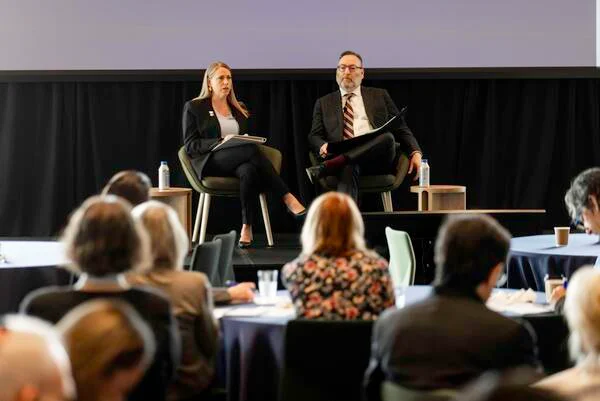
Academics, legal experts and Jewish community advocates gathered at Harvard University Thursday for an inaugural conference focused on antisemitism and civil rights law, held by the Louis D. Brandeis Center for Human Rights Under Law.
Speakers at the conference advocated for a multipronged approach to campus antisemitism, including educating faculty members and students and engaging in strategic lawsuits drawing on Title VI, the federal law that prohibits discrimination on the basis of race, color or national origin, and Title VII, which protects employees from various types of workplace discrimination, including based on religion.
The conference—a condition of the Brandeis Center’s settlement with Harvard last year—follows a rash of lawsuits brought by the Brandeis Center, as well as other Jewish and Israel-supporting organizations and federal agencies, against colleges and universities for their responses to campus antisemitism. Some of these lawsuits have resulted in landmark settlements.
Harvard has been targeted by multiple such lawsuits, including one from the U.S. Department of Justice last month, alleging the university didn’t adequately respond to antisemitic harassment and discrimination. Harvard announced a series of reforms last spring but has denied any wrongdoing. Harvard similarly admitted no fault in its legal battle with the Brandeis Center and other organizations but agreed to changes in a settlement last year, including making explicit that Zionists are protected under its nondiscrimination policies and agreeing to host Brandeis Center events.
Outside of the federal courts, colleges have faced investigations into how they responded to reports of antisemitic incidents. Critics of the approach argue the agency is using civil rights law as a cudgel to stifle pro-Palestinian speech, while proponents say it’s a necessary tool to protect Jewish students after pro-Palestinian protests rocked campuses following Oct. 7, 2023, when Hamas attacked Israel, killing upward of 1,200 people and taking over 200 hostages, and Israel waged war on Gaza, killing tens of thousands of Palestinians.
“This is not a normal moment,” said Kenneth L. Marcus, chairman of the Brandeis Center and a former U.S. assistant secretary of education who ran the Office for Civil Rights, in his introductory remarks. “We meet in the aftermath of Oct. 7 … in the aftermath not only of Hamas atrocities but also of subsequent campus upheavals here at Harvard but also across the country and of institutional responses that have in too many cases revealed not clarity and consistency but double standards and dereliction.”
Marcus argued that historically, in and outside the U.S., there’s been “a demand that Jews distance themselves from core elements of their identity, whether religious, cultural or connected to peoplehood, in order to participate fully in academic, cultural or civic life,” and the pressures on Jewish students to disavow personal connections to Israel or shed outward signs of identity are no different.
“Jewish students report not only hostility but withdrawal, a shrinking willingness to participate fully in campus life, a hesitation to speak openly, and in some cases, a decision to avoid certain institutions altogether,” he said. “The consequence is not simply tension. It is absence, a gradual contraction of the space in which Jewish identity can be expressed without cost.”
Marcus praised the ramping up of litigation efforts and federal intervention that “clarifies obligations under existing law” and some institutions’ adoption of the controversial International Holocaust Remembrance Alliance definition of antisemitism, which can include incidents that target Zionism. (The Brandeis Center’s settlements with several higher ed institutions, including Harvard, require them to adopt the IHRA definition.)
“In this moment, a legal movement must be organized across at least three mutually reinforcing domains that we address today: scholarship, litigation and public policy,” he said.
Andrea Lucas, chair of the U.S. Equal Employment Opportunity Commission, spoke about her office’s efforts on the public policy side during a fireside chat. The federal government working to address antisemitism isn’t “novel,” she said, but she asserted that the EEOC under the Trump administration has pursued “the most vigorous period of work combating antisemitism” in the commission’s 60-year history.
“For me, religious liberty is a core thing that EEOC needs to be focusing on and combating antisemitism is, of course, an integral part of defending religious liberty,” she said.
She highlighted, for example, the commission’s current legal battle with the University of Pennsylvania after the institution refused to produce a list of Jewish staff for an EEOC antisemitism investigation, among other examples. Multiple Jewish groups have also raised concerns about the subpoena, arguing that cataloging Jews echoes dark times in Jewish history. (A federal judge recently required Penn to turn over the names, a ruling the university has appealed.)
“I understand why the controversies have arisen, but fundamentally, to some degree, the Jewish community does have to decide, do you want to have civil rights enforcement in this space?” Lucas countered at the conference, because “there is no other way for me to be able to get money to victims who have been harmed … unless I know something about someone’s affiliation with a religious organization.” Similarly, “I can’t protect Black workers if I don’t collect information about the Black workers” in a given workplace.
Marcus noted that while Title VII includes religious discrimination, Title VI doesn’t, but now the civil rights law is understood to bar antisemitism, Islamophobia and other forms of religious discrimination as it relates to shared ancestry, which he pushed for while in government.
“That was a policy that for 20 years we’ve had to fight for,” he said. “We’ve had to fight for protection of the Jewish people in a provision that didn’t explicitly mention religion.”
Not Just a Legal Fight
Multiple speakers emphasized the importance of not just litigation but changes in academia as a route to curbing campus antisemitism.
The founder and president of Harvard’s Chabad chapter, Rabbi Hirschy Zarchi, said legal fights can only do so much.
“Even in the last few days and weeks, students constantly are at my office, in my email box, complaining of isolation, of exclusion and the victims of hate,” Zarchi said, noting he recently met with a candidate for Undergraduate Council afraid his running mate’s Jewish last name would sink his campaign.
“The law is very powerful, but it has its limits,” Zarchi said. “We’re grateful to the attorneys and to the legal experts who are fighting in the courtrooms, but at the end of the day, if we’re going to win this—and we certainly will—it’s through education. It’s by introducing light.”
He also encouraged Jewish students not to abandon universities like Harvard, despite the bad press and reports its Jewish population has been declining.
“Jewish life is thriving” on campus, and participation and engagement in Jewish programming is on the rise, he said. They’re experiencing “joyful Judaism … and if they’re discriminated against for it, there’s someone here [at the Brandeis Center] that will come to defend them, protect them and ensure that they have all the rights and privileges that this great country offers them.”
Miriam Elman, executive director of the Academic Engagement Network, a group that supports Jewish and Zionist faculty and administrators, said in a similar vein, her organization is trying to focus on not just “the oy” but also “the joy of Jewish life” on campus with its members and has been gratified to see Jewish faculty members growing more comfortable with displays of religious or cultural identity, like wearing kippahs.
In a panel called Towards a Jewish Civil Rights Movement, she described changing the hearts and minds of scholars as the most critical element in a broader fight against campus antisemitism. She noted that, in a survey of AEN members, 70 percent said their colleagues were “the key sources of anti-Israel bias and antisemitism” on their campuses.
“This is not primarily a student-driven problem,” she said. “We’re going to have to educate [faculty members] a lot better about Zionism and Israel.”
She went so far as to say some departments, particularly in the humanities, “may have to go into some form of receivership in order to get that open intellectual conversation and that diversity reflected in the curriculum.” In negotiations with Columbia University, the Trump administration initially demanded the Middle East, South Asian and African Studies Department be placed into “academic receivership” for five years, ceding control of the department to an external chair. The proposal spawned widespread faculty backlash and concerns about academic freedom.
More broadly, she believes Jewish scholars should align themselves with the broader movement against the “politicization of higher ed” and in favor of “open inquiry” and a focus on “knowledge production” as universities’ core mission. She also said faculty members can play a role in helping “those less versed in the law to understand the recourse that the law provides.”
Ultimately, “we need to have the right educational components so that the lawsuits can be avoided,” Elman said. The Brandeis Center “is a wonderful organization, but it should be going out of business at some point.” The goal is “to educate so that the campuses can actually avoid the lawsuits and get A’s on the [Anti-Discrimination League] report card.”
