

Institutions nationwide have created programs and initiatives to address basic needs insecurity among students, including by providing dedicated staff, emergency aid and wraparound support services. But a new report from New America notes that housing insecurity has received less attention than other basic needs challenges.
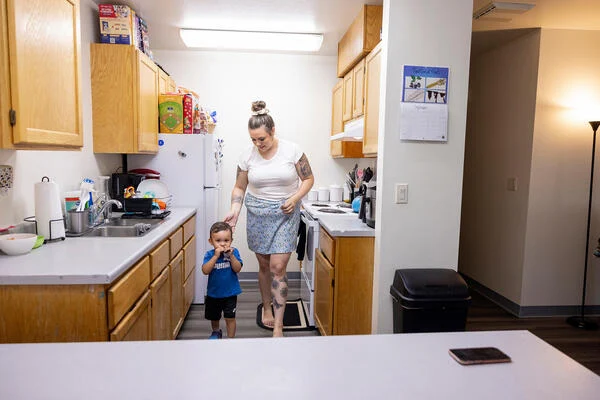
The report draws on data from the 2025 Student Financial Wellness Survey by Trellis Strategies, which partnered with New America, and includes responses from more than 24,000 undergraduates, with a focus on caregiving students—those who are parenting, caring for other dependents or providing financial support for family members.
Among caregiving students who moved three or more times in the past year, 46 percent said their most common reason was the need to be closer to school—a finding that reflects the “practical constraints that caregiving students navigate in finding housing that works for their lives,” the report said.
However, affordability and safety tell a more urgent story, the report authors note: Roughly 32 percent of respondents said they moved because they couldn’t afford rent, and about 23 percent said they relocated because their living conditions posed a risk to themselves or their families.
Richard Davis, policy analyst at New America, said the findings show that housing instability is not just a logistical challenge but also a structural barrier that can directly affect whether caregiving students are able to stay enrolled.
“They’re already a part of our colleges and universities, and for far too long, our higher ed system really hasn’t fully met their needs and has failed to fully see them,” Davis said. “This research really allows us to bridge that gap and be able to see, particularly when it comes to housing, how the resources that are available or not available are actually making that connection to caregiving students.”
Allyson Cornett, director of research at Trellis Strategies, said housing insecurity has lagged behind other basic needs issues in garnering robust institutional responses.
“We see institutions a lot of the time focus on food insecurity, which feels maybe more solvable or something that they’re able to more easily work on,” Cornett said. “We see that housing insecurity among caregiving students is widespread, racialized and fundamentally misunderstood. It’s not just about whether students have housing, but whether that housing is affordable, safe and stable enough for both their education and their families.”
Key findings: The report also highlights a widespread lack of awareness of available housing help: Roughly 73 percent of caregiving students said they didn’t know they could seek additional financial assistance from their institution to help cover housing costs.
But even among those who did ask for help, few received it. Just 3 percent reported both requesting and receiving additional housing aid, while another 4 percent said they applied but were denied.
“When it comes to student parents, most of them can’t cover a short-term emergency of up to $500,” Davis said. “Many housing challenges stem from things like security deposits, falling behind on utility bills or coming up short on rent. Being able to provide short-term assistance for students—particularly caregiving students—is really important.”
Beyond affordability, the report points to discrimination as another barrier to stable housing. About 7 percent of caregiving students reported experiencing housing discrimination, including roughly 9 percent of Black caregiving students and 5 percent of their white peers.
Among students already facing basic needs insecurity, about 10 percent said they encountered discrimination in the housing market.
“A lot of the housing challenges in higher education align with broader patterns of housing inequality, particularly along racial lines,” Davis said. “It’s important to recognize those structural barriers, while also understanding that caregiving students face an added layer of challenges when trying to pursue their education.”
“Housing discrimination was not theoretical for some of these students,” Cornett added. “That can push them into more unstable or unsafe housing and make persistence in college that much harder.”
Policy implications: The report points to multiple opportunities for action. At the federal level, policymakers should invest in “emergency aid for caregiving students, establish standardized data collection on parenting students so that this population is counted and not overlooked, and target policy interventions for these students,” the report said.
At the state level, the report recommends investing in “emergency aid programs and reforming cost of attendance policies to more accurately reflect what caregiving students across a state actually spend.”
And at the institutional level, Cornett said, colleges and universities can increase awareness by communicating more proactively about available aid and ensuring that housing is explicitly integrated into basic needs strategies.
“Institutions can’t fix the housing market, they can’t lower what the living costs are in the country right now, but they can close this awareness gap,” Cornett said. “When those fundamental needs are not being met, it becomes nearly impossible for these students to focus on being college students and fully engage in the college experience while also being academically successful.”
Get more content like this directly to your inbox. Subscribe here.
