

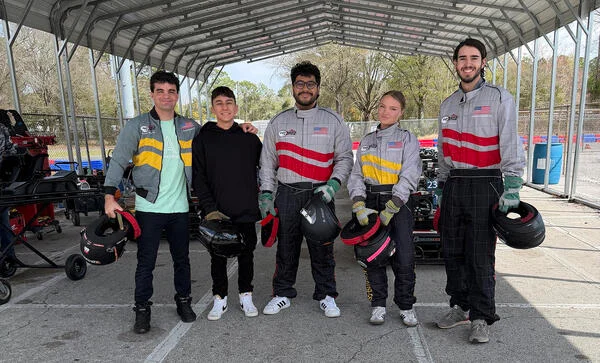
Stephen Coleman was 5 years old when he first climbed into a go-kart at a local short track on Long Island, N.Y. The roar of engines and rush of adrenaline sparked a passion for racing and an interest in engineering and mechanical design that would shape his future.
Last year, when he was in his third year as a mechanical engineering student at Jacksonville University, Coleman sent more than 500 cold emails to racing teams, engineers and NASCAR executives in hopes of breaking into the motorsports industry.
The persistence paid off. Coleman landed an internship with Alpha Prime Racing in NASCAR’s Xfinity Series last year. Now, he has secured a summer internship with Cadillac’s new Formula 1 team, where he will help engineer power unit components for the carmaker’s inaugural F1 effort.
The process “taught me a lot about perseverance, and you’re going to get a lot of nos, but you got to keep trying,” Coleman said. “That’s really important for people trying to get into the motorsports world because it’s competitive, it’s cutthroat, but if you keep trying, you keep putting yourself out there and working hard, you’re going to end up with an opportunity at some point.”
Hands-on learning: But Coleman credits more than persistence for his success. Faculty mentorship, industry connections and experiential learning opportunities at Jacksonville University helped him transform a childhood passion into a career pathway, he said.
With support from faculty and alumni mentors, he recently founded the university’s first Formula SAE racing chapter, an international engineering competition in which college students design, build and test small Formula-style race cars. The program gives Jacksonville students across majors an opportunity to gain hands-on experience and develop skills relevant to careers in motorsports and automotive engineering.
“I started talking to some people and found out there was a ton of interest,” Coleman said. “In engineering, and other majors, too, people have just said, ‘Man, I’d really like to work in motorsports one day, but I have no idea how to even get my first step.’”
Stephen Coleman working on a Formula-style race car for the university’s new Formula SAE chapter.
Coleman conceived of the Formula SAE team to help bridge that gap by giving students practical experience before they enter the workforce.
“Formula SAE is the perfect way for students to get involved in motorsport and get their foot in the door and learn so much, because you’re running not just a race car, but you’re running a business,” he said. “You have to fund the team, you have to get sponsors and you have to have the actual engineers doing the mechanical work on the car.”
Lisa Sutherland, interim dean of Jacksonville University’s Davis College of Business and Technology, noted that the Formula SAE chapter includes more than 50 students across disciplines, including engineering, business and psychology.
“We’re a very student-driven institution and that is fundamental to our core values,” Sutherland said. “If you think about a student [like Coleman] bringing that opportunity forward and really championing it, that’s part of that entrepreneurial spirit that we like to foster in the students.”
As a newly established chapter, Sutherland said, Jacksonville’s Formula SAE chapter plans to compete in Michigan next May. In addition to designing and building a race car, students will be tasked with developing and presenting a business plan.
“It’s part of the competition, so it was interesting that it came from a very student-driven place, which we see across the university,” she said.
Sutherland said it was important to leverage the university’s alumni network, including Tiger Tari, an International Motor Sports Association driver, to help students translate their interests into real-world opportunities.
“We reached out to Tiger Tari when we realized that we had students interested and said, ‘Would you come talk to the students?’” Sutherland said. “He got engaged with the students and, as an alumnus, really started championing them through his connections.”
Race car driver Tiger Tari (center, white jacket) with Jacksonville University students.
That network has since expanded to include a local Porsche racer and other motorsports engineers who speak to and mentor students.
“When a student has an interest and a passion, we say, ‘Who’s an alumnus that we think would also love this opportunity to be with our students? Who in the community are the right partners? Who are the possible funders and donors that might want to invest in this opportunity for the students?’ And we start to put that ecosystem together,” Sutherland said.
Building career pathways: Sutherland said building industry connections is not just about creating a network for students but also about helping the local partners.
“There’s a million car-racing relationships that we could probably think about, but how do we really hone in [sic] that it makes sense for our students and for that company as well,” Sutherland said. “It can’t just be one-sided. It has to be two-sided to be a relationship and not transactional.”
She also said it is important to normalize conversations about failure as part of that preparation.
“Stephen took a lot of rejection and a lot of failure. When you send out 500 emails, you either don’t hear anything back or hear, ‘Sorry, we’re not hiring,’” she said. “We talk a lot about failure at the university, because if you never fail, you probably haven’t pushed yourself far enough or taken a big enough risk.”
Coleman said experiential learning helped bridge the gap between classroom instruction and industry expectations.
“There’s a really great advantage in having this hands-on experience, and I think that’s the biggest gap between typical academia and industry,” Coleman said. “Jacksonville really does a good job of bridging that gap.”
Get more content like this directly to your inbox. Subscribe here.
