

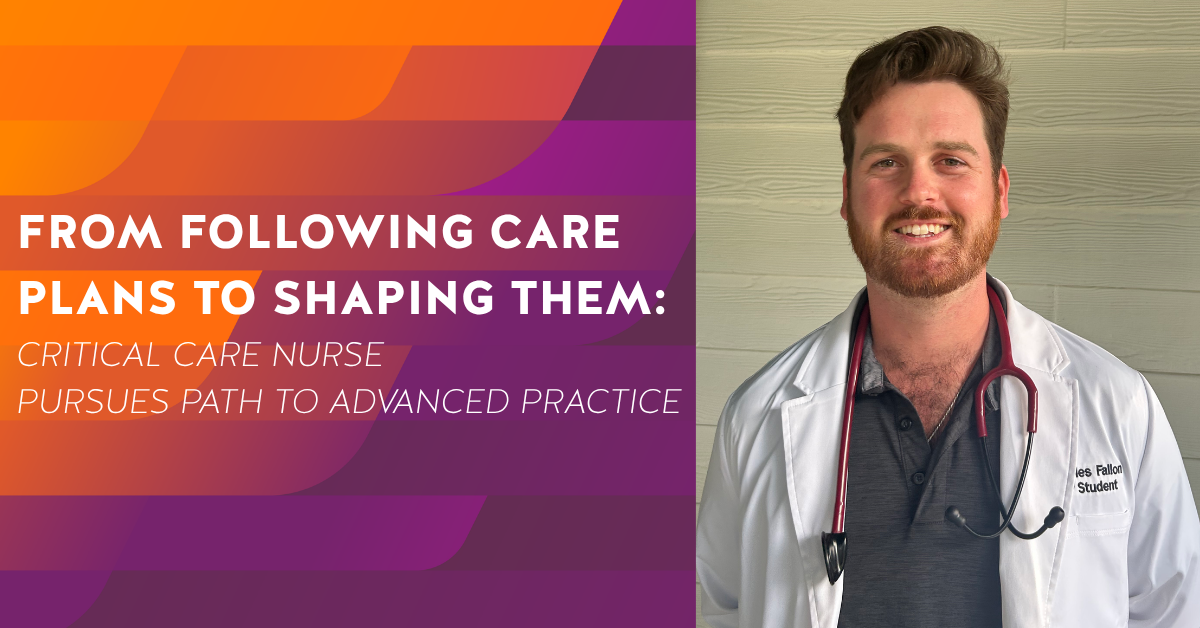
Charles Fallon comes from a long line of health care professionals.
His grandmother, mother, and aunt are nurses, and his sister and several cousins are physician assistants and doctors. In fact, his mother has worked as a dialysis nurse for 35 years. “The family influence definitely rubbed off,” Charles says. “I was always drawn to nursing growing up, and when I went to college, my parents encouraged me to take that path. I’m thankful that I did.”
A Foundation in Intensive Care
After graduating high school in New Jersey, Charles enrolled at East Carolina University. He earned a Bachelor of Science in Nursing in 2019 and set his sights on a career in intensive care. Charles joined a small community hospital in Little River, South Carolina, and was quickly immersed in hands-on patient care. “We didn’t have any nurse aides, so my nurse preceptors taught me to do everything on my own,” he says. “That made me a stronger nurse.”
When the COVID-19 pandemic hit, the demand for travel nurses surged, and Charles decided to join the response. “I was ready to learn more and go where help was desperately needed,” he says. In January 2021, Charles accepted an assignment in the Hospital Sisters Health System in Green Bay, Wisconsin. He was placed in the long-term acute care unit of a community hospital, then the neurosurgical intensive care unit (ICU) of the system’s main hospital.
Steady Progression Into Higher-Acuity Care
Charles’s next year and a half took him across the country, broadening his experience in high-acuity critical care settings. He joined the ICU float pool at UNC Hospitals—part of the UNC Health system affiliated with the University of North Carolina at Chapel Hill—and rotated through the medical, cardiovascular, neuro, and cardiothoracic ICUs and the burn unit. From there, he spent a few months at a community hospital in Ridgewood, New Jersey, followed by seven months at the Medical Center of Aurora in Denver, Colorado, caring for patients with conditions like heart failure and supporting those undergoing wound care and rehabilitation.
That exposure to critically ill patients in different hospitals taught Charles to adapt quickly to diverse clinical demands and patient populations. Eventually, he returned to North Carolina, joining New Hanover Regional Medical Center in Wilmington, where he worked in the ICU and step-down units.
Choosing the Next Level of Patient Care
During this period, Charles reflected on his experience and realized he wanted to do more than carry out physicians’ care plans—he wanted to help shape them.
“In my time as a nurse, I’ve been in situations when I knew what a patient needed but didn’t have the authority to act,” Charles says. “Whether it was ordering tests, prescribing medications, or recognizing when someone required escalation of care, sometimes I felt limited by my role. I decided to go back to school to become a nurse practitioner so I can be a better provider with more responsibility and autonomy.”
Charles began searching for a flexible online nurse practitioner program. By chance, he was introduced to Post University through his own primary care provider. “My doctor changed practices, and I was reassigned to the office’s nurse practitioner, who had graduated from Post,” he says. “It felt like a sign. I remember thinking, ‘this is someone doing exactly what I want to do.’ So I explored the Master of Science in Nursing – Family Nurse Practitioner (MSN-FNP) program and liked what I saw.”
A Step Toward Autonomy and a Future Imagined In January 2024, Charles started the MSN Family Nurse Practitioner at American Sentinel College of Nursing and Health Sciences. He already sees how much he’s grown in his clinical knowledge and critical thinking. “Post has helped me develop in ways I didn’t fully expect,” he says. “I’ve learned how to look at the full picture, approach patient care in a holistic way, and advocate effectively for patients and families. I’m more confident and trust my clinical judgment.”
In summer 2025, Charles stepped away from his role at New Hanover Regional Medical so he could focus on finishing the MSN-FNP program. With graduation on the horizon, he’s defining his next steps. “I’m excited to get back to patient care and plan to start as a family nurse practitioner, possibly in urgent care, which is a great fit with my critical care background,” he says. Longer term, Charles hopes to open his own practice one day and pursue a Doctor of Nursing Practice. “I’m very grateful to the professors I’ve had at Post University for pushing me to grow as a clinician, and I’d absolutely return for the DNP.”
