

This piece was copublished with The 19th, a nonprofit newsroom covering gender, politics, policy and power.
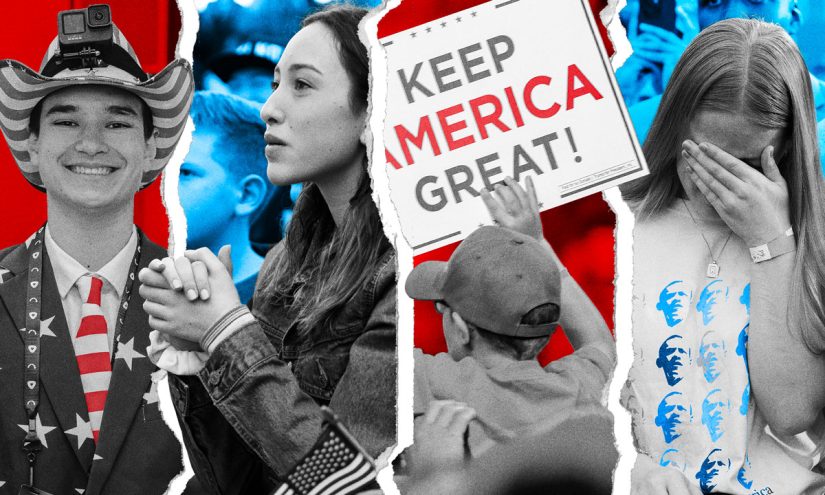
On Nov. 5, 2024, men and women around the U.S. headed to the polls to decide a race hyped as a battle of the sexes.
By evening’s end, Kamala Harris’ quest to punch through the “highest, hardest glass ceiling” and become America’s first female president lay in shambles. Donald Trump, the Republican Party’s undisputed alpha male since 2015, would return to the White House. And voters, especially the youngest ones, were themselves divided starkly on lines of gender.
As in each of the three previous federal elections, women’s support for the Democratic ticket considerably exceeded men’s. But the gulf separating Americans between the ages of 18 and 29 was historically wide: According to an analysis by Catalist, a data and analytics company that contracts with progressive organizations, Harris won the backing of 63% of women and just 46% of men.
The 17-point gap cleaving through Generation Z was not only bigger than that of every other age group; it was comfortably the largest Catalist had measured across four presidential cycles. Surveys of Trump’s approval conducted by NBC News corroborated the same trend the following year, showing disparities between the men and women of Gen Z that eclipsed smaller splits among Millennials, Gen Xers, and Baby Boomers.
Catalist
Jennifer Benz, a political scientist who leads the Associated Press-NORC Center for Public Affairs Research, said findings like that were consistent across surveys she administered prior to the Trump-Harris contest, as well as exit polling conducted at the end of the campaign. Men and women have generally favored different political parties for roughly a half-century, but it was unusual for newly minted voters to lead the way, she added.
“What’s been notable about this younger generation is that the gender divide is already shaping up now, as opposed to when they age into the more typical partisan patterns we’ve seen over recent years,” Benz said.
While Gen Z’s gender gap is a relatively new phenomenon, its features can already be seen in K–12 schools. They spring from the rancorous gender politics of the 2020s, which have left girls repelled by Trump’s policies and boys disaffected by Democrats’ seeming indifference to their concerns.
A young supporter of Donald Trump attends a rally in Parsippany, New Jersey on September 12, 2020. (Spencer Platt/Getty)
As the youngest “Zoomers” enter high school this year, they appear to be accelerating toward the political — and often social — estrangement already evident among their older brothers and sisters. Their stories, based on interviews with The 74 and supported by the insights of educators and public opinion researchers, offer a rare snapshot of that polarization as it takes shape. In America’s college dorms and high school homerooms, young adults are seeing the world differently, occupying separate online spaces and even demonstrating an aversion to dating.
Sarah Campbell, a high school teacher in Brunswick, Maine, said she’d noticed a pronounced change in her social studies classroom. Earlier in her career, students broadly approached discussions of politics and public policy with open minds. But over the past 10 years, a growing number have entered those conversations “already aligned with certain ideas.”
An estimated 10,000 demonstrators attended the Women’s March in Charlotte, one of hundreds staged around the U.S. on January 21, 2017. (Peter Zay/Getty)
“I’ve had girls talk about things like safety, rights or future opportunities in very real, personal ways, and in the same conversation, boys are questioning whether those issues are still relevant,” Campbell wrote in an email. “They’re not just disagreeing, they’re experiencing these issues from completely different realities.”
‘Feminism rooted in me’
Those distinct worldviews may have origins stretching long before adolescence. Celeste Lay, a professor at Tulane University who studies how young people acquire political beliefs, noted that their beginnings overlap with children’s early attempts to fashion adult identities for themselves.
“At the same time young people are going through political socialization, they’re also going through gender socialization,” she said. “So as they’re developing their politics, they’re learning what it means to be a boy or a girl and what society says those concepts mean.”
In a 2022 paper, Lay and several co-authors used survey data from more than 1,500 children to determine when they start to examine the world through the lens of partisanship. They discovered that kids as young as six are already tottering down the path to the ballot box, and nearly half the study’s participants affiliated with a party by the age of 12.
A high school senior named Lily was once such a novice partisan. Raised in South Lyon, Michigan, along the outskirts of Metro Detroit, she was encouraged by liberal-minded parents to take an interest in U.S. history and current events. When she was eight, the Democrats nominated the first woman to lead a major party’s presidential ticket. After that, her course was set.
“This sense of feminism rooted in me because my parents were letting me educate myself,” Lily recalled. “When Hillary Clinton was up against Trump, I was like, ‘There’s never been a female president! I have to support her.’”
A young supporter holds a doll of Democratic presidential nominee Hillary Clinton during a campaign rally at Heinz Field on November 4, 2016, in Pittsburgh, Pennsylvania. (Justin Sullivan/Getty)
A decade after that formative electoral heartbreak, she spoke to The 74 while taking part in the National Student Leadership Council, a for-profit summer program offering learning experiences in a range of fields. Alongside a few dozen others with similarly arcane interests in bicameralism and campaign finance, Lily — whose last name has been withheld to allow her and her peers to speak freely about political matters — spent nine days last July at the Georgetown University campus. In between sessions role-playing as U.S. congressmen, the group made field trips to walk the halls of the Capitol in person.
Lily and her fellow government enthusiasts might reasonably be called some of the most civically engaged high schoolers in the nation. But countless girls her age followed a similar trajectory to both political consciousness and the political left.
Can Civics Education Allow Schools to Rediscover Their Democratic Purpose — and Help Rescue America From Decline?
In the years spanning the Clinton and Biden administrations, the youngest female voters steadily warmed to the label of “liberal” (historically the least-popular ideological category). By 2023, Gallup research shows, the proportion of women aged 18–29 who described themselves as liberal had leapt from 28% to 40%, while liberal men of the same age stalled at 25% over the same period.
The evolution was not merely rhetorical. Teenage and 20-something women adopted more progressive stances on the environment, abortion, gun rights, marijuana access, the Israel-Palestine conflict and an array of other cultural issues. Today, the women of Gen Z are commonly regarded as the single most liberal voter demographic.
Marie Sarnacki, an English and history instructor in South Lyon, contrasted recent waves of female students with those in her own graduating class of 2009. While stipulating that she spoke only for herself, Sarnacki added that girls in 2026 had far fewer reservations about voicing feminist beliefs on some of the most pressing questions of the day.
“I don’t know if they would give themselves the label, but it’s safe to say they’re more open about their concern for reproductive rights or supporting classmates who are gay,” she said.
The elephant in the room
Sarnacki believes that the ideological shift she has witnessed throughout 11 years in the classroom can be substantially explained by a corresponding development unfolding on the Right.
Trump’s presidencies, each achieved through the defeat of historic female candidacies, have repeatedly pushed debates around sexism and women’s rights to the center of the national agenda, she argued. From the Women’s March to the #MeToo-inflected Kavanaugh hearings, the stunning demise of Roe v. Wade, and the president’s demeaning comments about various female antagonists, the Trump era may have hastened a leftward drift that was already in progress.
Hundreds of thousands of protesters mobbed the streets of Washington, D.C., during the Women’s March. (Mario Tama/Getty)
Daniel Cox, director of the conservative American Enterprise Institute (AEI)’s Survey Center on American Life, agreed with Sarnacki. While women have lately gained ground against or even pulled ahead of men in some professional and educational spheres, he continued, many of the most “momentous cultural events” of the last 10 years led them to the conclusion that their rights were imperiled.
“They were doing really well in higher education and high schools in terms of AP courses and graduation rates, and tons of statistics suggest that young women were comparatively doing better than men,” Cox said. “But when they looked around politics and the culture, they were upset about a lot of things and became politically active.”
Public opinion research provides clear signs that their dissatisfaction remains high during the second Trump presidency — and is equally vivid among those too young to participate in elections. An AP-NORC survey from last summer revealed that, within a representative panel of children aged 13–17, girls were vastly more negative than boys in their assessments of Trump (-38 from females versus -7 favorability from male respondents) and the GOP (-16 from girls and +2 from boys), while also much warmer toward the Democratic Party (+13 from girls and -5 from boys).
Children wear hats signaling support for Donald Trump in Bellmore, New York, in October 2020. (Andrew Lichtenstein/Getty)
Trump’s macho stylings and media omnipresence play a crucial role in expanding the rift. Lily remarked that he has become an inescapable figure, whether in school or on social media. If anything, the president’s ubiquity was actually heightened by his reelection defeat in 2020, which lengthened his time in the spotlight.
“He’s so loud, with all the scandalous things he’s done,” she said. “You can avoid the news, but you can’t avoid him.”
Another participant in the NSLC’s Georgetown session was Cate, a junior enrolled at a small private school in Louisville, Kentucky. Like Lily, she said she was motivated by societal injustice to become involved in politics. Her father is gay, and his experiences were part of what spurred her to activism.
But whether engaged in private discussions with friends or public outreach through her school’s Human Rights Club, Cate felt frustrated by her male classmates’ lack of interest in the politics of Kentucky or the wider world.
She expressed particular disappointment with boys in her school who, she suspected, held views similar to hers but would not voice them out of fear of losing face with friends who “idolize” Trump’s brash manner. The gush of short-form entertainment glorifying the president on platforms like TikTok helped foster a hero worship that was difficult to puncture.
School Choice Activist Jeff Yass May Have Prompted Trump’s About-Face on TikTok
It was understandable that young men would seek to emulate a powerful personality, Cate said, specifically citing the 2024 assassination attempt against Trump in Butler, Pennsylvania. The moment after that attack, when the then-candidate rose to his feet and exhorted his audience to “fight,” has become a centerpiece of video edits aimed at teenage boys, she said. Yet his influence heightened a dynamic in which “empathy is seen by this generation of men as weak, feminine.”
“It gets into all this misogyny,” she lamented. “But women, who don’t care about that and can be empathetic loudly, are more able to share their political opinions.”
‘Where am I in this equation?’
Girls were not alone in observing the stridency of gender conflict. Nor were self-described progressives the only ones to complain about its occasionally personal nature.
Nathan, a junior from the prosperous suburban enclave of Westfield, New Jersey, struck a note of bemusement when describing an oft-abused target of the online right: left-leaning white women, a category encompassing many of the students he’d met that week at Georgetown.
“There’s a stereotype that liberal white women are self-hating,” he said. “And supposedly it’s not feminine, and it’s not attractive, and it’s not manly if you support it.”
Voluble and direct, Nathan described himself as a “right-winger,” one of the few participating in the program. But he professed no admiration for political harangues mingled with sexism, and he objected to the treatment suffered by some of his gay classmates at home, who he said were frequently mocked in private.
Instead, along with several other male students, he spent much of an hour-long conversation with The 74 lampooning the fixation of social authorities — including his school’s leaders — with identity politics. A multitude of perceived sins drew their attention, including the proliferation of various “heritage months” across the school calendar and the alleged maligning of the Founding Fathers in history curricula. The most annoying of these were dismissed as “virtue signalling.”
Source: apnorc.org
Many politically engaged young men share Nathan’s perspective on the newfound prominence of equity-focused language and policies.
This is, in fact, a key distinction between male and female Zoomers. According to an AP-NORC poll released in 2022, Gen Z men and their Millennial counterparts were only about half as likely as women to “closely follow” news coverage of social issues. And while the rising salience of such causes, including LGBT rights and abortion, have clearly played a role in politically activating many American women, they do not appear to have galvanized men to support Democratic candidates.
Catalist’s overview of the election results shows that both men and women became more likely to vote Republican between 2020 and 2024, but the gender gap across all ages was principally driven by men abandoning the Democratic Party.
Monty, a junior from deep-blue San Diego, said that students attending his private high school were “extremely left,” and typically surrounded by friends and family members of the same mindset. A strong impulse to activism also pervaded the halls, he added, attracting a number of his peers to Pride marches and No Kings rallies over the past year.
L.A. Students Protest Against Trump and in Support of DEI
As Monty described it, the somewhat airless ideology of his school mirrored that of the larger progressive movement: Just as he’d periodically felt isolated during a long stretch of school assemblies commemorating the historic contributions of women and minority groups, a groundswell of “stranded people” were successfully targeted by the Trump campaign with identity-focused appeals.
“You have all these other groups represented, and then you have a generation of these young white males saying, ‘Okay, where am I in this equation? Because I’m not Black, I’m not a woman, I’m not LGBTQ, and I don’t know where I’m going to fit into this,’” Monty said.
Rachel Janfaza is an independent researcher who writes the newsletter The Up and Up, which aims to surface the attitudes of Gen Z for a national audience by convening focus groups and listening sessions around the United States. In an interview, she said Democrats had “fumbled” in 2024 with a critical group of potential male supporters.
“You have all these other groups represented, and then you have a generation of these young white males saying, ‘Okay, where am I in this equation? Because I’m not Black, I’m not a woman, I’m not LGBTQ, and I don’t know where I’m going to fit into this.’”
Monty, student, San Diego
“I don’t think the Republican Party necessarily set out to attract young men from the start, but the Democratic Party being so coded as being friendly to women made it hard for young men to see themselves in that party,” Janfaza said. “A lot of the men I spoke to who voted for Trump in 2024 felt like they were still not being messaged to by the Democratic Party.”
‘This system doesn’t benefit us’
Part of the difficulty in communicating to Gen Z is the fact that, beneath the level of partisan affiliation, perceptions of society and gender often differ significantly.
Nowhere is this clearer than in the respective views of men and women toward feminism, a cause that has continually gained public support since the 1960s. Women have always been more keen than men to accept the label of “feminist,” but a 2023 poll from AEI showed that over half of male Millennials said the term fit them personally; that figure was actually higher than the proportion of women from preceding generations who agreed with the description.
Yet far fewer of the youngest male respondents agreed. Zoomer men were only as likely as those in Gen X — a group more than twice their age — to call themselves feminists. Between that striking reversion and the leap in self-described feminism among younger women, Gen Z saw the widest gender gap on the issue of any age cohort.
In the same survey, 23% of Gen Z men said they had experienced gender-based discrimination, a nearly fourfold increase over the oldest men included in the sample. Women are also increasingly likely to express this belief, with half of all Gen Z females saying they’d been discriminated against (compared with just 38% of Boomer women).
Some fear that such sharp departures on fundamental questions will foment mutual resentment. Nathan, the New Jersey high schooler, said that boys his age were becoming embittered by a lack of recognition from the political left. In particular, he said that white males could be alienated from the Democratic Party in the same way that African Americans tossed aside their Republican allegiances in the 20th century.
“I think a similar situation is happening with young white men,” Nathan said. “They’re like, ‘This system, this establishment, doesn’t benefit us in any way. We have no stake in maintaining it.’”
Meanwhile, dramatic developments in the political realm can leave residue in the social one. The interpersonal relations of men and women are under greater strain than at any time in the past few decades, epitomized by a plummeting number of teenagers exploring romantic relationships. While almost 90% of high school seniors reported that they’d gone out on at least one date in 1987, according to a recent poll by the Institute for Family Studies, only about half said the same in 2024.
Competing partisanship seems to be at least partially responsible for the decline. In a poll conducted last year by NPR and PBS News, 60% of Zoomers agreed that it was “important to date or marry someone who shared your political views”; by contrast, 62% of respondents aged 60 or older said that politics didn’t carry much weight in matters of the heart. A broader report published last year on the American dating scene found that fully three-quarters of single women with a college degree said they would think twice before dating a Trump supporter.
Campbell, the Maine social studies teacher, said she had seen both sides of the dichotomy in her high school class. Girls are increasingly hesitant to pair off, or even socialize, with male classmates. Boys jokingly attack one another as “simps” — a slang term for men desperate for the attention of women — and have become “much more likely to push back” in class discussions of gender differences.
“The same way we find ourselves in social situations where we’re pressured to join some clique, that’s present in our political positions too. . . and guys experience that too. I just think they’re better at hiding it.”
Lily, student, Pennsylvania
“There is almost a defensiveness in their attitude, as if I am trying to tell them they aren’t important and girls are,” Campbell wrote. “It is genuinely a shift that is concerning to me.”
Lily, who now attends high school in State College, Pennsylvania, didn’t address her dating life. But she opined that the apparently right-wing outlook expressed by some boys may simply reflect their wish to fit in — an instinct with which she sympathized.
“The same way we find ourselves in social situations where we’re pressured to join some clique, that’s present in our political positions too,” she said. “And guys experience that too. I just think they’re better at hiding it.”
What comes next?
Neither students, teachers, nor researchers could guess whether the gender gap would reverse with time or continue to grow.
In his sixth year in office, young women haven’t relented in their loathing for Donald Trump. In fact, it might be said that American women and the Democratic Party have become increasingly synonymous, both measurably more feminist, more liberal, and more credentialed than they were a generation ago. According to Gallup data, one out of every three Democrats is now a college-educated woman.
On the other hand, it is far from clear whether a sufficiently large number of today’s high school boys will reverse course and embrace the Democratic candidate in 2028. A recently released edition of the semi-annual Yale Youth Poll showed that 68% of voters aged 18–22 disapprove of Trump’s performance in office, a four-point increase since the previous fall; still, men in that age range actually became less favorable toward the Democrats during that same five-month span.
If national Republicans hope that disenchantment brings them an army of converts, they may find themselves disappointed. AEI’s Cox said the evidence from most polling and election results shows only that young men have become hostile toward Democrats — not that they have become doctrinaire conservatives.
“I’m not even sure they like the Republicans that much, honestly,” Cox said. “It’s not so much that they’re attracted to the whole GOP agenda — it’s that, between the two parties, they’re looking at which one seems more receptive to the concerns they have.”
Asher, visiting NLSC’s summer program from Pennsylvania’s solid-blue Delaware County, said he would have voted for the Democratic ticket in 2024 had he been old enough. The measured junior particularly came to admire Tim Walz after he was selected as Harris’s vice-presidential pick.
Yet he critiqued the way in which the party sought to woo men as “pandering,” including an affinity group launched to rally “White Dudes for Harris,” and Walz’s misused football lingo. (The Minnesota governor later disclosed that he saw his ability to “code talk to white guys” as one of his major contributions to the campaign.)
Nathan recalled an episode that saw Walz join Democratic Rep. Alexandria Ocasio-Cortez in a gaming session streamed on the popular service Twitch. “They had the most artificial attempts to win over men,” he marveled. “Tim Walz and AOC playing video games, and you could tell they weren’t actually playing. No one related to that!”
Representative Alexandria Ocasio-Cortez and Governor Tim Walz Play Madden on Twitch (YouTube)
Asher — happy to number himself among the relatively scarce white dudes for Harris, albeit one without a vote — said he hadn’t personally felt excluded from political debates with left-leaning classmates, but acknowledged that such conversations sometimes hinged on participants’ personal “credibility” to speak on specific issues.
“I have seen that happen with people: ‘You don’t have female genitals, so you don’t get to have an opinion about abortion,’” he said.
The Up and Up’s Janfaza said that similar complaints are a hallmark of her listening sessions with college undergraduates. Many feel as though their sentiments, goals and desires are so diffuse that they are “talking past each other.”
“When I ask young men and women, ‘Do you see a gender divide in your community?’ they are so quick to tell me that they feel men and women are on different playing fields,” she said. “This isn’t fun for anyone.”
Did you use this article in your work?
We’d love to hear how The 74’s reporting is helping educators, researchers, and policymakers. Tell us how
