

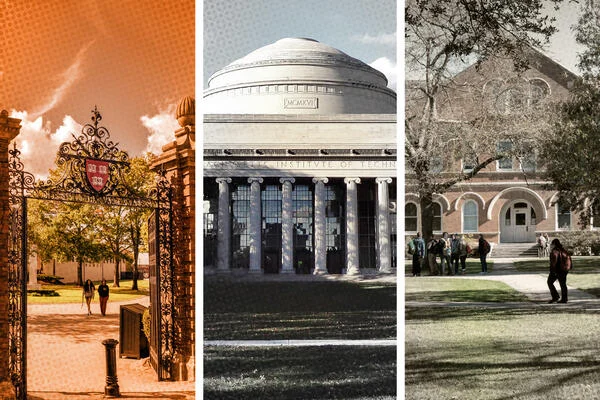
Harvard, MIT and Tulane (from left) all saw some union action last month.
Photo illustration by Justin Morrison/Inside Higher Ed | APCortizasJr, Nate Hovee/iStock/Getty Images | Education Images/Universal Images Group/Getty Images
The Harvard Graduate Students Union announced Monday that its 40-day strike has ended “with the close of the academic year,” though the union has still not reached a bargaining agreement with the university. The strike—the longest in the union’s history—spanned the end-of-semester grading period and university commencement, which wrapped on Friday. Over the last several weeks, the university offered to expand benefits to all graduate student workers, provide dental coverage for Ph.D. students and increase its four-year raise proposal by 1 percent, the union said in a news release. These moves were the “first indication of engagement” from the university on the union’s priorities, the release said.
Photo illustration by Justin Morrison/Inside Higher Ed
“Research laboratories ground to a halt, course material was left untaught, and assignments went ungraded,” the news release stated. “In communications that grew increasingly urgent as the semester drew to a close, Harvard pressured its faculty to report on their students and take on the burden of labor that student workers had withdrawn. In some cases, final exam and assignment requirements were diluted and AI was hastily deployed to assign grades. While neglecting to provide its student teachers pay parity at the bargaining table, Harvard offered new funding opportunities to hire replacement workers who could submit final grades.”
In an email to faculty obtained by Inside Higher Ed, deputy provost Jessica Soban and managing director of labor of employee relations Paul Curran said that student workers with ongoing appointments returned to work Monday.
“While a contract has not been agreed upon, the University remains committed to the ongoing negotiations with the student worker union and to bargaining in good faith. The University and HGSU-UAW bargaining teams have met 28 times, including in a session last Friday, May 29, with additional sessions already on the calendar in the coming weeks,” Soban and Curran wrote. “Our student workers have a vital role in advancing Harvard’s teaching and research mission, and we remain committed to reaching an agreement that recognizes their contributions to our pursuit of academic excellence.”
School is out for the summer and on-campus labor actions are drawing to a close, but May still saw plenty of union news. In this edition of Labor Watch, read about a contract win in Louisiana, a new community college union in California, the American Association of University Professors’ stance on artificial intelligence development and more.
LAWSUITS DEFINITELY COST MORE THAN $56: A drawn-out dispute between Cincinnati State Technical and Community College and its maintenance workers union over a $56 payment could end up costing students and taxpayers thousands of dollars in legal fees, WKRC reported. The union told WKRC that the conflict centers on whether on-call hours should count toward an employee’s weekly total hours, which, according to their contract, could make the employee eligible for premium or overtime pay. In the contested case, counting on-call hours would make the employee eligible for two hours—or $56—of overtime pay. The union won binding arbitration on the same issue last year, but the college is contesting the decision.
“If I was a student at Cincinnati State and I found out the college was spending money this way, I would be very angry,” the union’s lawyer Courtney Brown told WKRC.
A college spokesperson declined to comment on the case to WKRC, but said in a statement that “Cincinnati State values all of our employees and works to honor our collective bargaining agreements.”
MAKING HIGHER ED HISTORY: Student workers at Gavilan College, a public two-year institution in Gilroy, Calif., formed the nation’s first community college student workers’ union. On May 4, the union—which includes peer tutors, peer mentors and “departmental support assignments”—announced the college had voluntarily recognized it. The union aims to address pay disparities and improve working conditions on campus, as well as encourage other California community college student workers to organize on their own campuses.
CONTRACT WIN: Tulane Workers United, which represents non-tenure-track faculty at Tulane University, voted to ratify its first contract on May 6. The group began organizing three years ago, and this new contract “guarantees [members] more transparency around promotion and hiring, a grievance and arbitration process, academic freedom guidelines and equal representation in the operation of their departments and the university,” according to a news release. It also includes higher minimum salaries and guaranteed raises during the life of the contract.
AAUP SUPPORTS AI ‘PAUSE’: Last month, the AAUP endorsed the Data Center Moratorium Act, a bill sponsored by Vermont Sen. Bernie Sanders and New York Rep. Alexandria Ocasio-Cortez that would “enact a reasonable pause to the development of AI data centers to ensure the safety of local communities and humanity,” according to a news release.
“Higher education exists to advance human understanding, critical inquiry and the public good—not to become subordinate to an extractive AI economy that deepens inequality and erodes democratic life,” AAUP president Todd Wolfson said in the news release. “The unchecked expansion of AI data centers is not just an environmental crisis—it is a democratic one. These facilities consume staggering amounts of energy and water while consolidating power and wealth in the hands of a few tech corporations that increasingly shape how knowledge is produced, distributed, and controlled.”
A NEW CONTRACT FIGHT AT MIT: More than 100 members of the Massachusetts Institute of Technology’s Graduate Student Union rallied before commencement on May 28 to push for a new contract. Their existing contract expired on Sunday, May 31. The union, which represents about 3,000 graduate student workers, is asking for wage increases, health-care coverage and protection from the Trump administration for noncitizen workers, according to a news release.
“While we have come to the table with numerous proposals to improve life for grad workers, the Institute has thus far refused to substantively engage with and respond to our proposals,” Rohil Agarwal, a graduate worker, said in the release.
