

Get stories like this delivered straight to your inbox. Sign up for The 74 Newsletter
As we move into primary election season in this monumental midterm year, we have an immediate opportunity to welcome the youngest voters into our democracy.
Unfortunately, too many are not able to participate. Not because they don’t care but because the system is complicated, confusing, and nobody explained it — or why it’s important.
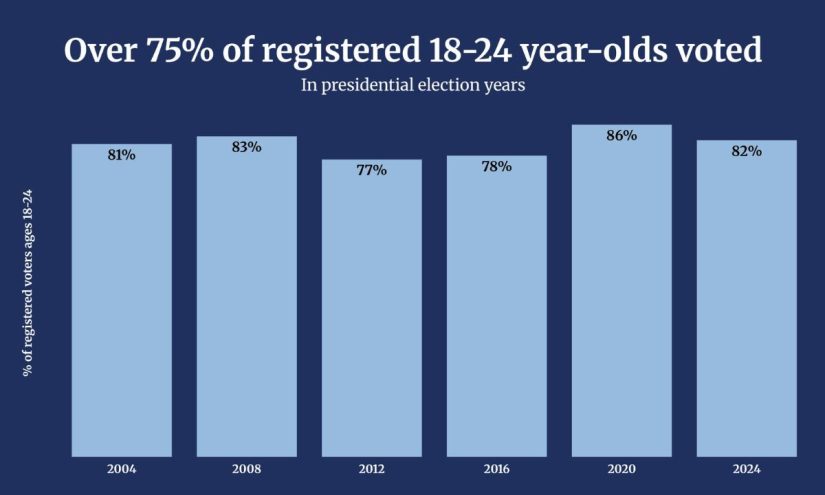
Every year, 4 million Americans turn 18, and most of them aren’t registered to vote. Here’s the thing: When 18-year-olds are registered in big elections, they turn out nearly as much as adults. The problem isn’t apathy — it’s access. In midterms, under 30% of this age group is typically registered, and even in presidential years, it’s fewer than half, versus three-quarters of older voters.
Regardless of the issues that motivate young people — whether it’s housing affordability, education or immigration — our collective responsibility is to ensure young Americans are informed and able to express their opinions at the ballot box.
I founded The Civics Center in 2018 because I believe we can and should make voter registration a regular part of high school life. Not simply to register more voters but to instill an understanding of and appreciation for democratic norms and values. With local partners in 38 states, we have supported close to 1,000 nonpartisan, student-led, peer-to-peer voter registration drives in U.S. high schools, because they’re the one place you can reach virtually every young American.
We provide training and materials so that students can lead voter registration drives in school, supported by trusted adults, year after year. It’s like the school newspaper: Once you set up the infrastructure and name faculty advisors, the students do the work, and teachers support. As organizers graduate, younger students take over.
Many people are shocked to learn that the majority of U.S. teens can pre-register to vote as soon as they turn either 15, 16 or 17, depending on their state. This means that not only is pretty much every senior old enough to register before graduation — so are many juniors and even sophomores.
Another little-known fact: 26 states have statutes already on the books requiring high schools to help students register to vote; sadly, few states implement those laws effectively. The 1993 “Motor Voter Law” highlights the ability of states to designate high schools as voter registration agencies, yet few have taken steps to do so. Absent official action, it’s in the hands of students, teachers, parents and others in the community.
The Kids Could Determine the Future of Democracy
That might seem like adding yet another responsibility to overburdened and underpaid teachers, so we’re lightening the load with state-specific online resources aimed at increasing youth participation. That includes information for every state and the District of Columbia: age to register or preregister; upcoming elections and registration deadlines; ID requirements; the number of 18-year-olds in each state; instructions for registering online and by mail; laws requiring high schools to help; and calls to action such as register to vote, join a free training or run a drive.
Toolkits help teachers who want to support their students’ work, a hands-on learning opportunity that encourages conversations about representative government and democratic power. These equip school communities with reliable information and action items to build a durable on-ramp to democracy and a path to lifelong civic engagement.
When we ask students to guess how their community is doing in registering young voters, they are shocked to hear the reality: Under 25% of 18-year-olds are registered in Ohio and Pennsylvania, 42% in New York,49% in New Jersey, 76% in Michigan. In those states, the same statistic for the people over 45 registered to vote is close to 90%. Many students are galvanized to take action to help their communities do better.
Some of the discrepancies across states and counties can be explained by drivers’ licenses and the over-reliance on state DMVs to serve as voter registration agencies. Few teens drive in New York City, where under 35% of 18-year-olds are registered to vote and under 10% of 16- and 17-year-olds are preregistered. In California, poor DMV system design results in 45% of eligible 16- and 17-year-olds opting out of preregistering to vote.
The situation would have been worse if Congress had passed the SAVE Act requiring a narrow range of citizenship documents to register to vote; many high schoolers don’t have easy access to a passport or birth certificate, which cost money to order and time to ship. Even as the federal version has stalled in the Senate, some states have similar laws enacted or in the works that could survive legal challenges.
No one will be surprised to hear that the hurdles around voter registration disproportionately affect students from low-income or urban communities. That fuels a cycle of neglect and despair: When people aren’t registered to vote, they don’t provoke interest from candidates or campaigns; they are less likely to be asked for their input and in turn, are less likely to believe they have power or influence. On the other hand, voting while young typically fosters lifelong democratic engagement.
Because state laws and practices vary widely, we partner with other nonpartisan organizations, including the League of Women Voters, to support high school voter registration. The results can be extraordinary, with hundreds registered in a single, well-organized effort, and students gaining leadership skills and commitment to democracy.
Imagine the impact: Adding just 100 new registrations per high school, repeated across the 27,000 U.S. high schools, we would see more than 2 million new voters every year.
All of which means that the next two months, leading to graduation season, offer the best chance we know to help the Class of 2026 turn into the voters of 2026 and every election to come.
Did you use this article in your work?
We’d love to hear how The 74’s reporting is helping educators, researchers, and policymakers. Tell us how
