

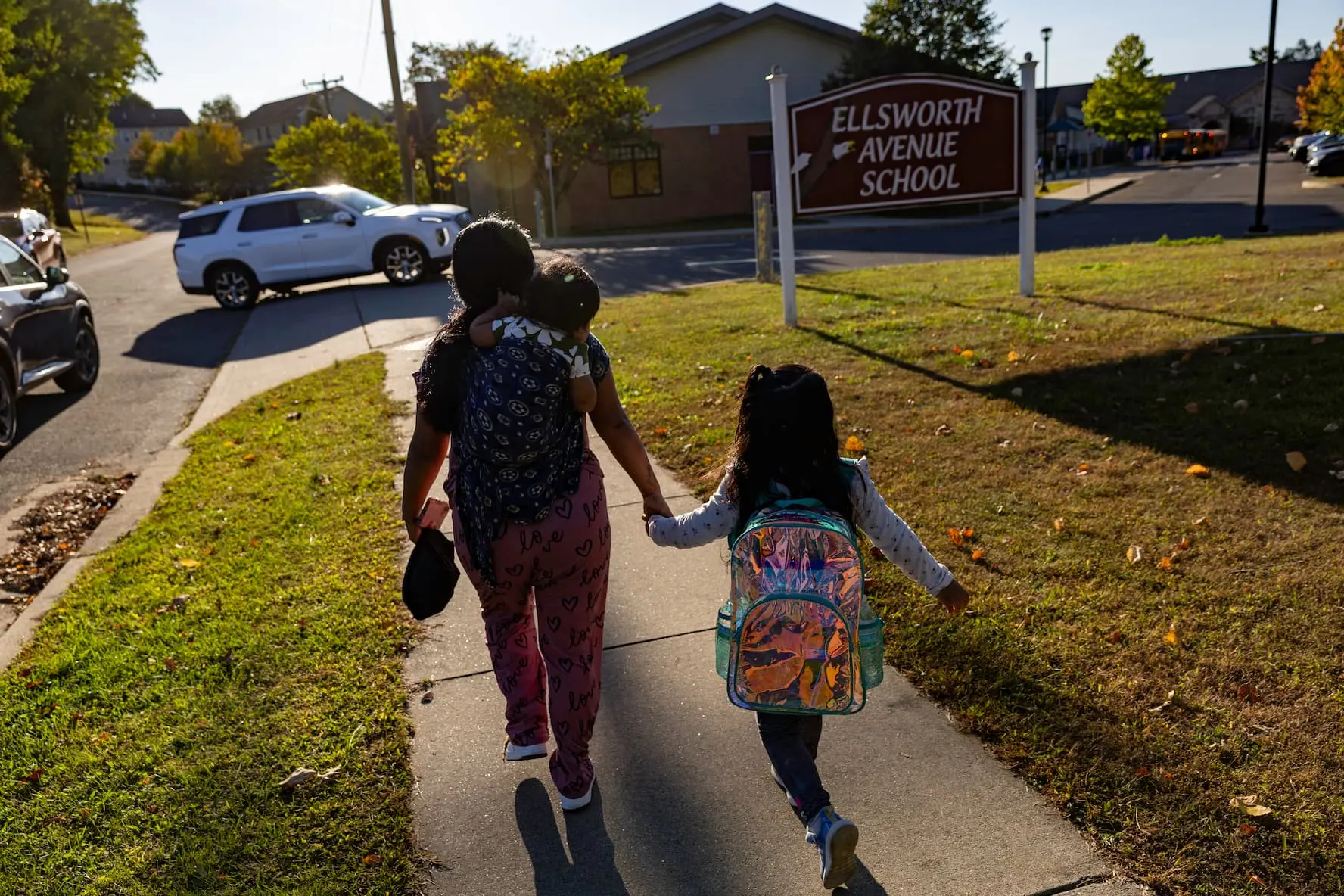
The terror being waged against immigrants in the United States marks a dramatic shift in the federal government’s approach to immigration enforcement. This shift has implications for millions of children in U.S. schools.
Almost immediately after taking office for his second term, President Trump rescinded Biden-era guidance that restricted Immigration and Customs Enforcement (ICE) agents from detaining people near “protected areas.” This means that ICE has more autonomy to operate at or near locations such hospitals, places of worship, sites of religious ceremonies, public demonstrations—and schools. Further, the federal government has relaxed the conditions under which ICE agents can forcibly enter homes, along with lowering hiring standards and reducing training for ICE officers. Taken together, these actions are destabilizing immigrant families and communities, for whom federal law enforcement has become a constant fixture.
The long-term consequences for these families’ and communities’ social, economic, cultural, physical, and overall well-being remain to be seen. However, research from the past year—along with earlier studies conducted during less intensive periods of immigration enforcement—point to the likely effects of enhanced immigration enforcement on students’ educational engagement, mental and physical health, academic performance, and developmental trajectories.
As a researcher specializing in issues related to immigrant-origin students’ access to equitable opportunities, I’ve studied the impacts of immigration enforcement threats on students and school communities and spent hundreds of hours in classrooms with educators working hard to support their students during times of intensified fear and violence. In this piece, I summarize what the existing research tells us about the likely impacts of aggressive immigration enforcement on students, and I consider the implications for educators, school leaders, and policymakers.
Effects on attendance and engagement
K-12 Dive has been tracking ICE activity on school grounds, and at least 13 instances have been reported since January 2025. Reports from across the country have also described how immigrant families are afraid to send their children to school. This could be due to parents’ heightened fears of being detained en route to school—or even on school grounds now that school entrances, playgrounds, and other public areas are no longer protected from ICE.
Research on student attendance patterns corroborate these reports, especially in places targeted by ICE and in communities with larger immigrant populations. A recent survey published by the Urban Institute finds that 10% of adults from immigrant families reported not sending their children to school because of immigration enforcement concerns. One study of a California school district showed that daily student absences increased by 22% after ICE conducted raids early in 2025. The largest jump in absences occurred among the youngest students. Research from Connecticut and Rhode Island showed declines in attendance and increases in chronic absenteeism for students classified as English learners (EL) since Trump took office for his second term. (Researchers often use EL status or Latino ethnic origin as a proxy for immigration status, since schools do not collect information on students’ immigration status.) Studies from earlier periods of enforcement have found immediate and sustained drops in student attendance following immigration arrests, as well as Latino student departures from school districts where local law enforcement entered into cooperative (287(g)) agreements with ICE.
Educators are noticing these patterns. In a nationally representative survey administered between June and August 2025, 64% of high school principals reported that students in immigrant families had missed school in the previous year due to policies or rhetoric related to immigrants.
When students are not in school, they miss important learning opportunities. But the benefits of attending school extend far beyond academic learning. When students are unable to go to school, they lose crucial socialization, community-building, and other enrichment experiences. They miss after-school clubs and activities, cutting them off from social connections that schools are designed to foster. And these costs may be especially steep for students with disabilities, who risk encountering ICE agents ill-equipped to handle their specific needs.
Effects on mental health
Research shows that social-emotional well-being among young people is negatively affected by exposure to immigration enforcement, or even the mere threat of it. Children of undocumented parents seem to experience the most severe difficulties.
Having an undocumented immigrant mother is associated with an assortment of mental health challenges—such as higher rates of anxiety or adjustment disorders—driven by fears of parental deportation. Children of detained or deported parents face a higher risk of PTSD symptoms, disruptive or aggressive behavior in school, and emotional distress compared to peers whose parents are legal residents or have not had contact with ICE. Finally, research indicates that where immigration enforcement occurs, students’ reported sense of safety declines while rates of depression, substance abuse, and self-harm increase.
More than ever, immigrant-origin students need adults at school who are calm, emotionally present, and equipped to help them navigate uncertain terrain while also focusing on their learning. All children benefit from having a stable, trusted adult at school; during periods of heightened enforcement, their reliance on educators to provide stability may be even greater. Additional demands on educators to serve in this capacity—one that many teachers, counselors, paraprofessionals, and other school personnel take on willingly—necessitates more investment and support from district and school leadership in the training and resources they need to fulfill these new roles.
Effects on academic performance
Given that enhanced immigration enforcement appears to lead children to miss more school and become more likely to confront severe stress and trauma, it should not be surprising that it brings academic harm, too. And that appears to be the case. Students score lower on standardized math and reading tests after immigration enforcement events. While the largest declines have been seen in Latino and EL students’ reading and math test scores, other student subgroups perform lower in the aftermath of heightened immigration enforcement as well.
Students’ postsecondary educational trajectories can also be hampered by exposure to immigration enforcement. One of the consequences associated with a large-scale workplace raid in Texas was a decline in direct four-year college enrollment immediately following high school and shifts toward employment during high school, particularly among Latino and EL students. These deterrent effects may compound already existing obstacles to the pursuit of higher education for undocumented students who are already more likely to enroll in two-year institutions.
What educators and school leaders can—and can’t—do
Teachers and school leaders are faced with unprecedented levels of uncertainty among immigrant-origin students and families in their school communities. Understandably, many educators feel overwhelmed and unprepared to handle this.
In my own experience studying schools serving large numbers of immigrant-origin students, I’ve found that educators struggle with what to say when students ask about their own safety or the status of their classmates who have been detained or deported. Educators worry about how to navigate discussions in class about immigration enforcement threats or how to address instances of anti-immigrant rhetoric and bullying. Most commonly, they want to know how to help their students and families during times of crisis. This includes awareness of programs and services in their communities that can address the sudden legal, financial, and mental health challenges arising from a family member’s detention or deportation.
There are resources available for educators to support students and families. For example, many state and local education agencies, attorneys general, teachers’ unions, and advocacy groups have developed policies or guidance. This includes guides for how to respond to immigration agents’ requests for access or information or presence on campus, to preserve all students’ legal right to education, and to protect student privacy.
These types of resources are a useful starting point. At the same time, we should recognize that, for decades, schools have been asked to serve as the backstop for communities. That’s a lot to ask—especially now. The federal government’s immigration enforcement machine is placing even more demands on already overburdened systems and professionals. Politicians, policymakers, and citizens must recognize the limits of school capacity and attend to the needs of both immigrant-origin families whose lives are being turned upside down and the educators working diligently to support them.
