

Listen to the article
This audio is auto-generated. Please let us know if you have feedback.
Lio Quezada is convinced his life’s path would have been troubled had he not been recruited for his school’s wrestling team in 7th grade.
Before joining the sport as a middle schooler, he said he lacked direction and was dabbling with substance abuse. But through wrestling, he found purpose, self-discipline and a community of supportive coaches and teammates. He wrestled in college and earned bachelor’s and master’s degrees in education.
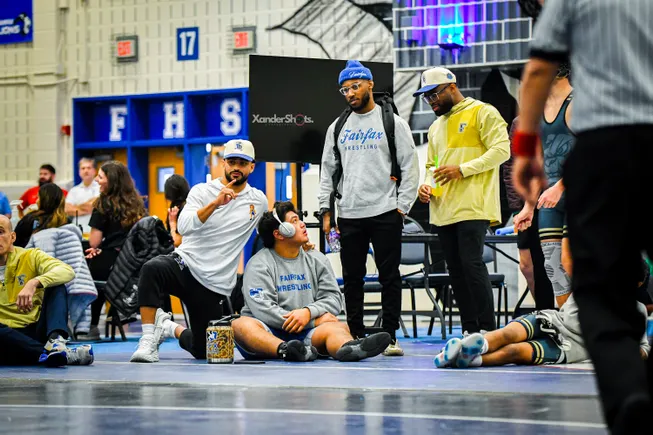
Now, as head coach of the boys and girls wrestling teams at Virginia’s Fairfax High School near Washington, D.C., he said he’s grateful for the guidance he got as a youth athlete. And he wants to make sure his student athletes have supports that address both their physical and mental development.
“If we want to get the best out of our kids, we have to learn to love them holistically,” said Quezada, who is known as Coach Q to his students.
Quezada is part of a growing movement of coaches and physical education teachers who are intentionally addressing mental well-being in youth sports by helping students recognize and process their feelings, have trusted adults to talk to, and be resilient through life’s ups and downs.
“I don’t care about the four years or three years of them winning and losing. I care about the 80 years after this, or the 20 years after this that they’re going to have the real scoreboard and how they’re approaching life,” said Quezada, who also teaches social studies at the school.
Brian Monday coaches his son Clay Monday during a 2025 football game at James Madison High School in Vienna, Va.
Permission granted by Holly Monday
Organizations take the lead
To better understand how to support students’ mental health, Quezada took part in mental health training for coaches through the Eric Monday Foundation, a nonprofit that raises awareness about mental health and provides tools to coaches, athletic directors and parents on how to support students’ mental well-being.
The foundation’s mental health training is required for all middle and high school coaches in Fairfax County Public Schools. In December, the foundation said 5,000 coaches in Virginia and 15 other states had participated.
The foundation is named after Eric Monday, a wrestler who died in 2009 at age 21 while suffering from depression. Brian Monday, Eric’s father, said he felt compelled to create the foundation after seeing Eric’s experiences with both coaches who were supportive and those who ignored or did not address his mental health struggles.
Monday, who serves as president of the foundation, emphasized that the free online training does not aim to make coaches mental health professionals or experts. It’s more about giving coaches — many of whom are not educators or full-time employees of school districts — tools to engage with students holistically and to address mental health concerns that arise.
The foundation’s training uses the acronym LASRR for Listen, Accept, Support, Refer and Report. It includes information about how coaches can recognize and respond to youth mental health issues when they occur.
“We spend a lot of time telling coaches that your teams are going to be more successful when everybody feels like they’re engaged and part of it, not isolated,” Monday said.
Other organizations also stress the importance of youth mental wellness through exercise and sports.
Morgan’s Message, another Virginia-based nonprofit, aims to eliminate mental health stigma among student athletes. The organization has a student athlete ambassador program where high school and college students promote mental health awareness on their campuses.
Having students know that coaches care about them “is that first step in a difficult situation for a teenager to say, ‘Hey, I’m struggling.'”
Andrew Baird
Director of student activities at James Madison High School
In 2019, the Society of Health and Physical Educators, or SHAPE America, launched the health. moves. minds. program alongside Booster, an education fundraising solutions company. The program, which offers publicly accessible curricula, integrates school fundraising with physical, social, emotional and mental wellness activities.
“We like to say that we teach our students that when they take care of their body as well as their mind, they live their best life,” said SHAPE CEO Stephanie Morris. “Mental health has to be something we pay attention to through physical education and health education so that our students have the opportunity to grow holistically.”
A youth mental health crisis
Nationally, youth mental health worsened during and after the COVID-19 pandemic — with educators and politicians calling the situation “crisis” level. Some faulted the isolation and social disruptions caused by the pandemic, while others pointed to increased use of social media.
According to the Centers for Disease Control and Prevention, 11% of children ages 3-17 were diagnosed with anxiety and 4% with depression in the 2022-23 school year.
While research has shown that youth participation in sports can bring mental and physical benefits, it can also lead to mental health challenges, according to a 2024 article published by Johns Hopkins Medicine. For example, some youth athletes might equate their athletic performance with their self-worth or feel overwhelmed and anxious.
According to a February website post by the National Federation of State High School Associations, specializing in a sport at a young age can put youngsters at risk for burnout, injury, mood issues, anxiety and lower self-esteem.
Andrew Baird, director of student activities at James Madison High School in Vienna, Va., congratulates Nathan Tondreault, who was named Northern Region Player of the Year during the 2025 All-Northern Region Baseball presentation at James Madison.
Permission granted by J.J. Rosenberg
The competitive nature of sports also makes it necessary for coaches to ensure youth athletes have the social, emotional and mental tools to handle the pressures they face on and off the field, said Andrew Baird, director of student activities at James Madison High School, which is also in Virginia’s Fairfax County Public Schools.
Baird said when he hires coaches, he looks for people who will help make sports a positive experience for students — including by being committed to supporting students’ mental and physical development.
“If we expect our teenagers to make the right decision 100% of the time, we’re setting them up for failure,” Baird said. Having students know that coaches care about them “is that first step in a difficult situation for a teenager to say, ‘Hey, I’m struggling.'”
Erasing mental health stigmas
As elite and professional athletes have become more open in recent years about their mental health struggles, efforts have grown to erase mental health stigmas in the student athletics community as well.
The parents, coaches and organizations leading the charge say it isn’t about lowering expectations or shielding students from disappointments or challenges. It’s about helping them recognize and work through tough situations, as well as having trusted adults to talk to, they say.
If youth athletes are “not in a good space — mentally, socially, emotionally — whatever we’re teaching them on the ball field doesn’t even matter, because they’re not going to retain it at all,” Baird said.
For Catherine Leighty, a varsity assistant lacrosse coach at Yorktown High School in Arlington, Virginia, it’s important to view her players as human beings first and athletes second, as well as to ensure that her players feel safe with her.
Catherine Leighty coaches a women’s lacrosse game in March 2023, at Yorktown High School in Arlington, Va.
Permission granted by Catherine Leighty
Leighty, who took mental health awareness training with the Eric Monday Foundation, said when she does level criticism, she’ll also highlight positive efforts the athlete is making. Additionally, she said she adjusts her coaching style based on how different students like to be coached.
Coaches “are role models, and we’re here to recognize signs of distress and encourage that our players do take care of their mental health,” Leighty said.
Quezada, the wrestling coach, said he takes this approach: After practices, he gathers his athletes and reads them excerpts from books with stories that have themes about mental wellness and living healthy, fulfilling lives.
“It plants the seed in their heads to know what the bigger picture is,” Quezada said, “and in sports how we can get the best out of ourselves, which then leads to erasing stigmas on mental health.”
