

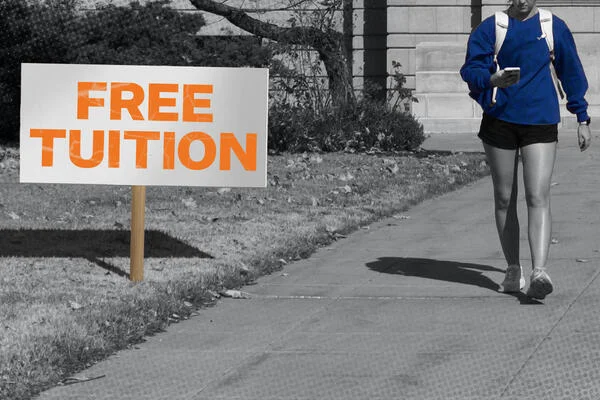
A new report explores best practices for creating promise programs.
Photo illustration by Justin Morrison/Inside Higher Ed | Wolterk/iStock/Getty Images
Free college programs have grown rapidly in recent years, with more than 200 state and local programs estimated across the country. But how they’re designed can make or break student outcomes, according to new research from the Brookings Institution, a public policy think tank.
The report concluded—based on studies about state and local promise programs and roundtables with financial aid experts—that students fare best in generous, flexible promise programs with less stringent eligibility requirements and more robust advising.
According to the report, published last week, a wave of 16 states instituted promise programs from 2014 to 2019, followed by another slew of programs after the COVID-19 pandemic. These programs have had a wide impact: Nationwide, about a third of first-year college students pay no tuition after aid, including 58 percent of low-income students and 41 percent of low-middle-income students, the report found. But how programs are designed matters.
Many promise programs are last-dollar, meaning they cover tuition costs left over after federal financial aid, but the report stressed that first-dollar programs have extra benefits for low-income students. Notably, students who receive Pell Grants can use the federal aid to pay for textbooks, room and board, and other college costs if local or state promise programs fully cover tuition. The report emphasized that only 2 percent of all students—and fewer than 5 percent of low-income students—pay no out-of-pocket costs for college. And those expenses outside of tuition make up 38 percent of a low-income family’s earnings on average.
As a result, first-dollar programs can lead to particularly strong student outcomes, the report suggested. It cited studies on a first-dollar program in Michigan, the Kalamazoo Promise Scholarship, which found an eight-percentage-point increase in immediate college enrollment and a 10-percentage-point jump in six-year credential attainment after the introduction of the program. Researchers also praised the New Mexico Opportunity Scholarship as a statewide first-dollar program.
But covering full tuition without the help of federal aid is an expensive endeavor for most states, and many can’t afford it, said Katharine Meyer, the report’s co-author and a governance studies fellow at Brookings’ Brown Center on Education Policy. If it isn’t possible, other design factors can make a difference when “operating in more of a last-dollar scholarship world.”
Notably, the report found that enrollment outcomes tended to be better in broader-access programs versus programs with stricter eligibility requirements.
The El Dorado Promise, described in the report as “one of the most flexible and generous local programs,” covers up to five years of tuition and fees for anyone who attended all of high school in the Arkansas school district, regardless of financial need. The program yielded high enrollment and college-completion rates compared to other programs studied—a 14-percentage-point increase in college enrollment and an eight-percentage-point improvement in bachelor’s degree completions.
By contrast, Atlanta Achieves, which has both merit and need-based criteria and caps annual awards at $5,000, resulted in persistence and completion increases but had no effect on enrollment. Similarly, an eight-year randomized controlled trial of a $12,000 merit-based aid program in Wisconsin, intended to fully cover community college tuition, showed the program didn’t improve enrollment or completion rates. Another study of local promise programs cited in the report found that programs with income eligibility criteria that required documentation similarly didn’t increase enrollment.
“As states think about designing their own program, they want to make sure that the students who would most benefit from the program are finding it easiest to access,” Meyer said. And “free college,” without caveats, is “simple and easy” for students to understand.
But she acknowledged that “there are complex trade-offs,” and some states have to impose limits for financial or political reasons. For example, some state aid programs incorporate extra hurdles, such as community service hours or GPA requirements, because legislators want “to make students have skin in the game.”
Getting promise programs through state legislatures involves negotiating “competing interests and opinions about what a program should look like,” she added.
But even for more complex promise programs, there are ways to alleviate some of the barriers to entry students face, the report argued, such as ramping up student advising and communicating early with prospective students about programs’ benefits and requirements.
For example, in Oklahoma, students at high schools with higher counselor-to-student ratios were more likely to make it through the complicated application process and access state aid, according to a study cited in the report. The rollout of Advise Tennessee, a state-run college counseling program, also improved application rates for Tennessee Promise and raised college enrollments by 6 percent.
There’s also evidence to support that knowing about local promise programs changes high school students’ outlook toward college. One study found high school students were eight to 15 percentage points more likely to plan on earning at least an associate degree after local promise programs were announced, especially low-income students and students of color.
“Very early, proactive information about the financial aid availability is really key,” Meyer said. “The sooner students can understand that college will be affordable and accessible, the sooner they can start planning and taking concrete steps to be ready for college.”
The report recommended state and local governments notify students of promise programs as early as middle school, make applications as straightforward as possible and consider first-dollar approaches or additional funding for nontuition costs, among other suggestions.
But improving the design of free college programs isn’t an all-or-nothing process, Meyer noted. “While there are a lot of features that make a promise program or any financial aid program successful, a program doesn’t have to have every design feature to have an impact.”
