

Get stories like this delivered straight to your inbox. Sign up for The 74 Newsletter
The International Baccalaureate, a renowned educational program found in more than 160 countries, has survived in the United States for more than half a century, pliable enough to accommodate multiple presidential administrations, including the current one, with its “America First” agenda.
Known for academic rigor and prizing comprehension over memorization, it’s holding steady even as right-wing forces continue to dissect curricula, curbing schools’ ability to address gender, sexuality and systemic racism among other topics.
And it’s still adding new schools here — nearly 300 in the past 10 years bringing the U.S. total to 1,955 — though the vast majority came before 2020.
The nonprofit IB has fared less well elsewhere: The UK recently pulled funding for the program from state schools starting next year and Russia abruptly yanked it from the country entirely this summer after its government labeled the International Baccalaureate a “criminal organization.”
Still, IB administrators insist the program, which seeks to cultivate “internationally minded citizens who appreciate different cultures and perspectives,” has wide appeal, even with its demands of teachers and students.
What’s the Best Way to Measure a School’s Quality? 5 Factors to Consider
Schools undergo an extensive authentication and training process to offer the program — this typically takes two years — and are assessed every half decade to ensure the quality of their IB offerings.
Robert Kelty, IB’s North American head of outreach, development and government relations. (International Baccalaureate)
“What makes the IB so special is that it creates the space for students to find their voices, to learn how to research around the problems they are passionate about and want to solve — and to be able to cite their beliefs in grounded research and sources,” said Robert Kelty, head of outreach, development and government relations for the IB in North America.
In the United States, support for the program runs across party lines, he said, adding that no matter how politically divided the nation has become, most people share the goal of providing a quality education for all kids.
The program might have a fresh ambassador in New York City after newly elected mayor Zohran Mamdani recently named Kamar Samuels, an ardent IB supporter, as chancellor for the nation’s largest school system. The program can be found in 48 NYC schools.
Are ‘Good’ Schools Good for All Students? The Answer Seems to Be Yes
“That’s why we are celebrated from Florida to Texas and from Oregon to New York,” Kelty said. “We create the space for students to learn how to learn and effectively communicate and feel like they can make a positive difference in the world.”
United Nations International School in Midtown Manhattan (Wikipedia)
IB thrives inside its first U.S. home, the elite United Nations International School in Manhattan where teachers use open-ended questions to help students arrive at their own conclusions about complex topics.
Established in 1947 and perched on the East River, this $48,000-a-year private school has been offering IB since 1965, serving the children of some of the world’s most influential thought leaders and policymakers: Roughly half the student body has at least one parent working at the U.N., an affiliation that also reduces the cost of attendance.
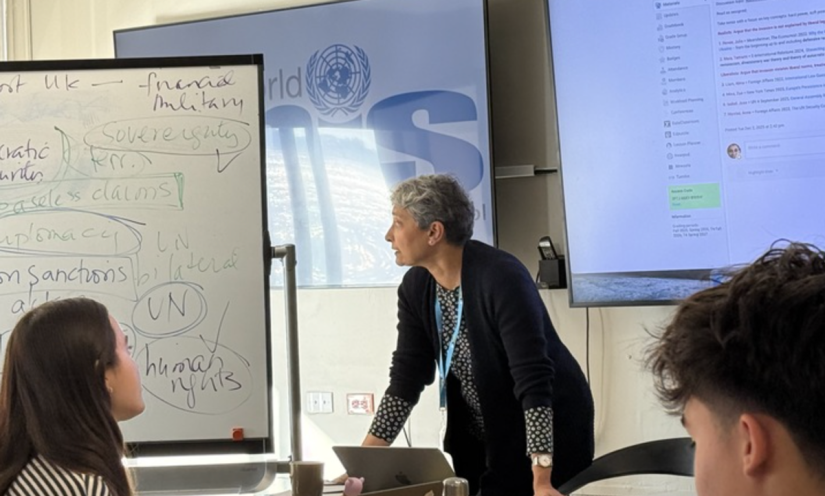
Those in Nila Chatterjee’s Global Politics class spent nearly an hour recently dissecting the war in Ukraine, examining the world’s response to the ongoing conflict and its impact on neighboring countries.
“Why is this a crisis for European states?” Chatterjee asked inside a small, white-walled and sparsely decorated classroom that more closely resembled those found on college campuses.
A hand rose gently into the air before a student mentioned economic fallout, a point his teacher acknowledged and expanded upon.
“For the rest of the world, it’s destabilizing,” she confirmed. “They are losing access to Russia, Ukrainian grain and other exports. It’s disruptive for world trade.”
Chatterjee, who previously taught at the university level, later asked the class whether it considered the possibility of a catastrophic escalation.
Renee Sharapov, 16, and a student at the United Nations International School (Jo Napolitano)
Renee Sharapov, 16, was the first to respond.
“If Russia feels so threatened, might it resort to nuclear war, increasing the death toll by millions?” asked the 11th grader.
Sharapov, who hopes to one day major in economics with a minor in international relations, said after class that she enjoyed the evolution of Chatterjee’s course, which started out lecture-based. Those early weeks, she said, afforded her the background knowledge she needed to further understand the war as seen and experienced from multiple viewpoints.
“We are not looking at issues from one side,” Sharapov said. “We are making arguments from every single perspective. As a political student, you have to be able to take into account what each side is arguing to be able to grasp the situation.”
Harlem Village Academies High on W. 124th Street. (YouTube)
Seven miles north at Harlem Village Academies High, students use Zadie Smith’s book White Teeth as a model for their own short stories.
Like the award-winning author, whose novel examines the unlikely friendship between two World War II veterans, they began each tale from an unusual starting point and had to explain why they chose that particular opening: One student started with a fight that fractured a family, another with a vivid dream.
The public charter school serves more than 200 students at the high school level, most of whom qualify for free or reduced-price lunch. Despite this economic challenge, every graduate was accepted to a four-year college at the end of the last school year, according to David Quinn, director of its IB program.
Matriculation didn’t mark their first time on a college campus: Students had already visited some of the most prestigious universities in the country — twice.
Study: Charters Boost College-Going — Even When Test Scores Fall
Ninth, 10th and 11th graders conduct brief campus tours at a number of regional colleges, including Princeton and Vassar. This comes in addition to week-long or weeks-long school-funded summer courses at Georgetown, Duke and the University of Southern California, among many others.
And while every child goes home with a laptop, Harlem Village Academies High is a “notebook school” with students filling black-and-white marbled composition books with tidy prose. Digital devices are largely banned during the school day.
Samantha Flecha, 16, and Emmanuel James, 17, of Harlem Village Academies High. (Jo Napolitano)
Emmanuel James, 17 and from the Bronx, has only been exposed to the IB model since the fall, the start of his junior year. He said it’s far superior to what he experienced before.
“It’s as if they let go of your hand, in a way,” James said. “They allow you to work a lot more independently compared to a different classroom setting.”
He said his favorite IB class is Theory of Knowledge, which forces students to interrogate how they know what they know. Friend and classmate Samantha Flecha, 16, and also from the Bronx, agreed.
“They tend to answer questions with more questions,” she said, describing her teachers’ techniques. “The whole point is to challenge what we know. And that is why I like the class: It helps me look at the way I perceive everything way differently. As a teenager, you don’t really think about how everything comes to be.”
Teacher Katelyn Conroy talks with students at Harlem Village Academies High. (Jo Napolitano)
English teacher Katelyn Conroy said IB’s approach is ideal for helping students talk about controversial concepts. She said her students are passionate in their beliefs but that the program’s antiseptic approach gives them the language they need to express their thoughts.
“They talk a lot about ICE raids and immigration, and also about what Trump has promised and has not done,” the teacher said.
And while some discussions have become heated, their skills help them speak productively.
“They have been practicing discussions since they were freshman,” Conroy said. “They are able to listen to other people’s opinions and disagree.”
Karalei Nunn, CEO of the 15-year-old Meridian charter school just north of Austin, Texas, said IB was a natural choice for the parents who banded together to create the school.
She said it’s well suited to withstand the restrictions on education imposed at the state level in recent years. New guidelines around social studies, for example, signed into law in 2021, whitewash history, critics say, greatly downplaying racism. But Nunn is unconcerned.
“We read the law to the letter,” Nunn said. “We do not go beyond what that letter is. And we believe you can adhere to the letter of the law and still provide good, sound teaching, facts.”
And while parents are welcome to raise objections to course material, they rarely do. She could recall only two cases, one involving a Harry Potter book and another about a book with a rainbow on its cover.
“We have had a few over the years who step up and say, ‘That’s not what I want my kid reading,’” she said. “And we honor that and provide substitutes.”
Michael Kyles Jr., principal at Hammond High Magnet School in Hammond, Louisiana, said his school system staves off controversy by inviting incoming and current parents to visit campus on IB literature night, which is held four times a year. During that event, the parents of freshman and sophomore students talk to juniors and seniors about their studies.
But even with this disclosure, parents sometimes take issue with certain texts. One, Kyles recalled, objected to the profanity in the acclaimed book, This Boy’s Life: A Memoir by Tobias Wolff.
“We heard their concerns,” Kyles said. “We met with them, explained the process, that this was what we chose.”
Librarians Gain Protections in Some States as Book Bans Soar
Daniel Falcone, who teaches freshman and sophomore humanities and IB Global Politics for juniors and seniors at the United Nations school, said part of the reason IB has generally sidestepped culture war critics is because it allows teachers to focus on big picture concepts.
Using the example of modern-day politics, it’s not about Democrats versus Republicans, he said, but about influence.
“We talk about who has power, how it is used and the evidence behind it,” he said, adding careful study and critical thinking helps students prepare for the next step in their learning process. “You have to earn your right to debate and contest ideas. It’s dispassionate scholarship that allows you to go further in academics.”
Did you use this article in your work?
We’d love to hear how The 74’s reporting is helping educators, researchers, and policymakers. Tell us how
