

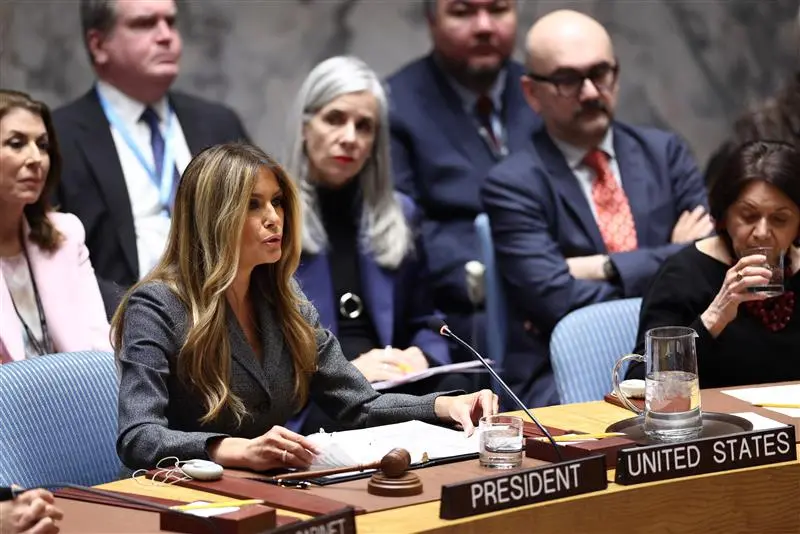
On February 28, 2026, a missile struck the Shajareh Tayyebeh girls’ elementary school in Minab, Iran, during the school day. According to multiple reports, at least 165 people were killed—predominantly schoolchildren, along with teachers, staff, and parents—and around 100 others were injured. Two days later, as families in Minab were still burying their dead, U.S. first lady Melania Trump presided over the U.N. Security Council—the first spouse of a world leader to do so—and delivered a speech titled “Peace Through Education” to the session on “Children, Technology, and Education in Conflict.” The speech called on Security Council members to “build a future generation of leaders who embrace peace through education.” It did not mention the Minab attack or the children who died inside their school.
That gap—between rhetoric and reality—is not merely ironic. It is dangerous. And the speech itself, beyond its timing, reveals deep misunderstandings about what education is, what it can do, and whose purposes it should serve.
Education does not automatically produce peace
Melania Trump’s speech rested on a premise that is as seductive as it is misleading: “Conflict arises from ignorance, but knowledge creates understanding, replacing fear with peace and unity.” This positions education as a simple causal mechanism: more education, more peace; less education, more conflict.
Decades of research demonstrate that this is not how education works. Education is a complex societal endeavor with what scholars have called “two faces.” It can promote tolerance and mutual understanding, but it can also fuel division, entrench inequality, and be weaponized for political ends. Dana Burde’s award-winning research,“Schools for Conflict or for Peace in Afghanistan,” documents how education aid—including USAID-funded textbooks promoting violence—directly fueled conflict rather than prevented it. Some of the 20th century’s most devastating wars were launched by the most “educated” societies on earth.
When policymakers refer to “education,” they often only mean schooling. However, schooling is only one component of education. Education encompasses a broader set of learning pathways, and its purposes extend beyond economic productivity to include cultural continuity, identity formation, liberation, religious and spiritual development, and overall well-being. In contexts of crisis and conflict, these broader purposes become especially significant. Social cohesion, resilience, cultural preservation, and the capacity to thrive as individuals and communities often take precedence over economic outcomes or technical skills. Education can contribute to lasting peace, but only when it is responsive to local contexts and embedded within a wider process of social, political, and economic transformation. Melania Trump’s speech offered none of this nuance.
The colonial echo in ‘Peace Through Education’
The speech draws a distinction between societies described as “rooted in intelligence,” which are associated with producing empathetic and innovative citizens, and those characterized as “rooted in ignorance,” which are depicted as fostering rigid thinking and prejudice. It further asserts that education enables individuals to transcend geography, religion, race, gender, and local norms. The speech envisions a “vast treasury of human knowledge” being transmitted through artificial intelligence from developed countries to more remote regions.
This framing reflects patterns found in colonial-era rhetoric. The concept of a civilizing mission, central to European colonialism, was based on the idea that “educated” European societies were moral and rational, while “uneducated” non-European societies required external intervention. The assertion that education should elevate individuals above their local norms is similar to Lord Macaulay’s 1835 statement about creating a class “Indian in blood and colour, but English in taste, in opinions, in morals, and in intellect.” The depiction of knowledge as a one-way transfer from those who have codified it to those who must receive it reinforces a framework in which some cultures are seen as knowledge holders and others as passive recipients. It is precisely this approach to education—decontextualized, universalized, imposed from the outside—that research consistently shows does not work, and leads to greater conflict.
What the research actually shows
The gap between the rhetoric of reform and the realities of classroom practice has been well documented. The SPARKS project at the Center for Universal Education, which draws on research with teachers, policymakers, and communities in Egypt, India, and Mexico, has shown that pedagogical reforms fail precisely when they follow the pattern implicit in Melania Trump’s speech—designed externally, transferred wholesale, and imposed without regard for local culture, existing education ecosystems, or how teachers actually understand their work. Reforms succeed when they are built collaboratively with the communities they serve, grounded in local realities, and responsive to teachers’ professional judgment.
Education that contributes to peace cannot be delivered from a podium—least of all by those representing an administration whose actions contradict their words. Effective education for peace is developed through collaborative processes, grounded in the needs and aspirations of the communities it is intended to serve, and shaped by those communities.
The weight of things left unsaid
UNESCO said the elementary school bombing “constitutes a grave violation of humanitarian law” and that “attacks against educational institutions endanger students and teachers and undermine the right to education.” Education International condemned it unequivocally: “Children, teachers, and schools must never be military targets.” The U.N. secretary-general urged that “the erosion of human rights [not] become the accepted price of political expediency or geopolitical competition.” Iran’s U.N. ambassador called it “deeply shameful and hypocritical” for the United States to convene a session on protecting children while conducting airstrikes on Iranian cities. And yet, not a single Security Council member directly condemned the strike on the school during the session.
The silence is not a gap in the speech. It is the speech’s defining feature. When our government uses the language of “peace through education” at the highest level of international diplomacy while its military operations are destroying the very schools we claim to champion—and while the global education community is mourning the children who died inside them—it undermines the credibility of the entire global education agenda. It tells educators in conflict zones that their work is expendable. It tells communities that their children’s lives are useful as talking points but not worth protecting. Education professionals worldwide have spent decades working to establish schools as protected spaces under international law. Using the language of education for peace while schools burn is not merely tone-deaf—it actively betrays the cause it claims to advance, and the children it claims to serve.
