

Student loneliness is increasingly shaping how students experience college in a post-pandemic, always-online world.
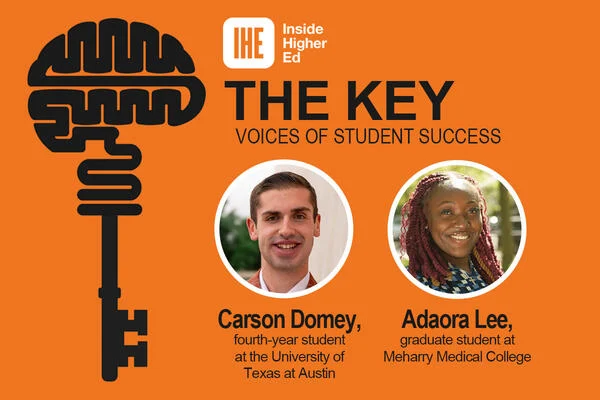
Carson Domey, a fourth-year student at the University of Texas at Austin and executive director of the Coalition for Student Wellbeing—an advocacy organization bridging the gap between students and decision-makers on student well-being on college campuses—and Adaora Lee, a graduate student in a hybrid program at Meharry Medical College, joined Inside Higher Ed student success reporter Joshua Bay on Voices of Student Success to discuss what loneliness and social isolation look like for students today—and how colleges may be struggling to keep up.
This episode is the second in a four-part series on mental health. The first episode explored the state of student mental health with Katie Hurley, vice president of community initiatives at The Jed Foundation (JED), who spoke about what’s driving increased demand for support, how counseling centers are adapting under strain and why student experiences vary so widely across different contexts and identities. The episodes ahead will turn to institutional responsibility and how AI is reshaping conversations around student support.
From fewer close friendships and more device-mediated relationships to the role platforms like Instagram and TikTok play in shaping how students understand mental health, Domey and Lee explore how connection is changing on campus. They also discuss how experiences differ for commuter and online students, how campus design and housing influence opportunities for connection, and what’s actually working when it comes to addressing student isolation.
Follow us on Apple Podcasts and Spotify.
This interview has been edited for length and clarity.
Q: When we talk about student loneliness, it often gets framed as an individual feeling. But when you look at your own experience—and what you’re seeing among your peers—how much of this feels personal versus structural?
Domey: Student loneliness is a very structural issue, especially for institutions of higher education, but it’s obviously felt on the individual level. When we look at college student loneliness, we have fairly recent data from Trellis Strategies showing that 57 percent of college students experience loneliness.
Part of what that report—and a number of other data points—has found is that this is undoubtedly tied to retention and completion rates. This is something we need to look at from a structural perspective in higher education. It’s not simply a student affairs issue or an enrollment issue, but a whole-campus issue, and we should treat it accordingly—looking for solutions that best support students throughout their two-year or four-year journey.
Lee: Coming into this student experience, I really thought that with social isolation—and taking that leap of faith into a higher education program—there would naturally be a lot of mental health support available. And while telehealth has become more accessible, there’s still a large stigma around speaking openly about mental health.
Speaking from my own experience and from my cohort, especially in an online environment where we’re not in a physical space together, we’ve had to do a lot of self-reflection. But we also saw a real shift in community building when we started sharing our feedback and feelings about the online experience. That openness helped create a stronger sense of connection.
Q: How have you seen relationships change in this post-pandemic, always-online environment—especially when so much connection is mediated through phones and platforms like Instagram and TikTok?
Lee: We’re definitely in a digital age, and there are a lot of online influencers—even in the political and policy spaces around mental health awareness—both positive and negative. So I think in this online realm, it’s really important to filter the information that’s being shared.
On a more personal level, especially with the digital world and AI, I try to focus on educating the community across my platforms and building that sense of connection—that it’s OK to feel certain things as it relates to your personal experiences.
Domey: Similar to student loneliness, I think this is another systemic issue that extends far beyond higher education, even though it certainly includes it. One of the policies I’m most interested in is digital literacy. I think it’s time we look at the American education system and consider how we can leverage existing platforms and courses to incorporate well-being in the digital age.
Education as a whole needs to adapt to prepare students for the world they’re walking into, which—for better or worse—very much includes social media. It’s not going anywhere anytime soon, especially as new forms of digital media, like AI, are rapidly becoming part of our lives.
We need to better educate young people on how to have a healthy relationship with social media and how to leverage digital media—whether that’s social platforms or AI—as a force for good. But we’d be mistaken to think that will happen naturally. That’s where things can go wrong, and where we see many of the harms of digital media. If we can think more broadly about how to better educate parents, policymakers and teachers to prepare the next generation, I think we’ll be better off as a society.
Q: What do you think higher ed is getting wrong when it comes to understanding social media and the broader online mental health space—especially where young people seem to have a better grasp than institutions?
Lee: I would say part of it comes down to what higher education is actually teaching in the curriculum in real time. Going back to Carson’s earlier point about digital literacy, it’s not a core part of the curriculum across many institutions. So it really takes advocacy to push for that kind of change. When I think about some of the curriculum I’ve seen, I question whether it’s preparing us for the workforce—even in the mental health field—or even just teaching us, as individuals, how to navigate our lives more holistically.
Domey: I think there are two major challenges that young people are facing when it comes to mental health. One is social media, which is always present. People can argue about whether that’s for better or worse, but my view comes down to balance and education, which is why we’ve talked so much about digital literacy.
But I think something we don’t talk about enough is a parallel issue: a lack of belonging and purpose. You could argue that social media contributes to that, but I also think this was already a growing issue before social media became so dominant.
When you look at broader trends—like the decline of community in many parts of the country—and the data on student loneliness, it’s clear that many students are lacking a sense of connection. I think higher education needs to do a better job helping students find their purpose. This isn’t just a student affairs or academic affairs issue—it’s a bigger philosophical question. In my experience at the University of Texas at Austin, the mission is to transform lives for the benefit of society, which I think is a great guiding principle.
Lee: That really resonates with me. When I think about purpose, I also think about it as something that evolves. When I started my graduate program two years ago, I came in with the mindset that we were part of an inaugural cohort and that we were going to make a difference. It was a big moment for our institution, launching a School of Global Health and aiming to have a broader impact.
But over time, I realized that my degree isn’t my purpose—it’s a tool that contributes to my purpose. My purpose isn’t defined by a job or a single outcome. It’s something that continues to evolve. That shift in mindset really impacted my mental health as I moved through the program. It helped me stay grounded. To Carson’s point, if we can build that kind of thinking into curriculum, I think we would see a broader return on investment—not just for individuals, but across different communities, including those that often face structural barriers.
Domey: Something I’ve reflected on personally is that I’ve been fortunate to find a sense of purpose relatively early in my life through advocacy. That came from my own experiences—growing up with a rare form of Crohn’s disease and later losing a close friend to suicide. But I think it’s important to recognize that not everyone will find their purpose within higher education alone. We should be encouraging people to look at all of their experiences as contributing to that sense of purpose. I believe everything happens for a reason, and ideally, higher education can help people make sense of that and move toward a more fulfilled life.
Q: How much do things like campus design, housing or being a commuter or online student shape whether students feel connected? Are we designing college in a way that makes connection harder?
Lee: To give some context, my program is hybrid—we meet in person twice a year, once in the fall and once in the spring, but we’re primarily online. When it comes to connection, I would say yes and no. A lot of higher education programs are shifting more toward online formats, and in my case, it works well—especially for working students, since we have evening classes. But there’s still a gap when it comes to building and maintaining connections, whether that’s with classmates, family or friends.
Higher education is a major commitment, and as a student, I’ve had to stay grounded in my why, knowing that a two-year program requires sacrifice, especially with my time in the evenings. One thing I did early on was intentionally seek out ways to build connection. During my program’s opening ceremony, I asked if they had ever had an online student involved in student life. They said no, since the school was new, and I volunteered to take that on. I wanted to represent the online student voice and help build connections for my cohort and future cohorts.
That looked like hosting weekly or biweekly meetings, organizing virtual events and even simple coffee chats where we could get to know each other beyond coursework. It created a space for building real relationships. Graduate school is different from undergrad—you don’t always have the same kinds of built-in communities like student organizations. Many of us are working adults, so it takes more intentional effort to create those connections. But I can honestly say I couldn’t have asked for a better cohort. We made it work, and many of us are still close.
Domey: Online learning has been transformative for higher education, especially in terms of access. It’s opened the door for many students who might not have been able to participate otherwise. At the same time, it shows up differently depending on the context—whether it’s a community college student taking classes after work or a four-year student doing online coursework during the summer.
That’s why I think it’s so important to have student leaders on campus—people like Adaora—who can represent their peers and help figure out what kinds of connections can still be built in those environments. Even in hybrid or online settings, there are ways to foster community, but it requires intentional effort.
Q: There’s a lot of talk in higher ed about fixing loneliness—but from what you’ve seen, what’s actually working and what feels more performative than meaningful?
Domey: In terms of what’s working, first-year experience programs are a great example. At the University of Texas, all incoming students are required to be part of a First-Year Interest Group. It’s both a class and a community, where you receive peer mentorship and learn how to adjust to the university and navigate the resources available on a large campus like ours.
A big part of what makes that effective is peer mentorship. You might meet as a full class once a week, but you’re also placed in a smaller group with an upperclassman. Having someone who isn’t a university official, but who can guide you through that transition, is incredibly valuable.
There are also other factors people might not immediately think about. For example, sports play a huge role in building community at UT. I grew up in the Northeast, so I didn’t fully understand how big college sports are, but they really do bring people together. You have 100,000-plus people in a stadium on a Saturday, and it creates a shared experience—not just for students, but for alumni as well.
As for what feels more performative, I’d say free pizza isn’t going to fix it. There’s value in bringing people together for events, but one-off efforts aren’t enough. This is a structural issue. That’s why it’s so important for administrators to work directly with students to figure out what actually works on their campuses. There’s no one-size-fits-all solution, but when student leaders and administrators collaborate, institutions are stronger for it.
Lee: I definitely agree. From my experience, especially being on campus in person only once or twice a semester, I really value that in-person time with my cohort. Even though it takes effort to travel, it’s refreshing to be in a different environment and physically together. That really helps counter some of the isolation that can come with graduate programs, whether it’s a master’s or a Ph.D.
In terms of what feels performative, I think institutions could do more to create space for honest conversations—whether that’s forums or opportunities for students to share how hybrid or online learning is actually affecting them in real time. It requires a willingness from leadership to listen to student voices, not just highlight the positives externally.
Q: So if loneliness is showing up in all these ways, it raises the question of how visible and accessible support really is for students. I know the Coalition for Student Wellbeing is actively pushing colleges to print the 988 Suicide & Crisis Lifeline—a free, confidential, 24-7 service connecting anyone in the U.S. experiencing a mental health or substance use crisis with trained counselors—on student IDs, and new data shows youth suicide rates have dropped most sharply in states that embraced it. From your perspective, why isn’t something like this more widely adopted across campuses—and what does that say about how institutions approach mental health support?
Domey: I think, to address the first part—why this hasn’t been more widely adopted—it really comes down to awareness. Data from the National Alliance on Mental Illness shows that fewer than a quarter of people are even familiar with 988, so there’s still a lot of work to do.
At the same time, the hotline has seen incredible success in the four years since it launched in July 2022. You mentioned the recent study showing an 11 percent lower-than-projected youth suicide rate—that’s incredibly meaningful. It represents thousands of lives. Seeing that kind of impact has been really powerful, not just for our work at the Coalition for Student Wellbeing, but for everyone across the mental health space who helped make 988 possible.
In higher education, this really is a common-sense initiative. It costs nothing for most schools to implement. One of the only challenges we’ve seen is with campuses moving to digital IDs, but even there, solutions are emerging. For example, a student at Arizona State worked with their administration and Apple to get 988 integrated into digital student IDs.
There are already 15 states that require this by law, and we’ve been reaching out to nearly 200 institutions in the remaining states to raise awareness. We’ve partnered with schools like the University of Michigan, as well as the University of Georgia, University of Arkansas and University of Florida, to help implement this change.
Our goal is to reach a million students through this initiative—we’re currently around 350,000—and we’re continuing to expand our outreach. A big part of this is simply making sure the right people know this is possible. It really can be as simple as sending an email or starting a conversation.
Lee: I think it’s also important to highlight the success stories behind 988. There are so many examples of how it has helped individuals in moments of crisis. At the same time, this speaks to a broader issue—we’re still dealing with mental health as an ongoing crisis across the country, not just isolated cases. That’s something we have to address more intentionally.
What stands out to me about 988 is its accessibility. It doesn’t matter where you are, what insurance you have or your financial situation—it’s available. And you never know when someone might need that support, especially in moments of loneliness or distress. So continuing to raise awareness, share those positive outcomes and expand access is really important. It’s a simple step, but it can make a meaningful difference.
Q: Looking ahead, what would real progress on student loneliness actually look like—and how would we know we’re moving in the right direction?
Lee: I’ll start by saying that while data and statistics matter, we also have to pay attention to student stories and lived experiences. When we talk about reducing isolation, we obviously want to see those numbers decrease over time, but we also need to understand how students are actually experiencing these systems and policies in real life.
I know policymakers often focus on numbers and budgets, especially when it comes to funding initiatives like 988 and other mental health efforts. But we also need to center student voices and ask: Is this actually helping students? Is it improving their experience?
For me, progress looks like closing the gap in access and making support more available to all students in higher education. It also means making sure decision-makers are thinking about students first—not just enrollment numbers or institutional metrics, but the overall student experience and mental health.
Domey: I think Adaora has a really strong perspective on this, especially in highlighting that student well-being is foundational to every institutional mission. If students aren’t well, it becomes much harder for them to complete their degrees, stay engaged or successfully transition into the workforce.
And while there’s an important national conversation happening around these issues, I also think we can’t lose sight of what institutions can directly control on their own campuses. One of the things we emphasize at the Coalition for Student Wellbeing is the importance of real collaboration between students and administrators. It sounds simple, but it’s incredibly nuanced in practice. Still, I think it’s one of the most important things institutions can do—creating consistent opportunities for students and administrators to work together over time.
That might look different depending on the campus. For some schools, student government might play that role. For others, it could be committees focused on issues like loneliness. But at the core of it, progress means students and administrators sitting at the same table, sharing perspectives and working toward the same goal: making sure students have the best possible experience in higher education.
Get more content like this directly to your inbox. Subscribe here.
If you or someone you know are in crisis or considering suicide and need help, call the 988 Suicide & Crisis Lifeline by dialing 9-8-8, or contact the Crisis Text Line by texting HOME to 741741.
