

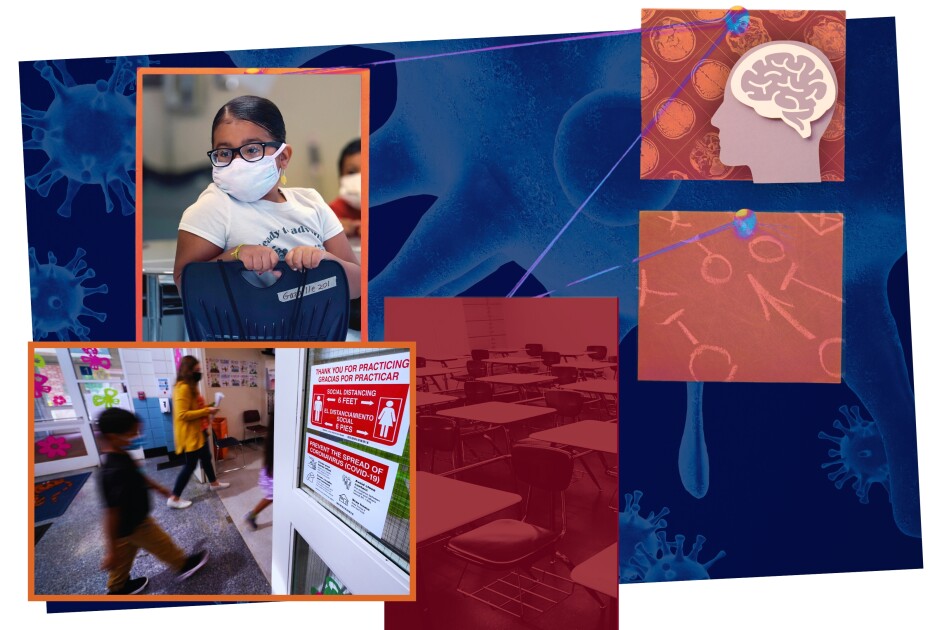
Children’s executive function skills need to play a game of catch-up, concludes a new research study.
The study puts the blame on the pandemic, when those skills grew at a lower rate than is developmentally typical.
Executive function is the set of cognitive skills related to attention, control, and goal-directed behaviors. Previous studies have shown that these skills are integral to children’s health, well-being, and success in school and beyond. The skills develop rapidly during childhood and are shaped largely by children’s life experiences.
The new study, which was published in the journal Child Development in March of this year, used data gathered from 2018 to 2023 as part of the “Early Learning Study at Harvard,” or ELS@H, a longitudinal, population-based, and representative study of children’s development in Massachusetts.
As part of the ELS@H, children take an assessment to measure their executive function skills. The researchers studying the impact of the pandemic on these skills used that assessment data to track the skill development over six years: before, during, and after the pandemic’s onset, analyzing a sample of more than 3,100 children ages 3-11.
In an interview with Education Week, two of the researchers discussed the findings and what they mean for K-12 educators. Stephanie M. Jones, the lead researcher, is a professor of early childhood development at the Harvard Graduate School of Education. Caitlin Dermody is a doctoral student at the Harvard Graduate School of Education and works with Jones on the Early Learning Study.
The interview has been edited for length and clarity.
What are some examples of executive function skills?
Jones: People describe executive function as a foundational set of skills guided by, or governed by, the prefrontal cortex and represent the skills of being like the air traffic controller [of the brain].
The skills themselves are things like working memory—being able to hold things in your memory and manipulate them in time and then use your working memory for other tasks. Another is attention, so being able to focus and then shift attention from one thing to another.
Another area is response inhibition, which some would generally call self-control or self-regulation—being able to inhibit one particular response in service of another. A classic [example] for a child who’s entering into school would be learning to raise your hand instead of calling out an answer, despite the great desire to let the teacher know what you know, but in the classroom setting, it doesn’t work for everybody to be yelling it out. You have to learn to inhibit and those skills are sort of the building blocks.
For an older child, it could be something like thinking through and setting short- and long-term goals. You might have an academic task that is complex and you need to do a number of things to do it successfully.
How is family/parental income linked to the development of executive function?
Jones: [Existing research] documents pretty consistently [show] that experiences, stress, and strain, exposure to vulnerability [and] adversity has an effect on executive function. We entered into this work thinking executive function is very sensitive to experiences of stress and strain. We would expect it to be influenced by experiences of the pandemic.
Because the research literature documents income-related influences on children’s executive function, we wanted to see if those pandemic effects were larger or smaller for children whose families are at different income levels, recognizing that pandemic experiences were quite different for families with different income levels. There was real exacerbation of stress and strain for families who were already vulnerable and struggling. We didn’t see [that effect in this study].
What do you take away from your findings?
Dermody: A lot of the extreme challenges that families were facing during the pandemic—social isolation, job loss, illness—really strained not only families and children, but they also strained the systems that are there to support children and families. We know from other research just how important those early childhood experiences are for young children and their developing executive function skills, specifically in social settings. [The findings] really called us to look at this as a systems-level effect.
Could we generalize the findings across the country?
Jones: We feel like we can generalize to the state of Massachusetts. Massachusetts had a particular response to the pandemic: Everything in the state shut down on the same day and stayed shut down for a pretty consistent period of time. There was some variation across the state in how schools managed the [re-]opening.
To the degree that other states map onto that kind of structure, I would say we could imagine that the findings could extend to that state—without saying it confidently.
One way of understanding the findings is through a “stress and strain on families” lens. Another way is through children’s experiences of social isolation. One thing we know about how executive function develops is that it happens through back and forth interactions with adults, but also other children. So to the degree that, in other states, children around 6 and 7 were experiencing that kind of social isolation, we might imagine that we’d see similar patterns.
What should K-12 educators take away from this?
Jones: Understanding children’s behavior demands that we think about children’s experiences.
We hear lots of reports from educators that children are really struggling in classrooms and that they’re seeing way more challenging behavior. The way I understand that, generally, is that it has some root in experiences like [the stress and strain from the pandemic].
So the way I would respond to educators saying “we’re trying to figure this out,” is to say there’s something that’s behind the behavior that you’re seeing, and because of that, there’s something that we can do to support children.
There’s lots of evidence that tells us that if we support children to practice executive function and self-regulation in the context of their learning environment, if we provide the supports that enable adults and other children to form strong, tight, warm, responsive relationships, that those things will build self-regulation skills, and that cascades into positive behavior.
We—the grand “we,” the policymakers, the decisionmakers—really need to pay attention to how to support educators to support children.
Is there such a thing as ‘too late’ to develop these skills?
Jones: Absolutely not. It would run in opposition to everything we know about human development. There are sensitive periods, but that doesn’t necessarily mean that the opportunity is gone [when you’ve passed that period]. There’s always time to support kids in these areas.
Images in the collage by Charles Krupa/AP— A summer school student wears a protective mask, due to concerns of the COVID-19 virus pandemic, while listening to instruction, at the E.N. White School in Holyoke, Mass., on Aug. 4, 2021. On the same day, students from the school walk past a social distancing reminder sign while heading to the nurse’s office to be tested for COVID-19 during summer school.
