

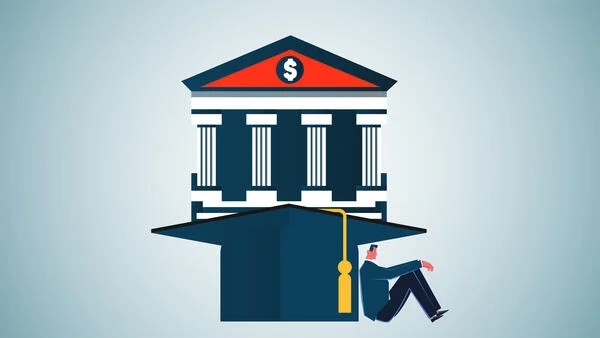
New federal caps on student borrowing are, in theory, designed to finally push colleges to rein in the cost of graduate education. But less than two months before those limits take effect, universities and private lenders are already building private lending pipelines that could keep tuition high while pushing students and their families into riskier debt.
The financial services company Ascent recently raised $45 million to expand its student lending platform, pointing to the loan caps as a major opportunity. The University of Pennsylvania has announced partnerships with private lenders, Yale’s School of Public Health is developing its own loan option and law schools from the University of Kansas to Washington University in St. Louis are already launching institution-backed financing programs.
These institutions are moving quickly to keep tuition money flowing. Students just trying to afford college will pay the price.
Imagine you’re a first-generation college student trying to figure out how to pay for school. Federal loans and grants get you partway there, but they don’t cover the whole bill, let alone food and housing. The current position of the federal government is blunt: If you can’t afford it, don’t go.
The caps established in the One Big Beautiful Bill Act represent a major shift in federal student lending. For decades, parents and graduate students could take out federal loans up to the full cost of attendance. Beginning July 1, parents will face a $65,000 lifetime borrowing cap per child, and graduate students will face a $100,000 lifetime cap, with higher limits for certain federally designated professional programs.
The Department of Education estimates the new caps will cut graduate lending by 39 percent and parent borrowing by 32 percent over the next decade.
Proponents have rightly pointed out that federal lending has played a role in distorting the cost of higher education. Too often, the cost is out of proportion with expected earnings.
The hope is that sharply limiting federal lending will impose market discipline—forcing institutions to cut prices or eliminate programs because lenders won’t make loans they don’t believe borrowers can repay. But the idea that private markets will get student lending right is just a prediction, and one that ignores lessons from the past.
In the early 2000s, private lenders engaged in widespread subprime lending, propping up low-quality for-profit programs and saddling students with crushing debt. That boom was driven by two forces: Federal loans dominated the market, leaving little incentive for lenders to carefully evaluate borrowers, and some institutions offered incentives that distorted lending decisions.
Both those factors remain relevant today. The federally dominated market will remain. Roughly three in four graduate students are expected to stay under the new caps, meaning private loans will still operate largely alongside federal lending—which has historically been far more favorable to borrowers.
And as recent announcements from lenders and universities suggest, institutions may again steer students toward private lenders in ways that sidestep due diligence. These deals could let institutions maintain tuition levels and still enroll students in poorly performing programs.
Blocking higher education from those who can’t already afford it is inegalitarian and socially corrosive. So is conditioning access to graduate education on loans that condemn people to decades of financial ruin.
Current law doesn’t clearly require institutions to disclose side deals with lenders, including up-front fees paid by universities and recourse agreements that require institutions to repay lenders when borrowers default. Lenders also aren’t required to disclose whether loans have been presold to investors—securing an immediate payoff while passing off the risk—or whether their own analyses suggest borrowers are unlikely to repay.
The Department of Education has adopted a new policy of warning prospective students who fill out federal loan forms when they are unlikely to see any earnings gain from the institution they are considering borrowing to attend. Private lenders should be held to at least the same standards of transparency.
Lawmakers have a responsibility to protect borrowers before the caps take effect July 1. If they don’t, we already know what’s next: Students will do what they need to do to get a degree, but no matter how hard they work, too many won’t earn enough to meet their monthly loan payment. They’ll pay more than they borrowed and still owe twice as much because of interest and late charges. They’ll be left with bad credit and no savings. This is our opportunity to step in before students and their families are forced to pay the price of the system’s failures.
Eileen Connor is president and executive director of the Project on Predatory Student Lending, where she has led litigation on behalf of more than two million borrowers and helped secure the cancellation of more than $30 billion in fraudulent student debt.
