

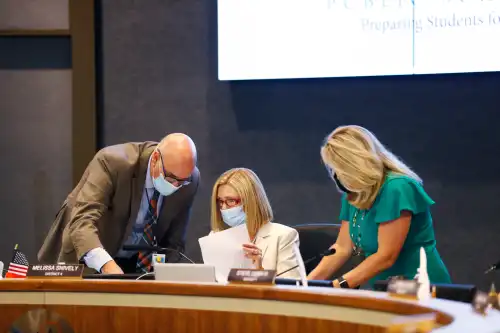
On Sept. 29, 2021, the National School Boards Association (NSBA) sent a letter to President Biden warning of a “growing number of threats of violence and acts of intimidation” targeting local school board members. The letter followed a wave of raucous meetings in which conservative protesters confronted board members over their response to the COVID-19 pandemic and “culture-war” issues involving race, gender, and sexuality. NSBA described these confrontations as tantamount to acts of domestic terrorism. It called for a response from several federal agencies—including the FBI and Department of Homeland Security—as well as local and state officials.
This letter had immediate consequences. It prompted an uproar from conservatives who argued that parents had been labeled terrorists for exercising their First Amendment rights. Republican legislators and attorneys general pounced. NSBA apologized, but it was not enough to quell the response. Several state affiliates cut ties with NSBA, eventually leading 22 states (mostly Republican-governed) to form a rival organization, the Consortium of State School Boards Associations (COSSBA). The episode marked a turning point for U.S. school boards.
Today, the NSBA letter serves as a symbol of a turbulent period in education governance. Conflicts at school board meetings are not new. They are as old as school boards themselves—and a feature, not a bug, of our most accessible democratic institutions. However, the early 2020s were distinctive in many respects. School boards confronted a series of complex issues, from pandemic mask mandates to transgender students’ rights, that had become both nationalized and politically polarized. This period was hard on America’s students, educators, and parents. It was hard, too, on the leaders responsible for making decisions.
Despite extensive media attention, we have much to learn about education politics and governance in this era. Public discussion has been shaped more by anecdotes than comprehensive analysis, leaving key questions unanswered about how conflicts unfolded and what they mean for school board governance.
With this report, we aim to fill that gap. This requires examining school boards from multiple vantage points:
- Chapter 1 analyzes media reports of conflicts involving school boards before, during, and after the pandemic, drawing on a nationally representative set of school districts.
- Chapter 2 presents findings from a nationally representative survey of school board members, capturing their perspectives on the conflicts of this period and their consequences for schools.
- Chapter 3 examines school board election results in Florida—arguably the epicenter of culture-war conflicts in the early 2020s—to assess trends in voter turnout and candidate participation during this period.
Individually, each of these approaches has strengths and limitations. Taken together, they provide a more complete picture of school boards during this consequential period. Across these analyses, we identify four overarching takeaways:
- Conflicts over COVID-19 and culture-war issues were widespread. School board members across many types of communities and school districts reported sharp increases in conflict between school boards and community members during the pandemic. Those conflicts only partially subsided in the years that followed. Media reports similarly indicate that conflict was not confined to any single political context.
- The nature of conflict differed by community, and politically “purple” areas and large districts had the most visible upheaval. While conflicts emerged across the country, they did not take the same form everywhere. Media reports, survey responses, and patterns of school board candidate participation indicate a particularly strong response in politically mixed or moderate communities and larger districts. Issue salience also varied: Mask mandates generated disproportionate conflict in red and purple areas, while debates over school resource officers and student discipline were more prominent in blue areas.
- Heightened conflict did not translate to measurable changes in voter turnout in school board elections. Even in Florida—a state central to education‑related political battles in the early 2020s—we find no significant post‑pandemic changes in turnout. This pattern suggests limited broad‑based political mobilization, even as a smaller subset of residents engaged intensely in school board meetings.
- Any single source of information on school board conflicts during this era provides, at best, an incomplete picture of what happened. We examined school boards from multiple angles because we suspected that each angle would suggest a different, if complementary, story. That is what we found. Skimming media headlines might suggest that all school boards were deeply embroiled in controversy, while systematic media analyses give the impression that conflicts were less common. Survey responses indicate major changes in community engagement. Election data, by contrast, suggest relative stability in voter and candidate engagement. A careful analysis of school boards during this era requires integrating evidence across methods and perspectives.
Together, these findings tell a nuanced story. Conflicts over pandemic responses and culture‑war issues touched nearly every part of the country, but the sources and intensity of conflict varied widely. Moreover, as tumultuous as this period was, it may not have changed how most Americans engage with school boards, if they engage at all.
The chapters that follow present detailed analyses underlying these conclusions. A final discussion synthesizes the findings and considers broader implications for education governance. Additional resources on school boards—including a report that covers the full results of our board member survey (not just its COVID-19 and culture-war items presented in this report)—are available on our school boards project page.
Media reporting on school board conflicts
(Photo by Matthew Hatcher/Getty Images)
Media reports of culture-war conflicts involving school boards during the early 2020s, drawing from a nationally representative set of school districts.
Read Chapter 1
School board members’ views of the COVID-19 and culture-war era
(Photo by KYLIE COOPER/AFP via Getty Images)
Findings from a nationally representative survey of school board members, capturing their perspectives on the conflicts of this period and their consequences for schools.
Read Chapter 2
A case study of school board elections in Florida
(Photo by Joe Raedle/Getty Images)
School board election results in Florida, assessing trends in voter turnout and candidate participation before, during, and after the pandemic.
Read Chapter 3
Discussion and conclusion
America’s schools, like its politics, have changed since the onset of COVID-19. Conflicts over pandemic-related issues such as school reopenings, mask mandates, and vaccination requirements gave way to culture-war battles involving race, gender, and sexuality. Many of these culture-war conflicts initially flared up outside of K-12 education—such as controversies related to police brutality against Black Americans and the inclusion of transgender athletes in college athletics. However, after pandemic-related disputes turned many school board meetings into battlegrounds, the nation’s culture-war battles quickly found their way to schools.
The result was a new political and policy landscape for K-12 education. This included a surge of state policies purported to eliminate CRT and DEI from schools, along with an accompanying flurry of “don’t say gay” policies seeking to keep schools from introducing topics related to gender identity and sexual orientation. These culture-war conflicts also provided fuel for a series of school choice reforms.
This was an important era for America’s schools. Yet, we have lacked systematic evidence of how and where these conflicts unfolded. We have known, from media reporting, that conflicts erupted in many districts across the country. However, in a nation of more than 13,000 districts, drawing conclusions based on media reports is challenging. Local news coverage has eroded over time, and media reporting can be sensationalized or misleading. Media reports offer an informative look at this era; they do not offer a definitive look.
With this report, we seek to enrich our understanding of this period. Our approach was to examine COVID-19 and culture-war conflicts from three complementary vantage points: media reports, a survey of school board members, and school board election results. Individually, each of those vantage points offers a limited view. Together, they provide a more complete picture of how these conflicts unfolded and what they might mean for America’s schools.
Our findings tell a story that, in some ways, reinforces the idea that the nation’s school boards erupted in conflict during this era and, in other ways, challenges that idea. For example, our analysis of media reports finds that only about 10% of districts (representing about 30% of the public school population) had any reporting on COVID-19 or culture-war conflicts involving their school boards. Yet, the vast majority of board members reported increased conflict between their board and community during the pandemic (2020–2022)—before subsiding to some degree in the years that followed. When we examine election results in Florida—a state that was arguably the epicenter of culture-war conflicts in the U.S.—we find only modest changes in voter turnout and candidate participation in school board races.
What, then, should we make of these findings?
First, conflicts were widespread but not, in all places, a catalyst for increased participation from the broader public. Most school boards across the country experienced some amount of heightened conflict in this period, particularly over pandemic issues. They heard from more constituents in school board meetings and, in too many cases, experienced extreme behaviors such as harassment or violent outbursts. However, that does not mean that a large share of Americans was driven to speak out in school board meetings or even to vote in school board elections. In fact, some polling suggests that parents and the public, in general, objected less to schools’ decisionmaking during this period than we might think based on media reporting. While many Americans were frustrated with education leaders and some acted on that frustration, many others either did not share that frustration or did not act on it. This part of the population—perhaps a silent majority—was hardly visible in media reports that tended to spotlight extreme behaviors. (In an accompanying report, we show that board members believe the most vocal community members care more than other members of their community about culture-war topics.)
Second, when it comes to political conflicts involving schools, what you see depends on where you look. This is because any one source of information provides a limited (at best) or distorted view of what occurred. One whose understanding of this era comes only from a generalized sense of media headlines might believe that every school board in America was ablaze in conflict. A formal analysis of media headlines could give the opposite impression—that conflicts occurred in only a small minority of districts. Yet even this more rigorous approach to studying media reports comes with serious faults, including that many communities do not have local media to cover conflicts (especially in less populous areas). Hearing from school board members, as we did with a nationally representative survey, provides essential insights. However, board members’ views could be distorted by a tendency to hear most from the most upset or engaged residents. Looking at voter turnout provides a look at community-wide engagement—albeit one that misses the importance of the interactions between school board members and their communities. To see the full picture of what happened with school boards during this period, one has no choice but to analyze it from multiple, complementary angles.
Third, the conflicts involving schools during this period manifested differently across different communities. We see more evidence of conflict in large districts and politically “purple” communities. To some extent, this could be a natural product of having more people, with more varied views, in more populous, heterogeneous areas. These areas have more potential for conflict, more local media to document those conflicts, and more bureaucratic complexity in making consequential policy choices. Even so, the variation by local political orientation is striking. We consistently see evidence of more conflict and community response in politically mixed or moderate areas. This was particularly evident in board members’ survey responses, but it also appeared in media reports and in candidate participation in Florida school board elections. It is consistent, too, with our prior work showing that Moms for Liberty (M4L), an influential, conservative “parents’ rights” organization that emerged during this period, was particularly active in politically purple (and blue) areas.
All told, our findings suggest there may be no singular story of what happened to public education during the pandemic and culture-war era. This was a tumultuous time, but the conflicts that arose were complex and varied, with greater intensity and more lasting impacts in some parts of the country than others. Some of those conflicts were harmful—and appear to have had lasting effects. Others were likely healthy, an intended outcome of our decentralized, democratic governance model.
The release of this report comes amid lively discussion about America’s school boards. These discussions are raising questions as fundamental as whether school boards should exist and, if they should (or if we are stuck with them), how they could be revitalized. This study was not designed to determine the optimal governance structure for K-12 education. Still, a close look at school boards during a period of extreme conflict is revealing. School boards’ accessibility to the public was on full display. Community members could—and did—show up to board meetings and speak their minds. On one hand, this accessibility ensured that board members heard from concerned constituents and may have shielded educators from direct confrontation. On the other hand, it left policymakers making difficult, high‑stakes decisions in emotionally charged environments where the views they heard may not have reflected those of their broader communities. Many board members, our survey shows, believe the conflicts of this period negatively affected their boards’ ability to govern—and, we fear, may have undermined schools’ response to exceptionally challenging circumstances.
