

Get stories like this delivered straight to your inbox. Sign up for The 74 Newsletter
Heather Feinberg has always supplemented her daughter’s homeschool education with other learning opportunities in their Austin, Texas, community, like church groups and music classes.
Now in eighth grade, her daughter attends a microschool twice a week. The part-time option is something that many small alternative schools offer for families who don’t want a five-day commitment.
“It never worked for us to isolate ourselves and be just the two of us at home,” Feinberg said. “We’re not that kind of homeschool family.”
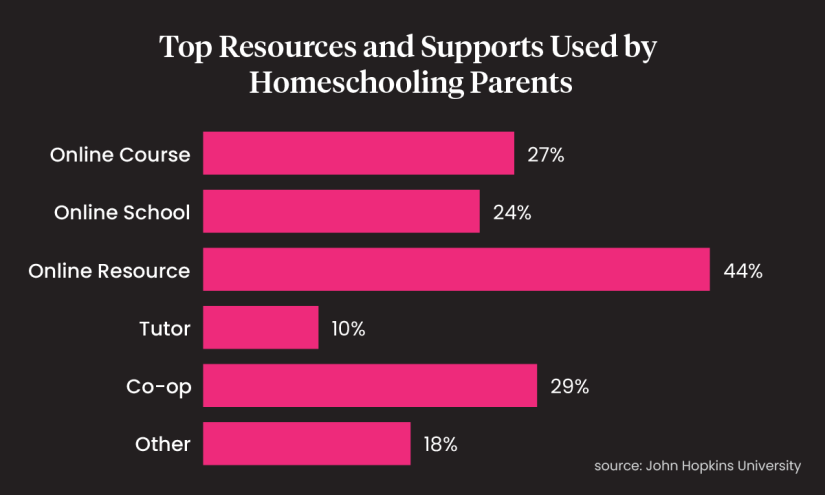
Her choices are more common than she thinks. Combining homeschooling with something else — whether that’s a microschool, an online class or a co-op has become the norm —according to new data released Wednesday from Johns Hopkins University and the Rand Corp.
In Rand’s nationally representative survey of parents, 88% of those who currently homeschool their children use some additional type of support. Over 40% said they use online resources, which could range from a YouTube video to an online curriculum. Nearly a quarter enroll their child in an online school, and 10% use a tutor. As public schools increasingly compete for students, many, especially in Florida, also offer a la carte classes to homeschoolers.
More Than a Third of Homeschool Families Also Use Public Schools, New Data Shows
Replacing federal data
To some traditional homeschoolers, those who enroll their children in virtual programs aren’t truly homeschooling, especially if it’s a public online school, because parents are less involved in directing the learning. But Angela Watson, researcher at Johns Hopkins University and director of the Homeschool Research Lab, chose not to define homeschooling on the survey.
“It’s getting so tricky,” she said. Some parents who attend a microschool “identify as being homeschoolers either for policy reasons or because they feel like they are homeschooling.”
The lines between homeschool and other models have been blurry for years, said John Watson, founder of the Community Advancing Digital Learning, a network of online providers. (He is not related to Angela Watson.)
He recently heard about some relatives who said they were homeschooling, but “upon digging deeper, I found they are attending an online charter school,” he said. The rise of education savings accounts, allowing parents to enroll their children in virtual programs using public funds, has further contributed to the “intersection of homeschooling and online schools or courses.”
Johns Hopkins University commissioned Rand to insert homeschooling questions into its survey to learn more about a population growing in both size and diversity.
“The hope is to better understand current homeschool trends and more about who is doing it,” Angela Watson said.
Of the 2,427 parents surveyed, about 10% say they homeschool their children. That’s nearly double the 5.2% last reported in 2024 when the National Center for Education Statistics released a “first look” at new data.
A fuller report, from the National Household Education Survey, was expected in January 2025. But that never happened after Elon Musk’s Department of Government Efficiency wiped out the Institute for Education Sciences. It’s unclear whether efforts to redesign IES include restarting that project.
“I thought, ‘Let’s just make some lemonade out of these lemons,’ ” Watson said, explaining why she turned to Rand.
A Year After Deep Cuts, Can the Institute for Education Sciences Remake Itself?
‘Run the gamut’
Some of the providers who market to homeschool families met last week near Atlanta for the fifth annual National Hybrid Schools Conference, a gathering of those serving students who split their time between different educational settings.
Exhibitors included twin brothers Matthew and Jared Young, who founded Read Write Create, which offers creative writing classes and materials like journals and colored pencils.
Jared and Matthew Young, who teach homeschoolers creative writing through their Read Write Create program, were among the exhibitors at this year’s National Hybrid Schools Conference. (Linda Jacobson/The 74)
The homeschoolers who participate in their program “run the gamut,” said Matthew Young. Some do it for religious reasons, while others weren’t happy with the traditional public system. What they have in common, he added, is that they “like the freedom of being able to use whatever they want.”
In one session, the marketing team from Kaipod, a network of microschools, coached school founders on how to use websites and social media to attract parents looking for something different.
“Enrollment of a child in school is a major decision especially if they’re walking away from a more familiar model,” said Christine Carlson, Kaipod’s head of content marketing.
Sometimes homeschooling is what’s most familiar, but parents want their child to have more socialization, said Candice Hilton, founder of Hilton Horizons Academy, a Kaipod program in Tennessee offering two-, three- or five-day schedules.
“They may just want to have community. When you homeschool, sometimes you feel a little bit isolated,” she told The 74. Other parents, she said, want an educator’s assurance that their child is on track. “It’s like ‘I feel like we’re doing really awesome, but I want to confirm.’ ”
At the National Hybrid Schools Conference, Christine Carlson, head of content marketing for Kaipod, told microschool leaders how to attract parents who are making a decision about a school. (Linda Jacobson/The 74)
Three survey samples
How homeschoolers’ complement their kids’ education with other programs is just a small slice of what Watson’s team will be able to learn from the parent survey. They also asked parents what grades their children are in, if homeschooling was their first choice or a last resort, what their political and religious views are, and whether their child has disabilities.
In Austin, Feinberg’s daughter has learning difficulties, but also needs the part-time arrangement because of a chronic illness.
“We’re super happy there,” Feinberg said. She originally enrolled her daughter for four days a week, but “she doesn’t have the stamina yet.”
Watson, at Johns Hopkins, also wants to learn directly from homeschooled students. Rand just completed a survey of students, with results out later this spring. The data will provide more information on how kids move in and out of different educational settings.
Exclusive Report: As Movement Grows, Microschools Aren’t So ‘Micro’ Anymore
“Nobody really thought to ask ‘Were you only homeschooled for two years?’ “ Watson said. “That seems different than being homeschooled for 12 years.”
Finally, Rand will soon conduct a broader survey of adults, asking if they were ever homeschooled and for how long. Results from the three samples, Watson said, will provide “more confidence that these survey findings are accurate and reflect what is actually happening in the nation.”
Did you use this article in your work?
We’d love to hear how The 74’s reporting is helping educators, researchers, and policymakers. Tell us how
