

Get stories like this delivered straight to your inbox. Sign up for The 74 Newsletter
As a new principal last year, I was trying to reconcile budget cuts with instructional needs when an idea occurred to me: What if I could boost our capacity by putting my administrative team in classrooms as co-teachers?
That’s now my school’s everyday reality. It took work, training and trust, but today each administrator serves in key instructional roles in the school.
To make the shift, we looked at achievement data and analyzed where it was lagging, by grade and across groups of students. Then we considered whether pairing a member of the administrative team with teachers in those grades and with those students could fuel growth.
Looking at achievement data, we saw that our special education students across grades 3 to 8 needed help to make more growth in reading. In fact, the school was under a state watch for failing to hit benchmarks related to literacy gains among students with disabilities.
To address the problem, my administrative team and I — former teachers ourselves — first received training on the school’s core English Language Arts curriculum and reading skills program. Next, we created a plan to give special education students an extra 30 minutes of English instruction three times a week during their advisory period. We spent that time on reading strategies, including introducing vocabulary that would come up in their English classes and building their background knowledge to support reading comprehension. The effort worked; students with disabilities subsequently made more growth in reading than in previous years.
This year, we zeroed in on third grade, because those students weren’t hitting desired benchmarks. This was also a strategic choice because Arizona has a third-grade retention law that requires students to demonstrate that they can read before being promoted to fourth grade.
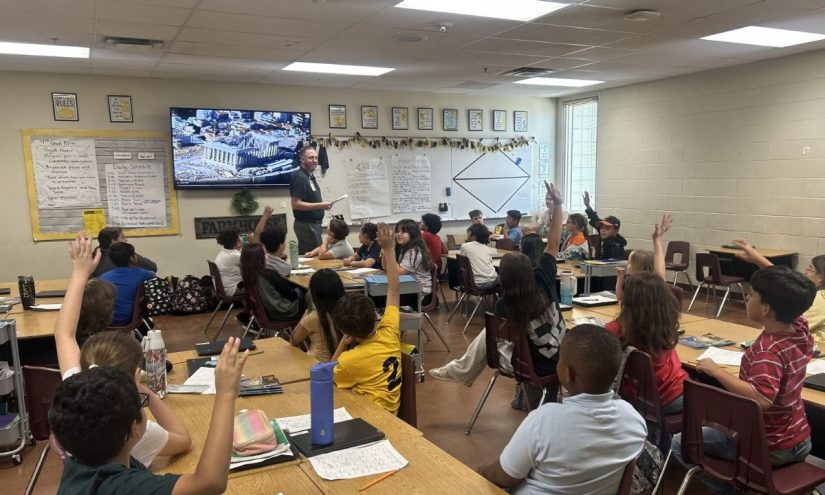
From October through February, I co-taught third-grade English Language Arts, while my school’s instructional coach has been helping struggling students with basic reading skills alongside another third-grade teacher. We also tutor third graders once a week after school on fluency and comprehension. In addition, the dean of students, who oversees school safety and discipline, is co-teaching a fifth grade science class.
One of the hardest things to navigate is how to go from being a co-teaching colleague on a given day to an administrator who has to observe and evaluate my co-teacher the next day. The co-teacher and I discuss beforehand when I’ll be putting on my evaluator hat, so she’s not surprised. When we debrief after a formal observation, I try to limit the conversation to the lesson I observed that day. This way, in other moments, she can share her thoughts and concerns openly, without wondering how I’ll interpret her remarks or whether they’ll show up in an evaluation. And this is not a one-way street. I routinely ask her for feedback on my lessons.
Among the most thrilling parts of this experience has been participating in professional development with teachers, joining their weekly planning meetings and studying instructional materials on my own so I can maximize their potential in the classroom.
Too often, administrators don’t participate in professional learning alongside teachers. When they try to, they are frequently pulled away for other duties. My team and I do everything in our power to avoid that.
Sometimes our learning curve is steep. The dean of students was previously a music teacher, and in addition to learning the science curriculum, he’s helping me lead afterschool tutoring in reading for third graders. He was a little nervous at first, but after doing some professional development, studying on his own and being unafraid to ask questions, he’s doing great and the students are benefiting.
The question I most frequently get is how I find time to do all this. One thing I’ve done is look for ways to work more efficiently. For example, we’ve streamlined how we track student progress data, putting it in a shareable online folder instead of having it live in multiple places, such as individual teachers’ files, which required us to spend too much time looking for it when we needed it. Today, more members of our team, including the school psychologist and instructional coaches, can easily look at and use this vital information..
When the children are in school, from 8 a.m. to 3 p.m., my administrative team makes a concerted effort to be with them. That means, to the fullest extent possible, I don’t take office meetings between those hours or work on budgeting, scheduling or other administrative tasks. I try to get those things done after the kids have left for the day.
Over time, I’ve also grown better at delegating and trusting the strengths of my team instead of trying to do everything myself. For example, we’ve trained some of our educators to lead professional learning meetings, which are focused on looking at data and strategizing ways to meet teaching and learning goals. Previously, these were headed by an administrator. Putting teachers in charge has boosted instructional leadership among the staff, which helps me and ensures the team feels valued, capable and invested in the school’s success.
At the end of the day, I didn’t become a principal to shuffle paperwork. I pursued this opportunity so I could help students excel and live promise-filled lives. Rethinking my role and that of other administrators in my building is doing so much to help the school achieve that goal.
Did you use this article in your work?
We’d love to hear how The 74’s reporting is helping educators, researchers, and policymakers. Tell us how
