

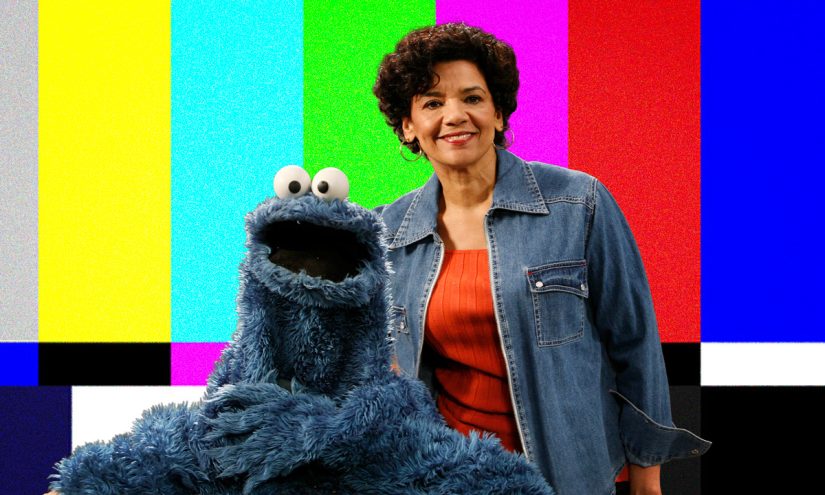
To several generations of TV viewers, actor Sonia Manzano is “the nation’s tía,” their friendly neighbor Maria from Sesame Street. She originated the character in 1971 and spent the next 44 years developing the role through nearly 4,000 episodes, teaching millions of children how to read, write, sing, dance, grieve and be better friends.
But when TV writer Ernie Bustamante read Manzano’s 2015 memoir, Becoming Maria: Love and Chaos in the South Bronx, his mind went to an entirely different neighborhood: He thought her life story would make a great sitcom.
He envisioned a coming-of-age series, with Manzano as “the ultimate protagonist” who pushes through all of her struggles. “She conquers. She overcomes.”
Manzano liked the idea, and the pair got to know one another as they worked to sell it to studios. But after years of trying with little success, they pivoted to a new enterprise.
Director Ernie Bustamante
“All young people want to change the world to some degree,” Manzano said in an interview. “I was lucky enough to fall into a group that wanted to do the same thing.”
In the film, she likens the show’s key creators — puppeteer Jim Henson, producer Jon Stone and composer Joe Raposo, among others — to another seminal ‘60s group: “The Beatles are great — separately they’re all good. But together they made some magic.”
‘I had to be myself on purpose’
Manzano grew up in the South Bronx in the 1950s, before the notorious city planner Robert Moses “destroyed” it, in her words, with a tangle of expressways cutting through mostly Black and Latino neighborhoods. Her parents were both Puerto Rican — her father was a roofer, her mother a seamstress, and the everyday talk in the neighborhood revolved around la lucha, the struggle to survive.
Raised in a home where her father drank and her parents often fought, Manzano quips in the film, “Mostly they struggled with each other.”
AI ‘Slop’ Is Flooding Children’s Media. Parents Should Be Very Alarmed
She found solace in TV, movie musicals in particular, and imagined herself in starring roles. When a teacher took her to see the movie West Side Story, she was “absolutely overwhelmed” by the spectacle and awed by how it transformed the gritty streets of New York into art. At the end of the film, she burst into tears.
“I think it touched me so much because it was the first time I saw things in my neighborhood exalted and made beautiful,” she says in the film.
Manzano’s first big break came when a teacher encouraged her to apply to New York’s High School for the Performing Arts. She’d eventually make her way to Carnegie Mellon University in Pittsburgh, studying with, among others, the renowned mime Jewel Walker, who introduced her to the physical comedy of Charlie Chaplin — she’d later bring her own Chaplin tribute to Sesame Street.
New York High School for the Performing Arts graduate Sonia Manzano, 1968.
By 1971, Manzano had fallen in with a group of Carnegie Mellon drama students helping classmate John-Michael Tebelak produce his senior thesis, an improvisational drama based on the Gospel of Saint Matthew. It was a hit at school and the group took it to La MaMa Experimental Theatre Club on Manhattan’s Lower East Side, where, with the help of composer Stephen Schwartz — only two years older than Manzano and the rest of the cast — it morphed into the surprise hit musical Godspell.
Sesame Street, another surprise hit, had debuted on TV in 1969, and by 1971, Mexican American activists on the West Coast were demanding more Latino representation on the show. Manzano got a call for an audition and impressed producer Stone, who offered her a part.
Manzano had actually glimpsed the show at Carnegie Mellon, wandering into the student union one day as a very young James Earl Jones recited the alphabet slowly and deliberately onscreen. The scene cut to Susan and Gordon, married characters who also happened to be Black. “I really flipped because in those days you never saw people of color on television — and if you did, it wasn’t these charming couples.”
PBS Behind the Scenes: A Visual History of Milestones and Iconic Moments
Coming on the heels of the Civil Rights movement, the show’s representations made sense. None of it happened in a vacuum, she said. “America was ripe for it.”
Manzano’s first moment of reckoning as a Latina on the show happened before she even appeared on camera: A makeup artist was at work heavily tinting her face when Stone walked in and insisted that she appear onscreen as natural-looking as possible. The makeup — at least most of it — had to go.
“It made me understand that these people at Sesame Street, they really meant what they said — they really were interested in having a real Puerto Rican on television that was not slick or glib. They wanted real humans.”
(Sesame Workshop)
Recalling the moment more than 50 years later, she said, “It freed me, because I realized I didn’t have to play any part. I could just be myself.” Whenever she tells the story, she likes to cite her favorite line from The Color of Money: “I had to be myself on purpose.”
With her improv and musical theater background, Manzano soon became a reliable player who could do nearly anything.
Puppeteer Joey Mazzarino, who performed on the show for 26 years, said her abilities shone through despite the show’s demands: In early seasons, cast and crew were expected to shoot as many as 130 episodes.
“Everybody is great, but when you had a scene with Maria, it was just guaranteed to be awesome, because she was such comedy gold,” he said in an interview.
James Earl Jones guest stars on Sesame Street with regular cast members Big Bird, Mr Hooper and Maria to try the perfect egg cream, New York, April 5, 1969. (Getty)
All the same, Mazzarino said, Manzano and her co-stars felt like real people. By the late 1980s, Maria would fall in love with and marry Luis, played by Emilio Delgado, another longtime player. Her scenes with Delgado rang true, he said, bringing a truly loving couple to the screen.
“Even though Sonia can do great comedy, she always felt grounded,” Mazzarino said.
Manzano herself has a fondness for the show’s loose, improvisational feel, especially in the early days: It was, she recalled, a party-like atmosphere in which everyone was trying to crack up everyone else. That allowed her to both try out her comedy chops and search for a way to let the Muppets’ madcap humor shine.
“They were completely zany,” she recalled. “They ate tables. You could throw them against the wall and nothing would happen to them.”
A still image from a 1985 episode of Sesame Street featuring Sonia Manzano and Emilio Delgado singing “You Say Hola and I Say Hola,” a tribute to the films of Fred Astaire and Ginger Rogers. (Courtesy of Ernie Bustamante)
She recalled an early episode in which a scene began taping before puppeteer Jerry Nelson, who played The Count, could make it to the set. As his colleagues proceeded with the scene, Nelson swept in. “And there was no interruption,” Manzano recalled. “It’s a remarkable moment.”
Over time, she became renowned for the knowing gaze she’d offer to the camera, breaking through the fourth wall in exasperation each time a Muppet co-star — most notably Oscar the Grouch — did or said something ridiculous.
“That was a real breakthrough — no pun intended — when I understood what my job was,” she said, “that I could have this relationship with the camera separate from my conversation with the puppet right next to me. I could look at the camera and say, ‘Do you get this? I mean, do you see what’s going on?’”
Actor Sonia Manzano reacts to the Muppet character Elmo. Manzano became well-known for breaking through the show’s fourth wall in exasperation each time a Muppet co-star did or said something ridiculous. (Courtesy of Sesame Workshop)
Over the years, Sesame Street scripts became more research-based and deliberate, and life on the set tightened up. Manzano left the show in 2015 and gets nostalgic about the “looser kind of environment” it had at the beginning. “As they became more tame, they kind of lost a little bit of that craziness.”
‘She never talked down to children’
Michael Davis met Manzano in 2005, when TV Guide sent him to write a piece marking the show’s 35th anniversary. By then, Manzano was also a writer for the show — she’d eventually earn 15 Emmy awards for her writing. She was the first cast member he met.
The Future of Children’s Programming After Federal Cuts to Public Media
“I remember coming home to my wife and saying, ‘You know, I met the actress who plays Maria on Sesame Street today,’” Davis said in an interview. “‘I had a long conversation with her, and she’s the realest deal I think I’ve ever encountered. She is exactly as her character and her TV persona projects — open, funny, candid, intelligent, capable of making great sense about preschool children and their needs.’”
He filled a notebook with her thoughts that day.
Davis, who would go on to write the 2008 book Street Gang: The Complete History of Sesame Street, said that for all of her comedic instincts, Manzano understood her job as a trusted adult in kids’ lives. “She never talked down to children,” he said. “And I think this is true of the Muppet performers and other cast members: They never talked the cutesy voice or talked baby talk, even to 2-year-olds. They addressed children with great respect and interest and really listened to what they had to say. And yeah, it was just a beautiful thing to watch.”
It’s difficult to imagine another actor whose entire adult life has been captured by the camera, he said. Manzano grew up on the show, first appearing at age 21. She fell in love and got married on Sesame Street, had a baby and changed careers several times, at one point working construction. In one renowned episode, she led the cast as they took viewers through the grieving process when old Mr. Hooper died.
In the documentary, Manzano quips, “We were the first reality show — without the whining.”
Davis, whose second book on the show, Street Fight, is due out this fall, said Manzano herself underwent a remarkable transformation from her Godspell days. “She started out as an ingénue — basically a character who was in her teens, just this perky Latina who is new to the street.” She grew, he said, “into one of the most influential characters in the history of Sesame Street and a trailblazer in many, many ways.”
Experts on Kids & Social Media Weigh the Pros and Cons of ‘Growing Up in Public’
Manzano stuck around the show until age 65 before stepping aside to make way for a new generation of actors — and to write books and produce her own animated series. At 75, she shows few signs of slowing down, working more recently with another Sonia from the South Bronx, U.S. Supreme Court Justice Sonia Sotomayor, to help found the Bronx Children’s Museum.
Through it all, Davis said, “she has the most level head, and she is almost painfully normal, and I love her for that.”
He added, “She knows who she is — she absolutely knows who she is, and why she’s here.”
Did you use this article in your work?
We’d love to hear how The 74’s reporting is helping educators, researchers, and policymakers. Tell us how
