

Get stories like this delivered straight to your inbox. Sign up for The 74 Newsletter
Delivering high-quality career-technical education has quickly moved up the policy agenda across the country, with many states turning to industry credentials to help build students’ professional skill sets and signal to employers that they are ready for a job. These credentials range from basic job-safety certificates (e.g., the Occupational Safety and Health Administration’s 10-hour training) to occupational licenses (e.g., licensed practitioner nurse).
Our home state of Ohio has put substantial energy into actively promoting credentials through various policy levers. For example, high school students can use state-approved credentials to meet certain graduation requirements, and schools receive credit in the state’s accountability system when students attain them. In the most recent state budget, policymakers renewed a funding program that incentivizes those approved credentials that related to state-identified “high-priority” careers such as advanced manufacturing and construction. With these incentives in place, attainment in Ohio has soared from 53,000 credentials earned by the class of 2019 to 170,000 by the class of 2024.
But which of these credentials truly add value for students?
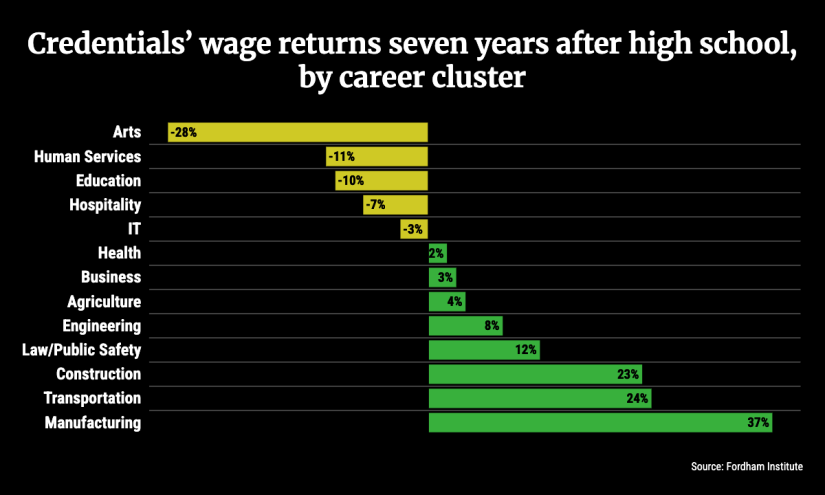
A new Fordham Institute study examined the labor-market value that various credentials have for Ohio students. In general, credentials are associated with substantial expected wage increases in the early years after high school (almost $2,000 higher earnings in the first year after graduation). However, we found widely differing wage returns depending on field, with male-dominated careers in the skilled trades linked to larger income benefits. Students attaining manufacturing-related credentials, for instance, typically earn about 35% more than their non-credential-earning peers with similar backgrounds.
Economists Say Ohio’s Education System Doesn’t Match Employer Demands
On the other hand, we also discovered that many credentials yield little to no economic value for students. For example, we found no significant differences in the annual incomes of students earning a nurse’s aide or culinary certificate six years after high school compared with peers who did not attain a credential. A few credentials, such as a cosmetology certificate, were even associated with reduced earnings after students leave high school.
Our findings lead to some important insights about how states can more effectively leverage industry credentials.
First, policymakers should not view credentials as an isolated indicator of career readiness, but rather as a key element within an integrated career pathway. In addition to finding variable wage returns by field, our study revealed that students who both attain credentials and complete a sequence of career-technical coursework reap larger wage returns than students who attain only a credential or do not participate in any career-focused education. This suggests that states’ accountability systems should count students as career-ready only if they both complete coursework and obtain an aligned credential.
Second, states must be selective about which credentials they approve and, in turn, incentivize. Here in Ohio, the credentials that provide the strongest and most enduring wage gains — lasting into people’s mid-20s — are linked to the transportation, manufacturing and construction industries. By contrast, credentials across a dozen other career fields provide no enduring wage returns. Policymakers should prioritize credentials that yield strong long-term economic payoffs. They should also be wary of approving credentials that lack a clear link to a specific occupation — for instance, a basic job-safety certificate versus a certified welder license — or those that might inadvertently encourage students to pursue low-paying jobs with limited opportunities for advancement.
Credential Chaos: Career Certificates Boom in High School, But Not All Have Value
Third, states should create robust frameworks for valuing credentials. Our study focused primarily on wages, which ought to play a central role in systems that identify “high-value” credentials and promote their attainment through policies such as targeted funding. Yet pay isn’t the only factor to take into account. How well credentials align with employers’ needs and labor market demands should also be a priority, because while wages and employer demand for a credential often overlap, that is not always the case. For instance, credentials linked to health care or education might pay modest starting wages but could also lead to employment that opens doors to a better-paying job later on. Policymakers should create tiered systems that place more value on credentials that are both high-wage and high-demand, and then provide secondary consideration to those that meet only measures of industry demand.
Ohio illustrates the promise and pitfalls associated with incentivizing credentials through policy initiatives. On the one hand, more students than ever are earning credentials that might give them an edge in the job market. On the other hand, the state has also struggled to pin down the value of credentials and maintain stringent quality control in the face of proliferating attainment rates.
All students should leave high school with the knowledge and skills needed for their next steps. To support this, make sure industry-recognized credentials benefit students and overall economic growth.
Did you use this article in your work?
We’d love to hear how The 74’s reporting is helping educators, researchers, and policymakers. Tell us how
