

Get stories like this delivered straight to your inbox. Sign up for The 74 Newsletter
OKLAHOMA CITY — Major changes to early childhood reading policies, including a return to strict third-grade retention, are now law in Oklahoma after being a top talking point throughout the 2026 legislative session.
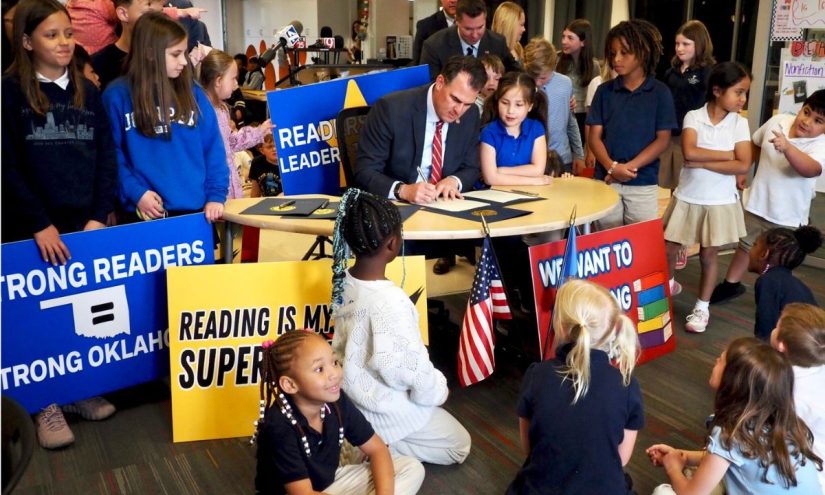
Gov. Kevin Stitt signed Senate Bill 1778 while surrounded by state leaders and students at John W. Rex Charter Elementary on Tuesday morning. Multiple children at the downtown Oklahoma City school asked for the governor’s pens as a souvenir.
The legislation implements stricter requirements, starting in the 2026-27 academic year, for public schools to intervene when students fall behind grade-level expectations in reading. Third graders who score below a basic level on state reading tests and fail a second state-approved literacy assessment would be held back from advancing to fourth grade, unless they meet limited criteria for an exemption.
“This is about early support, strong instruction and giving parents the information that they need to stay involved in their child’s progress,” Stitt said. “And it ensures that when a student is struggling, we act quickly before that gap becomes a lifelong challenge.”
About 27% of Oklahoma students scored at or above their grade level in English language arts last school year while 36% scored below basic, state test results show. Below basic is the lowest category and indicates a student is not on track to be college or career ready by the end of high school.
Legislative leaders said they hope to emulate Mississippi, a former bottom-dweller in education rankings before it dramatically raised student reading scores after years of investment and stricter policies. Mississippi similarly requires low-scoring students to repeat third grade, has an expanded network of reading coaches and specialists, and spends $15 million a year on literacy initiatives.
“We can do better because Mississippi has done it, which shows that other states can as well,” House Speaker Kyle Hilbert, R-Bristow, said during the ceremony while accompanied by two of his young daughters.
It could take five years for Oklahoma to rise in national rankings, Hilbert said, though he suggested the state could see “improvement pretty quickly.”
SB 1778 passed with overwhelming bipartisan support in the House and Senate.
It establishes three tiers of reading instruction and support starting in kindergarten.
Tier 1 represents the core reading lessons all students receive. Children who score below their grade level qualify for Tier 2 and 3 interventions, such as small-group lessons, extra tutoring, summer programs and transitional classrooms, which would involve separate reading classes for students who have fallen behind.
Families also could choose to have their children repeat first or second grade.
Schools will be required to notify parents or guardians within 30 days of a student showing a reading deficiency and must give monthly updates on the child’s progress through an improvement plan.
“The idea here is that third-grade retention is not the actual tool for learning,” Stitt’s education secretary, Dan Hamlin, said. “It’s a last resort after many other efforts have unfolded.”
The state, for the first time, will administer the annual third-grade reading exam to second graders to give students an early opportunity to pass and avoid retention the following year.
The new law lays out good-cause exemptions for students to continue to fourth grade despite poor reading results.
Students whose individualized education plan “indicates that participation in the statewide student assessment system is not appropriate” would qualify. Exemptions also would apply to children who have spent fewer than two years learning English as their non-native language.
Children who have been retained twice between kindergarten and third grade would be eligible for a good-cause exemption, as would students with disabilities who have repeated a grade once.
The state budget, which Stitt signed into law last week, adds more than $26 million to a fund that supports literacy instruction in public schools. The total $43.75 million Strong Readers Act Fund will dedicate 40% of its money to Tier 1 instruction across the state, 30% for students needing Tier 2 and 3 support, and 30% to reward districts that improve their reading scores.
The budget also adds $100 million to raise all teachers’ minimum salaries by $2,000.
Lawmakers dedicated $5 million to expand a team of literacy coaches at the Oklahoma State Department of Education. The team will grow from five to 20 literacy coaches, who assist educators in improving reading instruction and will prioritize low-performing schools.
State Superintendent Lindel Fields, who leads the Education Department, said the agency will begin hiring for the team immediately. His administration also will start preparing a new early literacy micro-credential program, called “teacher academies,” with Oklahoma colleges and universities.
SB 1778 requires all districts to employ a reading specialist, reading interventionist or staff member who has completed the micro-credential program, which will focus on the science of reading and best instructional practices. Any certified school employee who completes the micro-credential would receive a $3,000 stipend from the Education Department.
“The bill gets signed today, but the real work starts tomorrow morning,” Fields said.
Oklahoma Voice is part of States Newsroom, a nonprofit news network supported by grants and a coalition of donors as a 501c(3) public charity. Oklahoma Voice maintains editorial independence. Contact Editor Janelle Stecklein for questions: [email protected].
Did you use this article in your work?
We’d love to hear how The 74’s reporting is helping educators, researchers, and policymakers. Tell us how
