

Get stories like this delivered straight to your inbox. Sign up for The 74 Newsletter
This story is part of our SPOTLIGHT series focusing on the state of education in Oklahoma. Read more here.
A recent report from the University of Oklahoma documented the Sooner State’s “Fall to 48th” place on the National Assessment of Educational Progress. Its slide down the rankings from the middle of the pack in the 1990s to near the bottom today has been widespread, with declines in fourth and eighth grade in both reading and math.
What can the state do? One step might be to continue expanding its charter school sector, especially the brick-and-mortar schools serving predominantly Black and Hispanic students.
Oklahoma’s declining NAEP scores represent a sample of students across both traditional and charter schools, but Oklahoma has been fortunate to have a relatively successful charter sector. For example, using data through 2019, a Harvard report found that Oklahoma had the sixth-highest-performing charter sector in the country.
A new annual report from the Oklahoma Statewide Charter School Board allows for a deeper, more up-to-date analysis. The biggest takeaways focus on size, performance and cost.
The 74 examines everything from innovative approaches to teaching and learning to the headwinds teachers, students and families are facing across the state.
Both brick-and-mortar and virtual charters have grown in Oklahoma, collectively increasing from about 51,000 students in the 2022-23 school year to 55,000 last year. In the 2024-25 school year, 35,831 students attended a virtual charter and 19,190 were enrolled in brick-and-mortar charter schools. All told, charters serve about 8% of all public school students in the state.
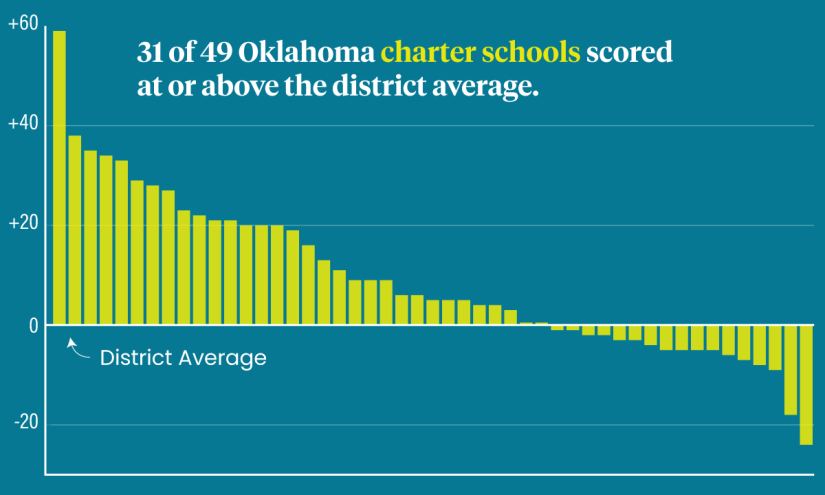
A comparison of student performance found 31 of 49 brick-and-mortar charter schools outperformed their neighboring traditional schools last year. For example, students at Stanley Hupfield Academy and John W. Rex Charter Elementary School outperformed the Oklahoma City average by 21 and 20 percentage points, respectively. The Dove and Santa Fe charter networks each had several standout schools, including Dove Science Academy, where students outscored nearby traditional schools by 34 points and which we named a Bright Spot for its third grade reading proficiency. The largest outperformance was notched by a standalone charter called Deborah Brown elementary school in Tulsa, where students scored 59 points higher than peers in the neighboring district.
As for virtual charters, the analysis found that only one — the Oklahoma Connection Academy High School — outperformed the statewide average, while 15 did not.
The Oklahoma Statewide Charter School Board’s 2025 Annual Report of Oklahoma Charter Schools
Note: Brick-and-mortar charter schools are compared to the traditional public schools in their physical districts. Virtual charters are compared to all traditional schools in the state.
A new report from Adam Tyner at the University of Oklahoma made similar comparisons for high schools. At that level, students attending brick-and-mortar charters had slightly lower ACT scores than peers attending traditional public schools, but they had higher graduation rates — especially the low-income students. Meanwhile, the virtual charters had significantly worse outcomes.
Notably, Oklahoma’s charters are getting these results with significantly less money. According to the state charter board, traditional public schools received $10,643 per student in state and local funding last year, compared with $9,684 for brick-and-mortar charters. This disparity of almost $1,000 per student has widened over time and is largely due to the fact that charters do not have the same access to money for facilities and do not receive the same share of local revenues that traditional district schools do.
Closing this funding disparity would likely boost outcomes for charter students even further.
While it is impossible to know for sure whether Oklahoma’s charter schools are getting their results by cherry-picking the best students, or even whether the rise of charters may have contributed to stagnation on the part of traditional public schools, the national evidence suggests that’s not the case. If anything, traditional schools tend to get higher scores when they face increased competition in the form of charter schools.
For instance, Tulane University researchers Feng Chen and Doug Harris found that the effects from this type of competition tend to materialize when charter schools surpass a 10% market share in a given district. The new charter report found that Oklahoma now has six communities where charters have surpassed this threshold, led by Oklahoma City at 23%.
When I spoke with Rebecca Wilkinson and Shelly Hickman from the Oklahoma Charter Schools Board, they said they wanted to create an annual report that was comparative and meaningful, and to dispel myths about what charters are and are not. They are optimistic about increasing market share in more communities, and they hope that success can generate even more momentum across the state.
Did you use this article in your work?
We’d love to hear how The 74’s reporting is helping educators, researchers, and policymakers. Tell us how
