

Get stories like this delivered straight to your inbox. Sign up for The 74 Newsletter
“We want to be good readers. We want to understand, not just get a good score on a test.”
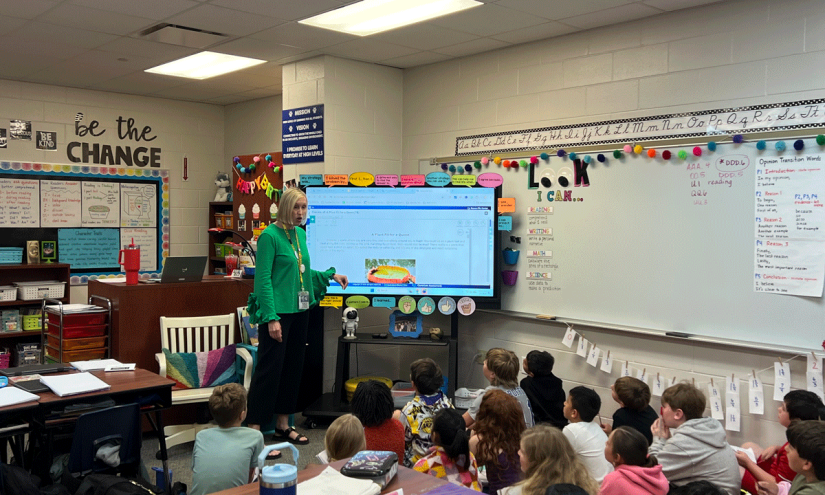
Anna Gawf scans her third graders, sitting cross legged on purple carpet at Hunt Elementary School in Springdale, Arkansas, to see if the concept sinks in. It’s a Tuesday in early April, and Gawf is prepping the class in reading comprehension for a state exam just a few weeks away.
While it’s a motto all four Hunt Elementary third grade teachers follow, they have achieved some high scores themselves. Hunt’s third grade teaching team has some of the highest educator growth scores in the state, a measure of how well their students meet or exceed academic growth benchmarks in all subjects.
Principal Michelle Doshier credits that success to the strategies the team created together. Three of the team members — Gawf, Jami Cheshier and Robyn Hubbard — have been with the school since Doshier helped open it 21 years ago. They came together as a third grade team five years ago, after teaching other grades. Teacher Lindsay Dees joined the team two years ago after working with adults in the district’s family literacy program.
“One of the things that is so great about them is [the fact that] Anna’s taught second grade and third grade, so she knows those grades really, really well. Robyn Hubbard has taught fifth, fourth, third and second, so [she] knows where they are and where they need to go,” Doshier said. “Jamie has taught kindergarten, first, second and now third — she takes a lot of the low-performing kids because she knows that foundation. And Lindsay brings lots of new, fresh ideas.”
The four teachers’ classrooms are located in a circle in a third-grade wing of Hunt Elementary. Students don’t stay in one classroom for the entire year, or even for the entire day. Instead, the four educators share students depending on their skill level. Children in Cheshier’s classroom might move to Gawf’s for reading instruction because they are more proficient than their classmates.
Doshier said this practice is used in all grade levels. Some students will spend a part of their day in a lower or higher grade if that’s where they’re at in a certain subject.
“We used to, I think, have the mindset of, ‘These are my little kiddos, or my 25 kids,’ and now it’s, ‘They’re all ours,’ ” Gawf said. “We want to see them all grow. For the bulk of the time, we do have our kids in our own classroom, but we do rotate so much. It’s nice to see other kids from other rooms and just know that you’re supporting your partner teacher.”
Arkansas Will Soon Hold Back Kids Who Can’t Read. But That Alone Is Not Enough
The third grade team meets regularly to review academic data and discuss which reading skills students need improvement on, such as understanding the main idea or articulating certain word sounds. Then, they decide which classroom the students belong in and whether they need higher-level reading instruction or interventions.
“I think we’ve done the best job ever this year of them really being all of our [students],” Hubbard said. “I’m noticing things like kids in my room have real relationships with [the other teachers]. They will say, ‘Hey, I drew this for Miss Gawf, can I go take it to her?’ Or they are making sure they say hi to Miss Dee every morning or telling me something Miss Cheshier said to them — they don’t just go to their classes. They really have relationships with all three of them.”
Administrators from other schools in the Springdale district, which serves nearly 22,000 students in northwest Arkansas, visit Hunt Elementary to observe strategies like those used in third grade.
“It’s been a journey to get to this point,” Cheshier said. “Don’t think we don’t have really hard days.”
Jami Cheshier is a third grade teacher at Hunt Elementary School in Springdale, Arkansas. (Lauren Wagner)
Teaching looks a lot different at Hunt Elementary now than it did when the school first opened, they said. Over the years, the percentage of English learners increased from roughly 5% to 35%, and more immigrant students are enrolling in third, fourth or fifth grade without many reading skills. In the last decade, the school’s poverty level increased from 39% in 2015 to 60% in 2025.
“My first year that Hunt was open, I taught third grade,” Hubbard said. “Back in those days, it was all about comprehension. And I never had taught a child how to read from the beginning until our population changed as drastically as it did. When I came back to third grade, I was now having to teach third graders how to read.”
Like teachers across the country, the third grade team has also dealt with a rise in student needs and behaviors since the pandemic. All four teachers recounted how last year’s class — which entered kindergarten during COVID — needed more support than any other group of students they’ve had in recent years. The children lacked social skills and required more discipline.
“In families, everyone was stressed out about their own jobs, and the students missed out on a chunk of learning during COVID,” Dees said. “They didn’t learn the right skills.”
Lindsay Dees delivers a reading comprehension lesson to third graders at Hunt Elementary School in Springdale, Arkansas. (Lauren Wagner)
Doshier said children who were in third grade in 2024-25 also needed more academic support than normal, and they had the lowest reading proficiency rates in Hunt Elementary’s history, at 37%. Third grade reading proficiency was at 57% the year before.
Doshier said the team is working hard to build the current class’ reading proficiency so the rate can go back up.
The teachers’ work can also be seen through their average growth score that’s measured by the state. A score higher than 80 means that teacher’s students are growing academically, on average, more than expected. Anything below 80 means the kids are progressing more slowly than they should.
Robyn Hubbard reviews reading comprehension on a digital whiteboard with her Hunt Elementary third grade students in Springdale, Arkansas. (Lauren Wagner)
Gawf, Hubbard and Cheshier have a three-year growth score average of 90 points or higher, according to school data. A quarter of Arkansas teachers have a three-year average greater than 82 points. Dees doesn’t have a three-year average score because she’s been at Hunt Elementary for only two years.
4,200 Arkansas Teachers Will Get Up to $10K for High Performance, Student Scores
Arkansas lawmakers approved the Merit Teacher Incentive Fund Program in 2023 to reward high-performing educators. Teachers who have a three-year growth score average above 80 can earn up to $10,000 in annual bonuses.
“I was recently talking to a friend who’s from another school in Springdale, and she said, ‘Are you still at Hunt? Do you still love it?’ Yes and yes,” Hubbard said. “She said that Hunt is known around the district as being a well-oiled machine. That comes from the top. Our administrators are amazing, and all the teachers want to work for them, and we want to do our best for them, because they give us so much grace and so much freedom. It creates a really awesome culture.”
Did you use this article in your work?
We’d love to hear how The 74’s reporting is helping educators, researchers, and policymakers. Tell us how
