

Get stories like this delivered straight to your inbox. Sign up for The 74 Newsletter
This story is part of our SPOTLIGHT series focusing on the state of education in Oklahoma. Read more here.
Tulsa, Oklahoma, STEM teacher Jacqueline Lanning had long had her eye on the Dove Schools. The public charter network incorporated science, technology, engineering and math in every grade, and its students received a well-rounded education inside and outside the classroom. Teaching there, she said, was a top goal.
She got her opportunity four years ago, when a K-8 art teacher position opened up at Dove School of Discovery, at the same time her daughter was preparing to enroll at a school in the network.
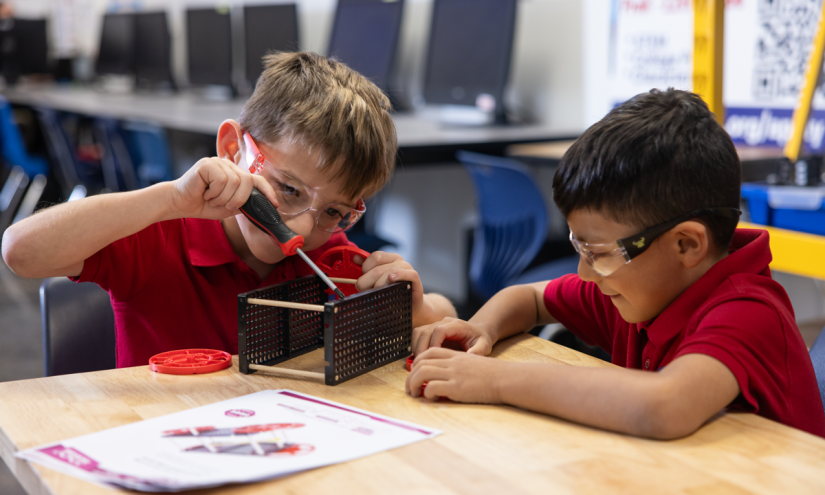
Lanning was thrilled that her new curriculum would combine art with STEM. Soon, she was helping students build cars, use a power drill and solder metal.
“I don’t allow the students second grade and under to use the dangerous stuff by themselves, but for third grade and up, once they’ve had safety lessons, they’re able to use those types of things — there is no limit to what they have access to,” Lanning said. “A lot of them are scared, but I walk them through it. I’ve literally held hands. Once they get that experience of trying it, they’re like, ‘Oh, I kind of like this.’ ”
STEM education is one of the foundations of Dove Schools, a public charter school network with nine campuses in Tulsa and Oklahoma City, plus a statewide virtual program. Educators there credit the presence of STEM in every grade — from computer science in kindergarten to high school career pathways — to the schools’ 100% graduation and college acceptance rates, and other measures of academic success.
“The [students] have grown up with the Dove Schools culture, and in elementary and middle school they already know what the meaning of college is and the importance of college,” said Ibrahim Eskikurt, Dove’s STEM coordinator. “From ninth grade until 12th grade, students already know they have to do something — go to college and graduate — and then they will have more opportunities.”
The first Dove School was founded in 2000 in Tulsa by Oklahoma State University graduates. Since then, the network has grown from roughly 200 students to more than 4,700.
The 74 examines everything from innovative approaches to teaching and learning to the headwinds teachers, students and families are facing across the state.
Last year, 157 Dove seniors each had an average of four college acceptances. Nearly 88% of them were the first in their family to attend college. The average scholarships each received topped $95,000.
Maureen Brown, Dove’s chief outreach and development officer, said she doesn’t know what the district’s “secret sauce” is, but a few main factors contribute to student success. Besides STEM programming and college preparation that begins in kindergarten, Dove Schools offers character education, a curriculum that teaches skills like critical thinking, kindness and morality. The district also arranges home visits to keep educators and families connected.
“Every teacher and school administrator, at the beginning of the year, wants families to see that the school is there to partner with them, so they make an appointment to go visit families at their homes,” Brown said. “The home visit is not to go check on their house and see their living circumstances — it’s providing information and resources they have at school. It’s really about building a relationship, and that’s been a really, really big deal for us.”
About 80% of Dove Schools students are low-income. Because the charter is tuition-free, a lottery system decides which students are accepted if there are more applications than open spots.
“Anybody can apply as long as they live in city limits,” Brown said. “If they want to come to Dove Schools, and if there’s a spot available for them, they come in.”
Sixth graders at Dove Science Academy Middle School work on coding for a robotics competition. (Dove Science Academy)
Students who enter Dove Schools as kindergartners will be immersed in STEM through computer science activities on their Chromebooks. In the higher elementary grades, they learn how to code. Middle schoolers explore hands-on STEM projects in robotics or electronics.
If students want to continue their STEM education in high school, they can enter a pathway to learn computer science, engineering or biomedical science. These also award college credits and offer specific career-focused courses.
After school, the network offers multiple STEM-based extracurricular clubs. The five-year-old drone program is particularly popular.
It began with one small team of students building and flying drones in local and national competitions. Now, Dove Schools has about 25 drone teams from fourth to 12th grade. Each group has roughly three students.
Members of a drone team at Dove Science Academy High School fine-tune the setup of their new drone. (Dove Science Academy)
Eskikurt said students can’t earn drone aviation licenses from the Federal Aviation Administration through the program, but that’s something administrators are working to offer in the future. The district also plans to add a high school pathway in aerospace engineering next year, as it’s one of the fastest-growing industries in Oklahoma.
While the drone club teaches students to build machines that fly the sky, another program is focused on those that operate underwater. Lanning is one of several teachers who manages the Dove Schools SeaPerch club, part of an international program in which students build aquatic robots that can be entered in competitions against other schools.
“We give them the materials, they do all the work, and we just guide them along as they do the engineering design and the science concepts,” Lanning said. “They have to go through an obstacle course, a mission course and an interview stage.”
Lanning’s program for third through fifth graders used to run for just a semester, but this year she extended the afterschool club to last the entire year. Roughly five students meet for 40 minutes once a week to build their robots. She said her goal for next year is to get 10 students involved at her school.
The favorite part of Lanning’s day, she said, is watching her elementary students discover STEM for the first time.
“They see what they can do, because I give them an idea, and the goal is to let them take that idea in any direction they want to,” she said. “Once you give them the materials and guidelines, they take off with it and they have no limits to their imagination.”
Did you use this article in your work?
We’d love to hear how The 74’s reporting is helping educators, researchers, and policymakers. Tell us how
