

Traveling with students is awesome. But when we’re intentional, we can travel AND connect with what we teach in the classroom every day. Oh, there are so many quotes about how amazing travel is, but I’ve included a few. Travel, if you can help make it happen, is one of those things that can change student lives.
I’ve taken students to Dubai (twice), Doha, Mumbai, Beijing, and Honolulu (oh yes, and Atlanta, Georgia several times) Every trip I’ve taken, I’ve learned more about traveling with students but have always received a lot of positive feedback from students and their parents. It is great to align your trip with Science, Technology, Engineering, Math and also Career and Technical Education, but it is one of those things that you’ll need some help.
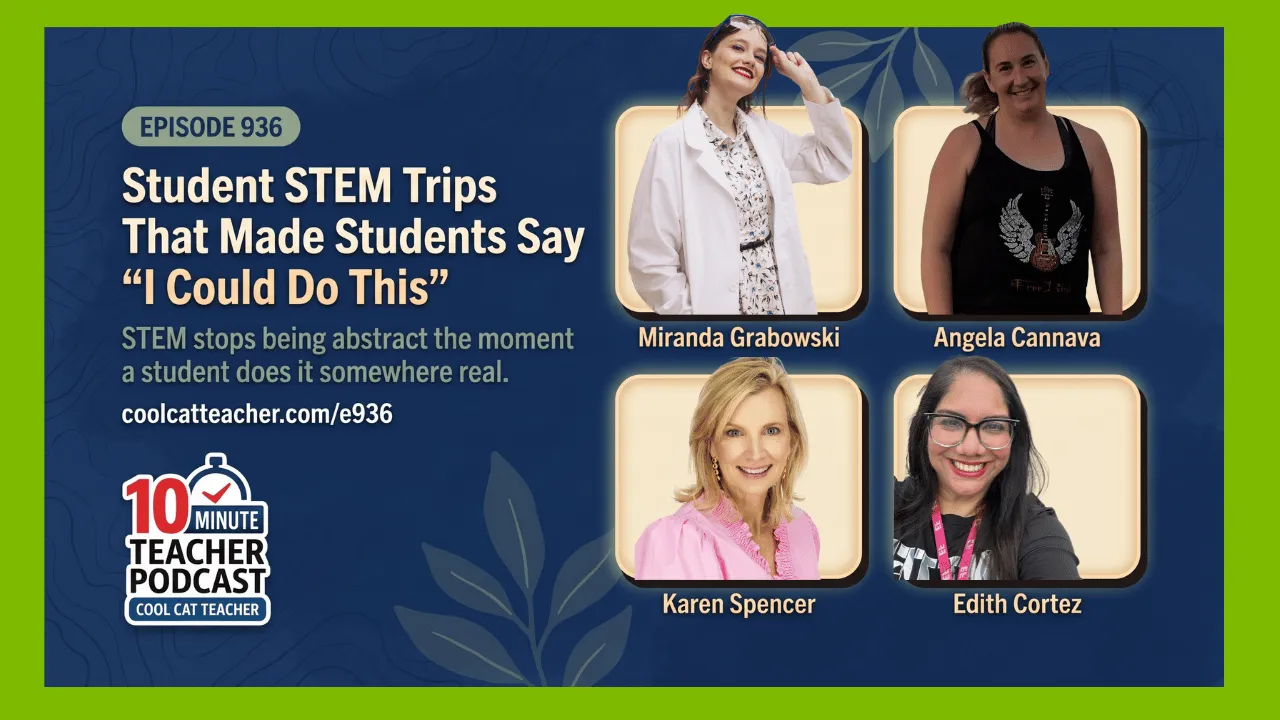
In today’s episode with Miranda Grabowski, Angela Cannava, Karen Spencer, and Edith Cortez, you’ll hear about students from middle and high school who took trips and how it helped change their world in marvelous ways. If you want to hear the extended episode where we talk about both STEM and CTE and tips for traveling with students, check out Traveling With Students: Five Teachers Who Took the Leap.
There are so many stories. But there are many common endings to the trips. You’ll hear how students “grow up” and “change” and are just different, as parents say. I would say that traveling with students is a good “bucket list” item for teachers. Some of my greatest memories of teaching happened across the ocean from the US. It is something worth checking out, for sure!
Miranda Grabowski is a biology teacher and instructional coach at Austin High School in Austin, Texas. In eight years in education, she has led eleven international trips with students — including Panama, Thailand, Italy, San Francisco, and Boston — with a focus on aligning educational travel to classroom curriculum. Her Panama trip took forty 11th graders to work with local NGOs on wetland conservation, planting mangroves to help protect Panama’s natural environment.
Angela Cannava is a CTE Biomedical Sciences teacher at Northfield High School in Denver, Colorado, where she established the school’s Health Sciences Pathway and serves as advisor for HOSA Future Health Professionals. She has been teaching for nineteen years. She holds a B.S. in Integrated Physiology from the University of Colorado, Boulder and has led student trips to Great Britain and Belize. Her UK Health Sciences trip included a live forensics workshop where students did real DNA fingerprinting — the same techniques working scientists use.
Karen Spencer is the principal of Parkview Baptist School in Baton Rouge, Louisiana. She has been taking her seventh-grade students to Boston on an annual STEM and culture trip that includes MIT, Harvard, MASS Robotics, and a FIRST Robotics regional competition. Her philosophy: students cannot want a future they have never seen — so she takes them to see it.
Edith Cortez is an eighth-grade social studies teacher at United South Middle School in Laredo, Texas. She helps her students fundraise for travel so that every student who wants to go can go. Her Washington DC STEM trip is built on hands-on science museums and interactive scenarios designed to show students from a community where international travel is rare that the world is waiting for them.
If this episode made you think, share it with a teacher friend.
This transcript was generated using AI and has been reviewed by humans for accuracy. Minor errors or artifacts may remain but I worked my best to find any issues with the transcript as I reviewed the show. – Vicki
Click to read the full transcript
Miranda Grabowski (00:04): I get to sit back and watch my students learn how science happens in the real world.
They’re actually doing the science on their own, not just sitting back and letting someone talk.
Angela Cannava (00:15): Ms. Cannava, everything you taught me is actually what they do in the real lab. This is so cool.
Vicki Davis (00:21): Today’s show is sponsored by EF Explore America and the STEM Tours. To show your students how STEM impacts the world up close and in action, go to efexploreamerica.com/STEM. And stay tuned at the end of the show to learn more.
Vicki Davis (00:41): Welcome to the 10 Minute Teacher Podcast. I’m Vicki Davis, the Cool Cat Teacher. And today we’re talking about something that changes students forever — teaching STEM when you travel with your students. Here’s what I’ve learned after more than two decades in the classroom: STEM stops being abstract the moment a student does real science in a real place.
A biology class in Panama plants mangroves. A biomed class in the UK runs a live DNA fingerprinting lab. A middle schooler walks the MIT campus. Today you’ll meet four teachers who did exactly that. Let’s go.
Miranda Grabowski (01:18): Recently I got back from our Panama trip. Forty of our 11th graders — our students — were in Panama to help conserve their wetlands.
I get to sit back and watch my students learn in real time how science happens in the real world.
They’re actually doing the science on their own, not just sitting back and letting someone talk to them. Out there in the boots, picking up the mangroves, getting on a boat, getting sunburned, going to plant these mangroves to help conserve that natural environment of the country. It’s great to see the students not just pretend to like the thing, but actually do the thing.
Which is one reason I love traveling with kids — is to see them actually get their hands into whatever it is, whether it’s mangroves or paint restoration or whatever the activity is focused on that day. That’s why I like traveling — is to see the kids actually experience things as opposed to just read about them.
Vicki Davis (02:14): Miranda Grabowski in Panama. But what happens when a high school CTE biomed teacher takes her class across the ocean and her students suddenly realize the experiment they’re doing is the exact same one working scientists do for a living? Angela Cannava, Denver, Colorado.
Angela Cannava (02:33): I remember one student that necessarily wasn’t the most excited to be in class sometimes — I just remember him coming up to me after doing the whole forensics workshop and saying, “Ms. Cannava, everything you taught me is actually what they do in the real lab. This is so cool.”
We did everything from health science related things — anatomical museums and seeing anatomical artifacts that were collected from years ago, a lot of the old paintings that were done of anatomy, some of the first anatomical paintings that were done. We had to go see all of those. That hooked really nicely also into the anatomy class that I teach, because I also teach an anatomy class. Lots of classroom connections with what we were actually doing and seeing. But then you also have all the really fun stuff beyond the learning part of the EF Tours. We went on the London Eye and it was like sunset and beautiful. And I have this picture of these students just looking out across the skyline — all smiles — and I’ve never seen such happy kids in my life. It was a really good mix of getting to see really good sites plus the learning.
A key for any teacher wanting to take students on a trip is just — number one — knowing that you can definitely do it. If you build strong relationships with students, they will want to travel with you.
Vicki Davis (03:57): DNA in the UK. Next stop, Boston, where a principal took seventh graders to MIT, Harvard, and the FIRST Robotics regionals — because you can’t want the future if you’ve never seen it. Karen Spencer, Parkview Baptist, Baton Rouge.
Karen Spencer (04:13): We went to MIT and Harvard — got a glimpse at Harvard, an Ivy League, more liberal arts school, and then MIT, a more STEM school — to show them options. But it starts now, building that résumé and getting your scores up, your transcripts ready, so that you have options when you get there.
We did a tour of Fenway Park, went to MASS Robotics, and just got to experiment there. And we, of course, turned it into a competition and they were all in. Did you know that Boston has a Museum of Ice Cream? We found that one on this trip and it was so fun. We did the Fine Arts Museum, the Museum of Science, we did Lexington and Concord, the Boston Tea Party, the USS Constitution. We did the Freedom Trail. We walked up Beacon Hill. You name it — I think we did it. I have to tell you, Boston this time of year was stunningly beautiful with all the trees in bloom and the tulips and the daffodils.
Vicki Davis (05:11): Yes. And we’re recording this in April 2026. If you’re saying, “Hey, I want to go when it looks like that” — so you’ve been using EF Tours for a while. Why do you keep coming back to them?
Karen Spencer (05:21): Well, they have proven time and time again that they’re willing to listen. They’re willing to help me. I will tell you — on this last trip, the Museum of Ice Cream was an absolute spur-of-the-moment thing. One of the parents mentioned it in passing at lunch. And I said, “Wait, what?” I looked at my tour guide and said, “We have to make this happen.” And he was like, “Let me see if we can squeeze it in.” He and I start looking at our schedule — how can we squeeze it in? I call EF. I said, “How can we make this work?” And they were like, “We’re on it.” They jumped on it with us and it was amazing. Three hours later we were there.
And that’s one of the reasons I like EF so much — they want to work with me. They want to make it a great experience. And I trust them. They’ve been in business a long time. They send security guards to help at night, that sort of thing. It just gives me a peace of mind.
Vicki Davis (06:15): We’ve been talking with Karen Spencer, principal at Parkview Baptist School from Baton Rouge, Louisiana.
Vicki Davis (06:21): Ivy League in seventh grade plants the seed. But what happens when a social studies teacher takes eighth graders to hands-on science museums in Washington, DC? Edith Cortez, Laredo.
Edith Cortez (06:34): Everyone thinks Washington — monuments and memorials. But the museums that we went to were hands-on and my kids loved it. The museums — they are so competitive. They had so many scenarios to gravitate from and moving around in every single one. And then they had to beat each other through the activities to get to the end game.
We went to several different museums that we were able to visit during our Washington STEM trip and that was very interesting for us.
Four boys that traveled with me were my students that year. And they were so excited to travel — “we’re gonna do this and we’re gonna do that.” And I kept saying, “It’s a STEM trip. It’s a STEM trip, we’re gonna do this.” And they all loved the idea of it, but they didn’t understand or internalize what it really meant.
Once they got there, they were like, “Hey, Miss Cortez — yo, this is really cool. I didn’t think we were gonna get to do all these things.” I’m like, “What did you think it meant?” They’re like, “I don’t know — we had no idea we were going to actually build on things or try to navigate through all of these activities or scenarios.”
There was one that showed about terminology and then they gave them scenarios and they had to build on a story. And my boys were so extravagantly engaged with it that they just ran with it. So many details, they added so much to it. They had the crowd going. I have a massive group thread with all the parents and I’m sending them pictures of everything. The parents are like, “My — we should have signed on to this trip.”
But it’s not easy. Hardships happen and life happens. Sometimes they don’t have that opportunity, and I totally understand — because my parents would have never, probably, been able. I always tell my students: if and when you have the opportunity in life, take advantage of it. Because there’s a whole world outside of Laredo, Texas.
Vicki Davis (08:07): Yeah.
Edith Cortez (08:25): We need to take advantage of seeing—
Vicki Davis (08:28): Four teachers. Four different subjects. One shared truth: once a kid has done it, they start asking, “Could I do this for a living?” That’s the magic. And that’s why EF Tours, our sponsor, exists — to help teachers like you and me take STEM off the page and into the world. This is Vicki Davis.
Vicki Davis (08:48): If you’re a STEM teacher like me, you want your students to see how STEM impacts the real world — not just read about it. On an EF Explore America STEM tour, they might code robots with MASS Robotics at MIT, explore marine ecosystems in Florida’s coral reefs, or even sit down with a former spy in Washington DC to discover how STEM thinking shows up where you least expect it. Every itinerary is designed by experts to amplify what you teach through hands-on experiences that can’t be replicated in the classroom. Visit efexploreamerica.com/STEM and see what an EF Explore America STEM tour can do for your students. Some of the greatest things I’ve ever done with my students have been tours. They make it all easy for you. So again, check out efexploreamerica.com/STEM.
Disclosure of Material Connection: This is a sponsored episode and blog post. EF Explore America has compensated me to share information about their STEM Tours. However, all opinions expressed are my own. I have personally reviewed these resources and only recommend tools I believe offer genuine value to classroom teachers. My endorsement is limited to the educational products and services discussed in this episode. I am disclosing this in accordance with the Federal Trade Commission’s 16 CFR, Part 255: “Guides Concerning the Use of Endorsements and Testimonials in Advertising.” The sponsor has no impact on the editorial content of this show.
