

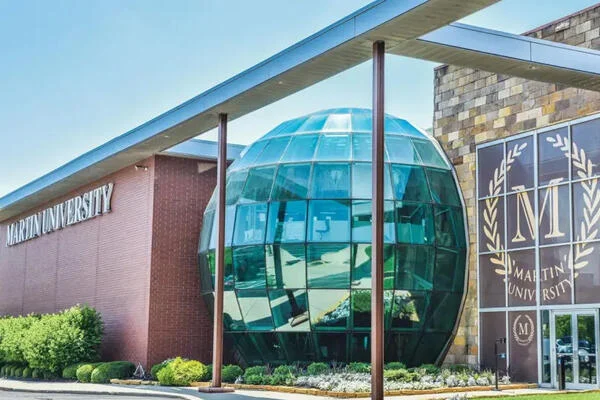
Martin University closed abruptly late last year.
Martin Communications Department
Former students and staff are suing Martin University for breach of contract and other damages after Indiana’s only predominantly Black institution closed abruptly at the end of last year.
Students in the lawsuit accused the defendants—Martin’s president and Board of Trustees—of undercutting their education, leaving some unable to earn degrees despite completing their programs. Plaintiffs argue that the sudden closure resulted in “diminished educational outcomes, diminished status of educational credentials, financial loss, loss of opportunity for advanced degrees, loss of employment opportunities and loss of the benefit of financial investments.” They also allege Martin failed to provide “promised educational training and services.”
Martin had been struggling for years when it closed its doors in late 2025. The university’s head count, which hovered just under 1,000 in the early 2010s, declined to between 200 and 300 in recent years, dropping to 198 students in fall 2024, according to the latest federal data. When the private institution announced plans to close, trustees claimed “teach-out agreements and transition plans are being established, and individualized support has been provided so that students can complete their degrees elsewhere.”
But such plans never materialized.
In the lawsuit filed last week in Marion Superior Court, the plaintiffs—four former students, a former staff member and the Martin University Alumni Association—asked the court to halt the planned sale of Martin’s Indianapolis campus “pending further investigation and hearing.” (Martin’s campus is currently on the market for $3.5 million.)
Plaintiffs alleged that the closure caused them significant financial harm.
Kevin Getter, a former student, alleged in an affidavit that he had completed all required courses and credits to graduate with a master’s degree but never received it due to the sudden closure. He said he’d been accepted into a doctorate program at Walden University, but when he applied for financial aid he was told that Martin was “actively attempting to collect from my financial aid account for the present semester,” meaning his financial aid account was still listed as active there. Those issues ultimately forced him to withdraw from Walden.
“I am presently not enrolled in any college and unable to pursue financial aid based upon my open financial aid account and the paused operations at Martin University,” Getter stated in court filings. “I have suffered damage to my educational status, financial standing, a loss of college degree/diploma mental anguish and possible loss of an accredited education.”
Another student, Linda Gude, alleged that she had completed all her coursework and was working on her thesis when Martin first announced it was “pausing operations.” Now, following the closure, Gude stated in court filings that she has “no idea” how to finish her program and that she has “received no communications from Martin University regarding the completion of my degree.”
Other students made similar claims, while a former staff member, Evelyn Blunt, alleged that she missed paychecks amid the closure and has suffered both emotional and financial duress.
The alumni association noted that “the Board of Trustees failed to implement or communicate a formal teach-out plan,” leaving many students scrambling without clear guidance from the university as they sought to complete their programs or continue their education elsewhere.
Martin did not respond to requests for comment from Inside Higher Ed.
Though at least 15 nonprofit institutions announced closures last year, most gave students an off-ramp, providing several months’ notice or more. Martin, however, was one of a few institutions whose sudden shutdown left students in the lurch. Others include Saint Andrews University in North Carolina and Limestone University in South Carolina, though both offered transfer opportunities to partner institutions to help remaining students finish their degrees; Martin did not.
