

For some families, a parent’s workplace exists at a distance—a building you pass, a place you hear about, but rarely know.
For the Errington family, it was something else entirely.
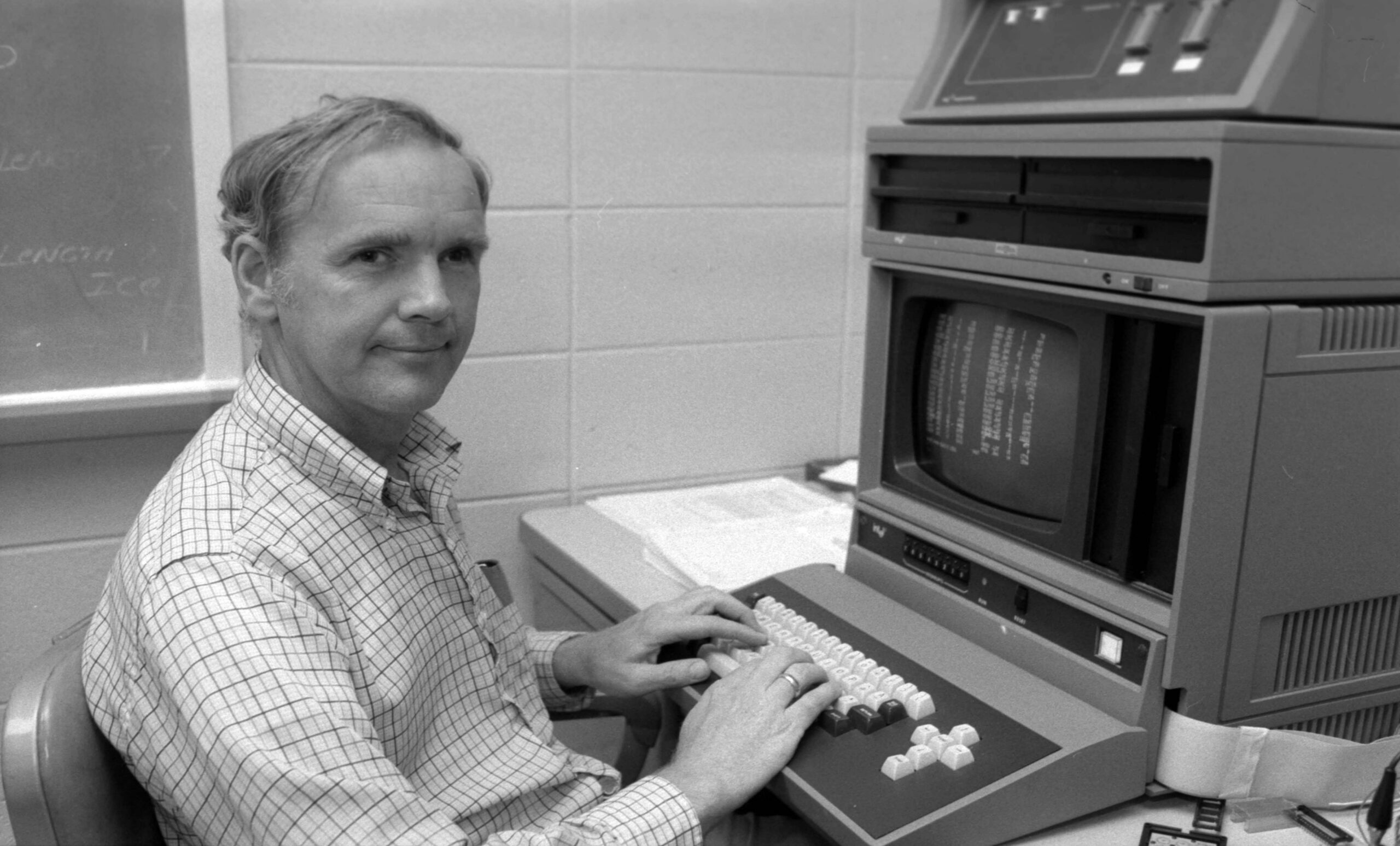
At Ball State University, Dr. Paul R. Errington’s work was never confined neatly to office hours or classroom walls. His daughters spent time in the spaces where he taught and tinkered. At home, there was a garage workshop filled with tools, machines, and half-finished ideas. On campus, there was the lab.
The settings were different. The instinct was the same.
“He loved to make things, to take things apart, put them back together,” said his wife, Sue Errington. “Being in the lab was like being in his dad’s workshop in some ways.”
That instinct—to build, to understand, and to help others do the same—defined both his life and his teaching. It is also what makes the newly dedicated Dr. Paul R. Errington Electronics Laboratory feel less like a symbolic gesture and more like a continuation of the work he began decades ago.
A Place That Became Home
When Dr. Errington arrived at Ball State in 1970, he did not expect to stay.
He had grown up in a coal-mining town in West Virginia, earned degrees in electrical engineering and physics, taught at Bethany College, and spent time abroad on a Fulbright lectureship in Peru.
Ball State, at first, was a temporary stop—an opportunity that filled a gap in a difficult academic job market. By the early 1970s, the rapid expansion of science and engineering tied to the space race had begun to slow, and positions for physicists had become increasingly scarce.
“I figured Ball State would be a great central location and that I would be here a year or two,” he said in a 2004 Ball State Oral History interview.
But something shifted.
“The people in the department, for one thing,” he said. “It was a very congenial department.”
Sue Errington heard that answer often. “He said, ‘My colleagues, the people I work with,’” the longtime state representative recalled in a recent interview. “And of course the students—he really enjoyed the students. Teaching was his favorite thing. He enjoyed working with people and working with students more than with ideas.”
What began as a short-term stop became a 34-year career. But to understand why, it helps to go back a little further.
Before Ball State, there was Bethany College in West Virginia, where Paul Errington met Sue. Both were faculty members there, part of a close-knit academic community, and their relationship grew alongside a shared commitment to teaching. After they married, their careers and lives would remain closely intertwined.
“We got engaged, and the president of the college had a party for us,” Sue recalled in a 2020 Ball State Oral History interview. “He said it was the first faculty-faculty marriage he could remember.”
Their path took them from West Virginia to South America— where Dr. Errington held his Fulbright lectureship—and eventually to Muncie, where they expected to stay only a few years.
They stayed for decades.
The Kind of Professor Students Remember
Some professors are remembered for research. Others for titles or administrative roles.
Dr. Paul Errington is remembered for something simpler—and harder to replicate.
At the start of each semester, Sue said, he would memorize the name of every student in every class before the first day. Then he would walk into the room and call roll from memory. Some classes had 40 or 50 students.
“I think that had to make those students feel like, ‘Here’s somebody who went to that effort to know who they were,’” she said. “That here was somebody that was going to take a real interest in them learning about physics.”
His own words aligned with that approach. “My emphasis has always been more on teaching,” Dr. Errington said. “I like that more than a research atmosphere.”
Even as he contributed to faculty governance through his service in University Senate, his focus remained clear: students came first. That commitment was on full display at the lab dedication ceremony in April.
President Geoffrey S. Mearns described Dr. Errington as “a Ball State educator who, for many years, empowered our students to pursue their passion for physics and for problem solving.” Drawing on an Albert Einstein quote, President Mearns said Dr. Errington proved himself to be “a man of value”—a professor who shared his knowledge generously, mentored students, and strengthened the department around him.
Curiosity, Made Practical
Dr. Errington’s curiosity did not stay theoretical. It became something tangible, often improving people’s lives in direct ways.
In the early 1980s, he developed an electronic speech synthesizer designed to help people with disabilities communicate. The device allowed users to generate words and phrases through a numerical system, giving voice to individuals who otherwise struggled to speak. Originally created as part of a class assignment, it evolved into a working tool used by students in Muncie and beyond— a way of turning complex ideas into something practical and usable.
Outside the classroom, that same curiosity took many forms. He played guitar and trumpet. He ran marathons. He volunteered in the community.
In his garage, he built and rebuilt machines—at one point constructing a replica of a 1929 Mercedes Benz Gazelle piece by piece. He designed and constructed projects simply to understand how they worked.
He also climbed.
With a group of Ball State colleagues, he set out to summit the high point in as many U.S. states as possible—a pursuit that took them to peaks across the country, including Mount Rainier and Mount Whitney. He also climbed beyond U.S. borders, reaching the summit of Mount Kilimanjaro in Tanzania. On many of those climbs, he carried a Ball State flag to the top.
A Legacy Still at Work
The laboratory that now bears Dr. Errington’s name sits inside the renovated Cooper Science Building, serving as a primary instructional space for electronics courses and a hub for student research. The lab’s significance extends beyond what happens inside it.
“Ball State dedicated the Dr. Paul R. Errington Electronics Lab because it reflects both Dr. Errington’s legacy and our University’s future,” said Dr. Maureen McCarthy, dean of the College of Sciences and Humanities. “Dr. Errington was a deeply respected teacher-scholar who devoted his career to helping students pursue their passion for physics and problem solving, and this lab will continue that work by giving today’s students a modern space for hands-on learning, discovery, and research.”
For Sue Errington, that connection became tangible during the ceremony itself. A faculty member pointed out several pieces of equipment still in use— equipment her husband had built years earlier.
The lab carries his name, and his influence is still visible in the way it’s used.
“There were like seven or eight of them around the lab. And they’re still using them. Students are still using them,” she repeated, almost incredulously.
Dr. Errington retired in 2004 after more than three decades at Ball State. He passed away in 2016 at the age of 79. What remains is a way of thinking about teaching—patient, personal, hands-on, and grounded in curiosity.
For Sue Errington, the hope is that the laboratory will do more than support students’ work. She hopes it will prompt them to ask a simple question.
“I hope that students will be as curious about things as Paul was,” she said. “And when they see his name on that plaque, they’ll wonder, ‘Who is that?’ And find out a little more about him as they go about the experiments in the lab.”
