

Get stories like this delivered straight to your inbox. Sign up for The 74 Newsletter
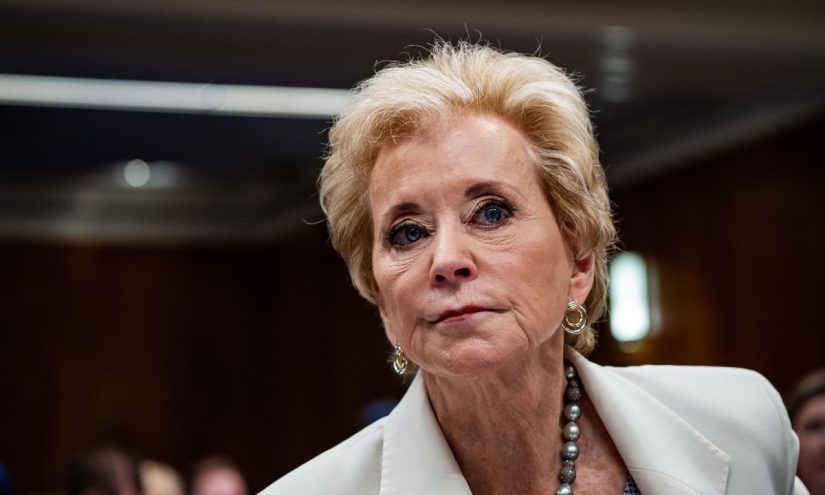
Late last month, Education Secretary Linda McMahon celebrated what she called the Trump administration’s “unprecedented progress in reducing the federal education footprint” and “giving education back to the states” as she announced that the U.S. Department of Education would be moving out of its headquarters at the Lyndon B. Johnson building in Washington.
Ironically, the announcement comes as the administration is aggressively inserting itself in state and local education decision-making through a little-known administrative process.
A General Services Administration proposal that would require almost all applicants for federal funds to certify compliance with federal laws, executive orders and regulations — including non-discrimination laws — would also mandate adherence to the administration’s interpretation of what is discriminatory. In doing so, the announcement suggests that the Trump administration is interested not just in enforcing the law, but in discouraging efforts to increase diversity in education and beyond.
The document treats “diversity, equity, inclusion and accessibility” initiatives as potentially discriminatory, including, for example, statements used by many employers to encourage applicants from various backgrounds. It rejects what the administration calls “cultural competence” requirements, potentially imperiling teaching practices that connect instruction to students’ backgrounds. And it would likely ban questions asking applicants to describe how they have overcome obstacles, as colleges are increasingly doing in the wake of the 2023 Supreme Court ruling striking down affirmative action in admissions. States and school districts found in violation of the proposed requirements would be subject to funding reductions, civil liability or even criminal prosecution — stark consequences for refusing to conform to administration policy.
U.S. Supreme Court Strikes Down Use of Affirmative Action in College Admissions
The GSA’s proposal flies in the face of studies showing that teacher diversity benefits all students.
Robust research demonstrates that student and teacher diversity in schools and colleges helps Black, Hispanic and other traditionally underserved students achieve in school and beyond. As FutureEd noted in a 2023 report, when students of color have teachers of color, attendance, academic achievement and college enrollment increase and disciplinary infractions decline.
The research has an important bearing on the performance of the nation’s schools, given that students of color comprise more than 50% of public-school enrollment nationally, while nearly 80% of teachers in the country’s schools are white.
White students also benefit from having teachers of color. In a study of four East Coast school districts, white students who studied under a teacher of color reported working harder and being more confident in their abilities than those who did not. Among the potential reasons for the greater engagement: Teachers of color were more likely to believe that student intelligence is malleable rather than fixed and to address student misbehavior in ways that didn’t damage classroom climate.
For their part, teachers value diversity in their ranks. In a national survey of K-12 teachers conducted for FutureEd by the RAND Corp., 81% of participants said it is “important or extremely important” for students of color to be taught by teachers of diverse racial and ethnic backgrounds, and 79% said it is “important or extremely important” to have colleagues of diverse racial and ethnic backgrounds.
Of course, subject matter expertise and effective teaching experience should be paramount in hiring decisions. And anyone who receives federal funds should comply with non-discrimination law. But the GSA announcement would put at risk diversity initiatives that are valuable in schools and would seemingly pass legal muster.
It’s the latest administration move against diversity in education. Weeks into President Donald Trump’s second term, the Department of Education canceled hundreds of millions of dollars in grants awarded under the previous administration that had already been distributed and sought in part to increase educator diversity.
After Outcry, Education Department Walks Back Diversity Guidance
Then, the department issued a Dear Colleague Letter that sought to eliminate DEI programs in school districts and institutions of higher education. It was subsequently struck down by the courts, and the department of Education dropped its appeal in January, only weeks before GSA’s proposal was released. This suggests that the administration is trying to achieve through administrative means what it failed to accomplish with last year’s letter.
If the Trump administration wants to ensure appropriate enforcement of anti-discrimination laws in education, it has the tools to do so through the Equal Employment Opportunity Commission and the Department of Education’s Office for Civil Rights. Unfortunately, the administration last year downsized OCR dramatically, leading a federal court to order the reinstatement of hundreds of staffers so the agency could fulfill its duties. And staffing levels at the EEOC are down more than 20% since the end of fiscal year 2024.
Civil Rights, on Paid Leave: The True Costs of Trump’s Ed. Dept. Cuts
The resulting cutback in civil rights enforcement under the Trump administration has been dramatic. As of December, OCR had 24,000 unaddressed complaints, compared with 16,500 at the end of the Biden administration.
Rather than staffing the federal government to enforce civil rights laws, the administration seems to be trying to weaken diversity efforts in schools by intimidating state and local educators with the threat of lost funding, criminal prosecution or civil liability into preemptively complying with its priorities, as it did with its Dear Colleague Letter last year.
But that tactic not only contradicts research on the value of educator diversity; it takes authority over teaching and learning out of the hands of the very leaders McMahon says she wants to empower.
Did you use this article in your work?
We’d love to hear how The 74’s reporting is helping educators, researchers, and policymakers. Tell us how
