

After the death of her child, Sharee Wilburn Grimes leaned on her mother to help her through her grief. As an angel mom—a term used by mothers mourning the loss of a child—Grimes said having someone to guide her through healing made the journey toward acceptance far less difficult.
That experience eventually led Grimes to the Community Health Worker program at California State University, Stanislaus, a course designed to prepare learners for immediate employment as front-line public health workers connecting rural, underserved communities to care and services.
After completing the program, Grimes now helps Black mothers in South Stockton—a community in California’s northern San Joaquin Valley—overcome some of the same maternal health barriers and disparities she experienced after losing her child.
“As a community health worker, being closest to the problem means that I’m closest to the solution to help our angel moms, or whatever that health disparity looks like, navigate through and just be their voice and advocate,” Grimes said. “When you have someone who’s helping you navigate through the same systems and barriers that you’re faced with, it’s just that much easier.”
Stanislaus State’s Stockton Campus is part of a broader push in higher education to offer short-term workforce training tied to regional needs in public and community health.
Launched in June 2024 and supported by a grant from the Health Plan of San Joaquin, the 80-hour program has expanded across the northern San Joaquin Valley. To date, nearly 200 students across seven cohorts have completed the training.
The hybrid program includes paid stipends and trains nonlicensed public health workers to help community members access health services, manage chronic conditions and receive preventive care.
Black maternal health: Grimes, who now works as an instructor, said being a member of the community has helped her build trust with people who are skeptical of or underinformed about the care they need.
She recalled working with a young pregnant woman whose baby had fetal growth restriction—a condition in which an unborn baby is smaller than expected for its gestational age. The woman resisted going to the doctor after being told she would likely need a C-section.
“We know a lot of our moms, once they have that C-section, they do not recover well. Sometimes they hemorrhage, and sometimes they pass away,” Grimes said. “She didn’t understand it, so we started going to the doctor with her and we got her boyfriend involved.”
Through her work as a community health worker, Grimes said she helped the mother stop smoking, improve her nutrition and continue receiving care throughout her pregnancy. The baby was ultimately carried to full term and born healthy, weighing eight pounds.
“Black maternal health is very important to me [because] our moms and our babies are dying at an alarming rate,” Grimes said. “[The mom] is one of our success stories. Part of her name is Star, because she’s our star story.”
Navigating care barriers: Grimes’s experience has been widely replicated across the program. About 70 percent of graduates have found employment within three months, and 78 percent are currently working as community health workers through community-based organizations, health-care providers, schools or local agencies. Together, they now reach about 2,000 community members each week.
Sarah Sweitzer, the Stockton Campus dean at Stanislaus State who oversees the program, said the northern San Joaquin Valley is medically underserved—a designation that has a significant impact on health outcomes across the region.
“If you look at the ZIP code effect—if you look at somewhere like Irvine, which is very affluent, versus Stockton, which is less affluent—there’s a huge difference in life expectancy,” Sweitzer said. “We know community health workers can bridge that gap. They’re trusted messengers—the go-to neighbor, the go-to church member, the go-to person at a nonprofit—who help connect communities to healthcare.”
Sweitzer said students are taught to operate within what she calls a “triangle,” marked by health care, social services and nonprofits at each point.
“People may not have transportation, they may not have resources,” she said. “Community health workers help communities navigate through that triangle, and the triangles within those triangles.”
Nearly 200 students have completed Stanislaus State’s Community Health Worker training program through seven cohorts.
California State University, Stanislaus
Bilingual support: The Community Health Worker program also includes Spanish-language cohorts, which represent 26 percent of participants, to better reflect and serve the region’s large and growing Latino community. Community health worker instructor Miguel Ortega, who completed the program and now teaches the bilingual cohorts, said being Chicano—an American of Mexican descent—helped him build trust within the tight-knit Latino community.
“I was always deemed to be a pocho—like you’re Mexican, but not Mexican enough,” Ortega said. “Due to intercultural discrimination and disparities, I was often alienated by the community. However, being raised by parents who were migrant workers—who came to America with the American dream, leaving everything behind to give us a shot at education—we were raised to put other people’s needs first.
“At a very young age, I was the first Spanish and English speaker in my household,” he added. “I was translating doctor’s visits, pediatric visits, parent-teacher conferences. That gave me a pathway into the [Community Health Worker] bilingual program. I’m often looked up to not only as a translator, but as a go-to person.”
Born in Oceanside, a coastal city in California’s North County of the San Diego area, Ortega recalled his family moving to Stockton when he was young due to overpolicing and fear of immigration enforcement.
“We came to Stockton, to the [northern San Joaquin] Valley, to pick cherries, apricots, tomatoes, cut grapes, and we were immersed into the migrant worker and farmworking community,” Ortega said, noting that he grew up seeing—and feeling—the fear his community had of immigration officers.
Ortega said that fear can make it difficult for migrant farmworkers in particular to trust health-care systems.
“It’s hard to build that trust when they’re overworked, underpaid and scared to go to work, scared to go to the grocery store because they might get picked up by immigration,” he said. “The last cohort was with a few farmworkers that were in the agricultural fields volunteering their own time. They’re out there in the blazing sun, helping someone with medical needs, helping someone connect to social services—and they’re doing it because their community needs them.”
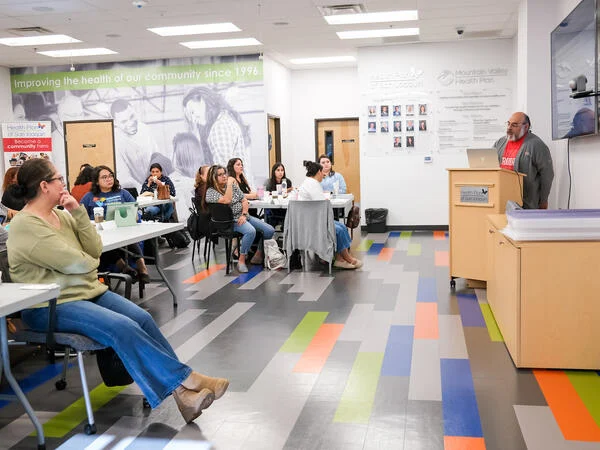
Miguel Ortega (right), a Community Health Worker program graduate and instructor, teaches a Spanish-language cohort at Stanislaus State.
California State University, Stanislaus
Experience as expertise: Sweitzer said the program is a cornerstone of place-based work, where issues of equity and access come into sharp focus. She emphasized the importance of meeting students where they are and recognizing the value they bring from historically underserved and underresourced communities.
“I remember the first class, I had students ask me, ‘Are you sure we’re allowed to be here?’ And I’m like, ‘What do you mean? Of course you’re allowed to be here,’” Sweitzer said. “And they’re like, ‘Well, we’re not usually welcome in spaces like this.’ I said, ‘Wait a minute—you belong here. This is your campus. This is your state institution. You belong here.’”
“We graduate about 100 [students] a year, and each one of them takes something transformative from this training,” she added, whether it’s a job, new skills for their current job, career advancement or just a sense of belonging.
“We all belong in these spaces because our lived experience becomes a tool of transformation,” Grimes said. “We may have slightly different knowledge and scopes of work, but we come together. We’re able to lean on each other, and that’s the great thing about the [Community Health Worker] program.”
Ortega pointed to that same connection between lived experience and structural need, describing how it shapes the work of community health workers in practice.
“The need for health care, medical services and social services: It doesn’t matter what community or what ZIP code—that shouldn’t determine the services you get or the quality of life you have,” Ortega said.
Get more content like this directly to your inbox. Subscribe here.
