

Madison Rohrbaugh originally attended Duquesne University in Pittsburgh but quickly realized that living and taking classes in a big city felt overwhelming.
“At Duquesne, I realized I wasn’t outgoing and mostly kept to myself,” Rohrbaugh said. “I was more introverted than extroverted, and because it was such a huge school, I was scared to really talk to anyone.”
After leaving the university, Rohrbaugh, a first-generation college student, moved back to her small hometown in Pennsylvania and began taking general education classes online at Harrisburg Area Community College. There, she discovered a partnership with nearby Lebanon Valley College that made pursuing a bachelor’s degree feel possible again.
Rohrbaugh now plans to transfer to Lebanon Valley this fall, thanks to the program’s combination of dual-admission and personalized transfer advising, which she said gave her the confidence to continue pursuing her degree.
“Taking classes at two different schools at the same time was a little difficult at first because I didn’t know how it would play out,” Rohrbaugh said. “But [the partnership] made it easy. At HACC I was taking classes online, so going to classes at Lebanon Valley gave me that in-person experience.”
“Just going to classes, seeing the professors and meeting other students really helped me realize I wanted to learn more in person,” she added.
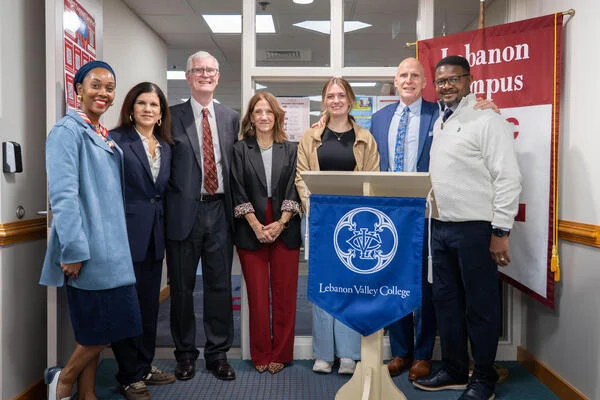
Launched last year, the partnership allows Pell-eligible students like Rohrbaugh to take up to four courses at HACC’s Lebanon campus, which is located on the campus of Lebanon Valley, at no cost while still attending HACC. This early exposure to a four-year college helps address challenges that often derail transfer student success, said Julie Denniston, transfer student adviser at Lebanon Valley.
“We know college is expensive,” Denniston said. “If students can take roughly $3,000 off per course and complete up to four courses through the partnership, that’s $12,000 less in debt they may have to take on.”
“I think that really translates, especially in today’s world,” she added, noting that many students work full-time, so the financial support can make earning a bachelor’s degree feel more attainable for those who may already be hesitant about transferring.
The transfer model: Denniston noted that the transfer model, supported in part by a grant from the American Talent Initiative, grew out of a recognition that while many community college students express interest in earning a bachelor’s degree, far fewer ultimately make the transition.
“There’s a financial barrier that we always have to knock down and address,” Denniston said. “But there’s also a social barrier: Will I fit in? Can I see myself there?”
“There’s sometimes an academic jump from taking courses online to being in face-to-face classes, and students wonder whether they’re ready for that,” she added. “These are COVID-era students, so there’s also that social aspect of, ‘Do I really feel like I belong here?’”
To address this, the partnership allows students to spend full days on Lebanon Valley’s campus, access resources and begin building relationships with faculty and peers before they transfer. She noted the personalized transfer advising students receive is a key part of the model.
“I introduce them immediately to their faculty and department chair. I’m almost like a concierge service for them,” Denniston said. “I often tell students that advocating for yourself is a skill. You’re not nagging, you’re not complaining—you just may not know how to ask for help yet, so we’re going to figure that out together.”
“Getting to students early, even before they set foot on campus, is huge because they know me before they arrive,” she added. “Because of that, they’re known as a person. They’re not just another student.”
Why this matters: Rohrbaugh said the support she received from Denniston and others at Lebanon Valley helped her feel more confident about pursuing a bachelor’s degree again.
“Talking with Julie, she explained everything to me and gave me all the information I needed,” Rohrbaugh said. “She’s really easy to contact, and that made the overall experience of transferring and balancing two schools so much easier.”
Denniston, a retired high school and college basketball coach, said coaching transfer students is right up her alley. She noted that four-year institutions need to rethink some of the assumptions they make about them.
“Sometimes they think [the students are] going to be behind because they’re coming from a community college, and they’re not,” Denniston said. “Sometimes they think they’re going to have to hand-hold them a little bit more, but you don’t.”
“They think transfer students just want to get in and get out of school, but I don’t find that at all,” she added. “I find that transfer students really want to be part of the full four-year experience. They just took a different path to get here.”
Get more content like this directly to your inbox. Subscribe here.
