

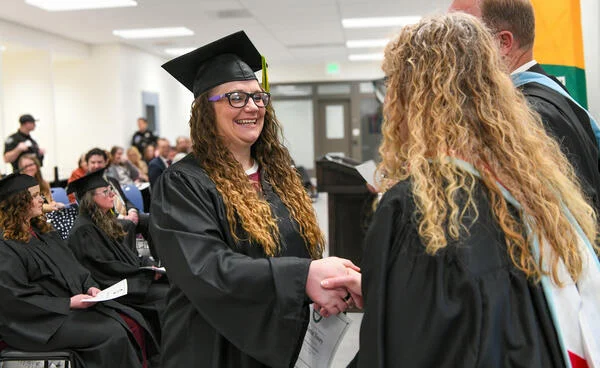
At the Utah State Correctional Facility last week, more than 50 incarcerated students donned caps and gowns to receive career-focused certificates from Ensign College—the first full cohort to have a commencement ceremony held inside the prison.
The graduates are part of the inaugural class of the Ensign Prison Education Program, an online course delivered through the Utah Department of Corrections. The program has no faculty or physical campus presence inside the facility.
Since launching in October 2024, the Ensign Prison Education Program has enrolled nearly 500 incarcerated students, making it one of the largest higher education partnerships with the Utah Department of Corrections. The program offers certificates in small business management and project management as well as pathways toward associate and bachelor’s degrees.
Located in Salt Lake City, the private college enrolls roughly 2,500 students on campus and serves more than 19,000 online learners worldwide, including those in the prison education program.
Ensign president Bruce Kusch said the program is designed to prepare students for employment after release through a workforce-aligned, certificate-based model.
“We have gotten really good at creating meaningful educational experiences for students who are studying online, and I subscribe to the philosophy that online education should be compelling and not just convenient,” Kusch said. “[Incarcerated students] are participating in the same courses as students in our traditional program, so the quality of the experience is consistent.”
Inside the program: Megan Rice, director of prison education at Ensign, said that of the students the program has served, about 30 have been released.
The program aims to enroll students who are at least a year away from release, allowing them to complete a professional foundation course. The 21-week course is meant to prepare incarcerated students for both college-level work and the job-search process after release.
“We know that they have a huge mountain to climb when it comes to re-entering the workplace,” Rice said. “But we think coupling that professional foundation [course] with that skill certificate is going to give them a good boost.”
The course includes workshops on career readiness, including résumé writing and mock interviews. Rice said one student, after applying to nearly 100 jobs without success, was able to use those lessons to land a job.
“In this workshop, we talked through how to be forthcoming with your criminal history, but also not overly apologetic and own it,” she said. “He was able to get a job the next week—that was probably our best anecdote.”
Ensign College enrolls serves more than 19,000 online learners worldwide, including those in the prison education program.
Faith-based model: As part of the Church Educational System of the Church of Jesus Christ of Latter-day Saints, Rice said, faith-based instruction is embedded throughout Ensign’s coursework. She emphasized that participation is not limited to students who share those beliefs, noting that students have responded positively to the emphasis on character development.
“Connection to a higher power often comes up in data about recidivism, so we love that we can be overt about this,” Rice said. “We love that we can talk about the role we believe faith can play—specifically Jesus Christ, our savior—but students are not required to be members of the church or to convert.”
“We have lots of students who identify with other beliefs, and they’ve told me there’s value in being in a space that focuses on how to be a good person and make good decisions,” she added.
Despite being delivered online, Rice said, the program includes in-person components within the facility. For instance, a cohort meets weekly for an hour as they move through the curriculum of the 21-week professional foundation course, with sessions facilitated by church volunteers.
“They have an agenda each week that’s largely student-led, and the volunteers stay with the cohort for the full 21 weeks,” Rice said. “They serve as student success advisers—supporting participants, checking in with them and attending worship services together on Sundays.”
Students can also communicate with instructors through a secure messaging platform and, in some cases, meet them in person at the facility, she added.
“Our theory is that giving students a broader network—through their cohort, the church and the college—gives them a better chance after release,” Rice said. She noted that space constraints inside the facility make a fully in-person model difficult, and that the hybrid approach allows the program to reach more students.
Faith-based instruction is embedded in Ensign College’s prison education program.
Re-entry and second chances: Beyond career-ready training, Kusch said, the program is aimed at reshaping how incarcerated students see themselves and helping them envision a different future.
“This provides students an opportunity to see themselves in a way they maybe haven’t before,” Kusch said. “It gives them a sense of hope and the ability to imagine a future that once felt out of reach.”
Rice added that incarcerated students are often underestimated, despite the personal growth they demonstrate during the program.
“They know what it is to take a hard look at themselves and make changes,” Rice said. “If we can ensure they re-enter in a way that is safe, stable and meaningful, that’s a win for them and for the communities they return to.”
Get more content like this directly to your inbox. Subscribe here.
