

Get stories like this delivered straight to your inbox. Sign up for The 74 Newsletter
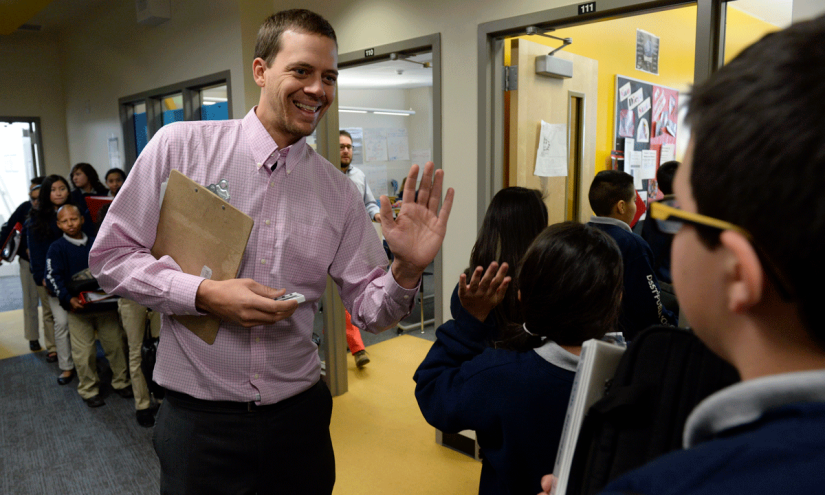
A few years ago, a video of a teacher greeting every student with a personalized handshake, clap pattern or dance move made its way around the internet. It was joyful, creative and clearly meaningful to the students.
It was also the kind of video that makes many teachers think, “That’s amazing — and there is absolutely no way I can do that.”
Most educators are not looking for one more performance to add to their day. They are already managing lesson plans, behavior, parent communication, paperwork, staff meetings, substitute shortages and the emotional weight of trying to meet every student’s needs. So when “greet students at the door” gets presented as another big, elaborate thing, it can feel unrealistic.
But the real power of a doorway greeting is not in the choreography.
It is in the connection.
I have seen this moment matter from preschool classrooms to high school hallways. After years of working with students and schools as a social worker, district administrator and consultant, I’ve learned that the ages and settings may change, but the need is remarkably consistent: Students want to know that someone is glad they are there.
Research suggests that this small routine can make a measurable difference. In one study, classrooms where teachers greeted students at the door saw a 20 percentage point increase in academic engagement and a 9 percentage point decrease in disruptive behavior. The researchers estimated that this kind of increase in engagement could add roughly an extra hour of engagement across a five-hour instructional day.
That is a significant return on a very small investment.
The beginning of class is one of the most important transitions of the school day. Students are moving from the hallway, cafeteria, playground or another classroom into a learning environment. They may be carrying noise, conflict, anxiety, excitement, frustration or unfinished conversations with them. The first few minutes of class can quickly become a scramble: students talking over each other, wandering, negotiating, arguing, sharpening pencils, asking what they missed or waiting to see how much the teacher will tolerate before stepping in.
A doorway greeting sets the tone before students cross the threshold.
The good news is that the most effective greetings in the research were not complicated and did not require special dance moves. The essentials are: Teachers used the student’s name. They made eye contact. They offered a brief nonverbal greeting — a handshake, fist bump, high five, nod or wave. Then they added a short positive or “pre-corrective” statement, which is simply a friendly reminder of what to do next.
That might sound like:
“Good morning, Jayden. I’m glad you’re here. Take a look at the warm-up on the board.”
“Hi, Maria. Good to see you. Grab your notebook and start with question one.”
“Welcome back, Marcus. Today is a fresh start. I’m glad you’re here because we’re going to learn about those volcanoes you were asking about.”
There is nothing flashy about it. But it is powerful because it combines connection and structure.
That combination matters.
Too often, schools treat relationships and expectations as if they are competing priorities. Some educators worry that a focus on relationships means being permissive. Others worry that a focus on expectations means being rigid or punitive. But students need both. They need to know that adults care about them, and they need to know what is expected.
A doorway greeting brings those two needs together in a practical way.
From a behavioral perspective, it is a predictable routine that explicitly teaches and reinforces expected behavior. Students know how to enter, where to look, what to start and how the class begins. That predictability lowers stress for students and teachers.
From a restorative practices perspective, it is a relationship-building habit. It communicates belonging. It gives teachers a daily opportunity to notice students before there is a problem. It allows a teacher to quietly repair after a difficult day, offer encouragement to a student who struggled yesterday or simply communicate, “You matter here. I see you and I’m glad you’re here.”
And from a classroom management perspective, it is prevention.
Teachers know that once a class begins in chaos, it can take a long time to recover. A calm, consistent start protects instructional time. It also reduces the need for repeated corrections once students are inside the room.
This practice becomes even more powerful when it is adopted schoolwide. I have seen schools make a community agreement for everyone to stand at their doors during passing periods or arrival time. The effect was immediate. Hallways felt calmer. Students were more connected to adults. Minor misbehavior decreased because adults were present, visible and welcoming. The whole building felt different.
And something unexpected happened, too: Teachers began connecting with one another. They smiled and waved across the hall, offered words of encouragement, shared a quick joke and reminded one another, in small but meaningful ways, that they were in this together.
Tackling the Youth Mental Health Crisis: Why Every Child Needs a Trusted Adult
Of course, implementation matters. Doorway greetings should be simple, sustainable and adaptable. Teachers can choose a greeting style that fits their personality and their students. Some may use a fist bump. Some may use a warm verbal greeting. Some may offer students a choice: wave, elbow bump, peace sign or no-contact greeting. The point is not the gesture itself. The point is consistent positive contact paired with a clear start-of-class direction.
School leaders also have a role to play. If they want teachers greeting students at the door, they can model it themselves. They can be present, visible and engaged with students and staff during passing periods. That kind of modeling communicates that connection is not one more classroom management trick. It is part of the culture.
The best strategies in schools are often not the most complicated ones. They are the ones that are easy to repeat, grounded in research and aligned with what students and teachers actually need.
Greeting students at the door will not solve every behavior challenge. It will not replace strong instruction, meaningful relationships, clear routines or effective support systems. But it is one small practice that brings all of those ideas together. And when a routine becomes a habit, it becomes easier to sustain.
Two minutes at the door can say: You are welcome here. We are ready to learn. I see you. Let’s begin again.
For many students, that may be exactly the connection moment they need.
Did you use this article in your work?
We’d love to hear how The 74’s reporting is helping educators, researchers, and policymakers. Tell us how
