

Join our zero2eight Substack community for more discussion about the latest news in early care and education. Sign up now.
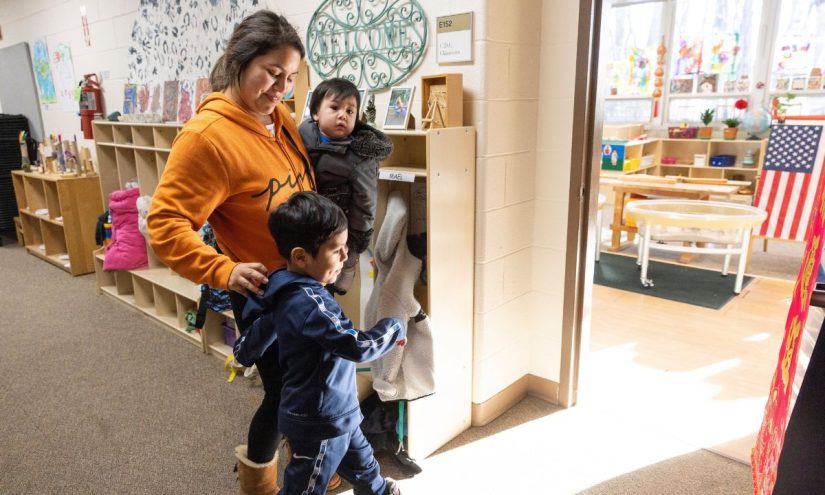
In February, the University of Nebraska at Omaha (UNO) announced it would shutter its on-campus child care center, which has operated for nearly 40 years, at the end of the spring semester.The decision caused a weeks-long uproar on campus, with families, staff and students expressing confusion and distress at what many say was a sudden and unexpected move.
The child care closure at UNO is reflective of a concerning trend: Across the country, universities, school districts and hospitals are shutting down affiliated child care programs at an alarming rate as the cracks in America’s child care system begin to widen into fissures.
Since the beginning of 2025, a growing number of institutions have closed or put forth plans to close on-site child care programs that serve employees and, in the case of universities, student parents. These include universities such as Purdue University, Shawnee State University, UCLA and the University of Louisville, along with community colleges in Washington, Arizona, Colorado and Kentucky. During the same time, public K-12 districts — including Bloomfield Hills School District in Michigan, Dallas County School District in Missouri and Westminster School District in Colorado — have announced similar closures, as have hospital systems in Arkansas, Nebraska and Oklahoma.
In almost every case, administrators are pointing to rising costs as a key culprit. Indeed, absent public funding, large institutions cannot run a sustainable child care business, particularly as most institutionally-affiliated programs offer tuition discounts to employees. In the case of Baptist Health, a nonprofit health care organization in Arkansas, the system said it lost $2 million a year operating two of its child care centers.
While there may have been a time when such losses were manageable, these institutions are being buffeted by other headwinds. Many colleges, universities and school districts are dealing with declining enrollment numbers that have blown holes in their budget. A key federal funding program that helps colleges and universities subsidize child care for student parents — Child Care Access Means Parents in School (CCAMPIS) — has been held flat, which is a functional decrease in the face of inflation and rapidly rising child care costs.
Why Cut a Federal Program That Helps Student Parents Access Child Care?
Meanwhile, hospital systems are struggling with Medicaid cuts, rising labor costs, and tariffs increasing the costs of imported medicines and supplies; The American Hospital Association has called it a “perfect storm of financial pressures.”
The rash of institutional closures should be a stark warning about the future of employer-sponsored child care. That term usually conjures the concept of private companies offering on-site centers or subsidies for child care as a workplace perk. But in practice, these institutions function similarly: They operate on-site child care for their community members, such as staff, students or patients — and in many cases, the programs have been around for decades. In a sense, we might consider institutionally-affiliated child care programs the best-case version of employer-supported care. The institutions are often anchored in public missions, subject to greater accountability and backed by generally reliable funding streams. Yet, even these programs are disappearing.
If institutions designed to serve the public can’t sustain employer-linked child care, it raises a larger question about how realistic it is to expect employers to carry the load at all.
It seems clear that, reluctant as the decision may be, child care quickly finds itself on the chopping block when budgets tighten. Often, it is viewed as a nice-to-have for institutions, even while it’s a must-have for families. When programs close and families lose subsidized care, they’re often forced into a wild scramble for a spot among scarce options. With the aforementioned headwinds only projected to worsen, more closures are, unfortunately, likely on the way.
To be clear, the closures don’t signal that on-site child care is inherently flawed. In fact, the passionate reaction of families and providers show just how valued these programs are. The question is, how should such programs be funded? A model that relies on institutions themselves bearing the cost seems to be breaking down. Similarly, depending on a single funding stream, like CCAMPIS, is clearly risky, as it keeps programs in a constant state of vulnerability — just one unfavorable grant cycle away from collapse.
What’s needed, instead, is a way to wrap institutionally-affiliated child care into a broader publicly-funded system, as is done in nations like Canada and South Korea.
The child care sector may well be entering a phase where Band-Aids like incentivizing employers to offer child care benefits like on-site programs or stipends can no longer hold back the bleeding. If universities and hospital systems — to say nothing of Fortune 500 companies like Google and General Mills — are increasingly unable or unwilling to maintain their child care programs despite evidence of their positive impacts, then a course correction is needed.
Policymakers are rushing to incentivize employer-sponsored child care at a moment when the American economy is slowing down and financial headwinds are picking up. If there’s any good news, it’s that about five thousand years ago humans invented a way to pool individual resources and redistribute them for collective benefit. In other words, the antidote to institutional child care closures is the same as the antidote to mom and pop child care closures: tax dollars.
Did you use this article in your work?
We’d love to hear how The 74’s reporting is helping educators, researchers, and policymakers. Tell us how
