

This article is part of Bright Spots, a series highlighting schools where every child learns to read, no matter their zip code. Explore the Bright Spots map to find out which schools are beating the odds in terms of literacy versus poverty rates.
At John Barry Elementary School, the veteran third-grade teaching team laughed and cried when they talked about their long journey together.
It started 12 years ago when Emily Angiletta, Stephanie Timek and Emily Silluzio were first time teachers at the Meriden, Connecticut school, staying late to plan lessons — long after the custodians shuttered the building.
The teachers were hired under the leadership of a new principal with a new vision of what student success would look like in a low-income school. The three educators were in their 20s, fresh out of college and trying to figure out what it meant to be effective in the classroom.
Emily Silluzio, Stephanie Timek and Emily Angiletta pose for photo at John Barry Elementary School (courtesy: Meriden Public Schools)
More than a decade later, their friendship is like a sisterhood or a sports team: They call each other only by their last names and can practically finish each other’s sentences with a smirk and a head nod that says “yeah, that’s what I was going to say.”
Together, they’ve experienced getting married, losing a parent and having children. They have also lived through the highs and lows of the classroom – some years “soaring through expectations” and others questioning if their teaching had worsened.
“We were all learning together, struggling together, learning from our mistakes, growing together,” Silluzio said, “and I think that’s a huge part of what led to our unity. We were in the same boat.”
The Barry teachers’ close relationships show not only what a culture shift in one school has done for staff, but also students. The friendship and strong working collaboration are the results of a bold plan set in motion by their former principal Dan Crispino, who helped transform the school from 5% proficiency to a National Blue Ribbon School in 2019.
Now, Crispino has been tasked with scaling Barry’s academic success across the district.
The Meriden school district, in many ways, is similar to Angilleta, Timek and Silluzio – learning, struggling and growing together.
An almost decade-long overhaul of the district has been a systematic transformation – rooted in consistency across classrooms and campuses, accountability, hands-on oversight, relationship and trust.
It’s about finding ways to put their students “in a position to do things that people don’t believe are possible,” said Crispino, now the district’s director of school leadership. “Their backgrounds – all these things – are tough and you can’t control everything. But, what you can control is when they’re ours and that we’re giving them every single freaking thing possible to help them be successful and to get ahead of whatever challenges.”
A third grade teacher at Pulaski Elementary School works in a small group with students during a reading rotation (Jessika Harkay)
While there’s often an expectation that students in urban districts won’t perform well because of high concentrations of poverty, which affect school funding levels and supporting high student needs, Meriden is Connecticut’s lowest funded school district and is beating the odds in how successful it’s been at teaching kids to read.
Despite being made up of nearly 9,000 students – more than three quarters of whom are from low-income families – kids in seven of the district’s eight elementary schools are reading at higher levels than expected, according to a data project focused on Bright Spot schools launched by The 74.
The data analysis highlighted schools that were among the top 5% of their state in outscoring their expected reading proficiency based on the percentage of children who qualified for free or reduced priced lunch.
Connecticut was home to 25 exceptional schools. And of the state’s top five Bright Spot schools – three were in Meriden, including its highest need campus, Pulaski Elementary School, which has a poverty rate of 87.7% and expected just 16.4% of students reading on grade level but instead had nearly 54%.
In the last seven years, the school system has reworked its master schedule and implemented a rigorously supervised accountability model from district and school leaders who are in classrooms daily. Staff across the district have meticulously tracked student progress and have improved collaboration to make data more accessible among one another.
The district has also incorporated instructional coaches, who are assigned by grade and travel between campuses. Their role, beyond meeting with educators several times a week, is bearing the weight of lesson planning every unit by outlining curriculum and other resources.
The initiatives are part of an underlying mission: Alignment.
No matter the school building or the classroom, all third grade classes across the district are learning the same material on the same schedule – even if it looks a little different teacher by teacher. They’re meeting with the same coaches and district leadership.
System alignment through relationship building
Whether it’s children who have lost a parent, are experiencing homelessness, learning English or have a disability, Meriden staff have successfully worked with many such students — including Enzo, a third grade student at Pulaski Elementary School.
He doesn’t know what he wants to be once he gets older, but he knows he enjoys math and science. Enzo knows all about the Fibonacci Sequence, he said, explaining how “one plus one is two, and two plus one is three, and three plus two is five, and five plus three is eight,” going all the way up to 13 plus eight.
Enzo, a third grade student at Pulaski Elementary School, works on a laptop during class. (courtesy: Meriden Public Schools)
He admitted he thought reading was boring, but he couldn’t sit still when he talked about a book he’s reading at home.
“It’s called ‘What Cats Want,’” said Enzo, 8. “I’m on page 102.”
He’s more than halfway through the book and he likes to read “two or four” pages before he goes to sleep. His favorite tidbit of information from the book is to be careful when you let your cat outside.
“Number one, they can get run over. Number two, they can get lost. And number three, a stranger cat can attack them,” Enzo said, holding up three green marker stained fingers. But, “I remember [everything] from page one.”
Earlier this school year, Enzo lost his father. But through services at his school, including an individualized schedule that allows him to work for 30 minutes, then take a two minute break, he’s been able to stay on track in the classroom.
But before a student like Enzo can be successful, the needs of educators must be met.
Dan Crispino, director of school leadership, observes a reading lesson at Nathan Hale Elementary School. (Jessika Harkay)
Before taking on his central office job in 2020, Crispino spent more than 20 years as a first grade teacher and as a principal at Barry for a handful of years. When he began working as a district administrator, and was asked to mirror his success at Barry across campuses, union relationships were among his top priorities.
“I would never ask anyone to do anything that I wouldn’t do or have done myself,” Crispino said. “You don’t want surprises. They’re your human resource. They’re delivering what you’re trying to put forth. If you don’t have their support, then it’s never gonna work.”
This Texas Elementary Is Achieving High Reading Scores a Million Words at a Time
Time and expectations were the biggest concerns from educators, both in Meriden and across the country, with surveys showing staff often feel like they’re asked to do the impossible in a school day.
Step one, in Meriden, was overhauling its master schedule, which originally “was not, physically, mathematically, possible,” Crispino said. Teachers were being asked to start reading at 12:30, the same time recess was supposed to end, so everyone’s transitional time looked different and there was no uniformity when students were actually supposed to be back in the classroom and at work.
“That had to go away,” Crispino said.
Though it seemed simple, just taking the first step in building in five minute transitions made the schedule “viable, conducive and real,” Crispino said, which helped align schools and teachers on expectations. They also built in a reteach day at the end of every unit for concepts that had students struggling.
Next was making oversight a norm.
Stephanie Timek works with her class to analyze and break down vocabulary words and their meaning. (Jessika Harkay)
Crispino and his building principals spend most of their time in classrooms, at least four times a day. It began as a practice that at first “wasn’t pretty,” Crispino said, with many complaints from union leaders who said administrators spent too much time in the classroom, but has since shifted to educators stopping them when they walk by to see if they want to check their recent data collection.
“We’re not there to get you, there’s a difference,” Crispino said. “For support and accountability, we’re going to be there.”
Coaches that changed, and streamlined, the game
With administrators who better understand what’s going on in the classroom, it means resources can be allocated better. In Meriden, Crispino has spearheaded bringing in instructional coaches who are assigned by grade levels and rotate among campuses.
“When I was a first year teacher, … I had to go home and write all my little lessons. I had no one to help me. I was on my own. Your admin would come in doing observations and you’d either have it or you don’t,” Crispino said, “and that’s different now.”
Veronica Germe recalled being a teacher in the state capital’s public school system. In Hartford, a district home to more than 15,000 students, she remembered how she only saw her principal in her kindergarten classroom once during the entire school year and how “visibility is the biggest difference” between the two districts.
Germe, now a K-3 grade English language arts and math coach in Meriden, is part of a team of about a dozen other elementary instructional coaches who are responsible for supporting both new and veteran teachers by managing lesson planning and acting as a resource for implementation.
“We’ve almost become a catch all in the district for all the questions K-5,” she said.
In many districts, instructional coaches may be brushed off by educators, but in Meriden, the group has worked hard to develop a relationship where they’re “almost like a teammate,” Germe said. “We’re not evaluating them. We’re there in it with them. We’re helping and we want to get to know the students too. … Their scores are our scores.”
The coaches organize curriculum into bite-sized emails that are delivered before a unit. The emails give an overview of the lessons for that unit, with breakdowns of assessments, test questions to pay attention to, review slides, videos and pacing guides. The emails also explicitly outline state standards, which allows teachers to better target their instruction.
They meet with teachers every week for at least one planning session for upcoming lessons, and observe and offer advice during classroom time. The group of coaches are also able to provide pacing calendars and resources to help teachers differentiate instruction based on class needs.
Last year, Connecticut implemented a new state mandate that limited the curricula elementary schools could use to teach reading. When the district fully shifted its K-3 curriculum, it was painless – “phenomenal”even – Crispino said, thanks to a rollout supported by union leaders and the instructional coaches that gave educators “everything they would need.”
Despite budget constraints, the district has committed to leaving their elementary instructional coaches untouched, and funded by Title I, a federal grant for schools with high-concentrations of low-income students.
Nathan Hale Elementary School Principal Eric Rank works with students during a reading rotation learning about grammar. (Jessika Harkay)
Investing in these coaches for early grades gives all teachers and children “equal footing,” Crispino said, where everyone gets the same emails and meetings, then gets to decide what they’re doing with the resources.
In mid-March, if you walked into Meriden’s Pulaski, Nathan Hale, or Thomas Hooker elementary schools during its rotational reading blocks, you would’ve seen almost the same snapshot in the three campuses.
While teachers have autonomy on the use of laptops, printed worksheets or using dry erase boards, the 60-minute period across a dozen classrooms generally looked the same.
The Maryland School District ‘Doing the Improbable’ in Teaching Kids to Read
During the reading rotation block, a small group of students, usually six or less, would be sitting in one corner of the room working on answering questions about a text with their teacher. In another corner, you’d see a paraeducator, tutor or reading coach with another small group.
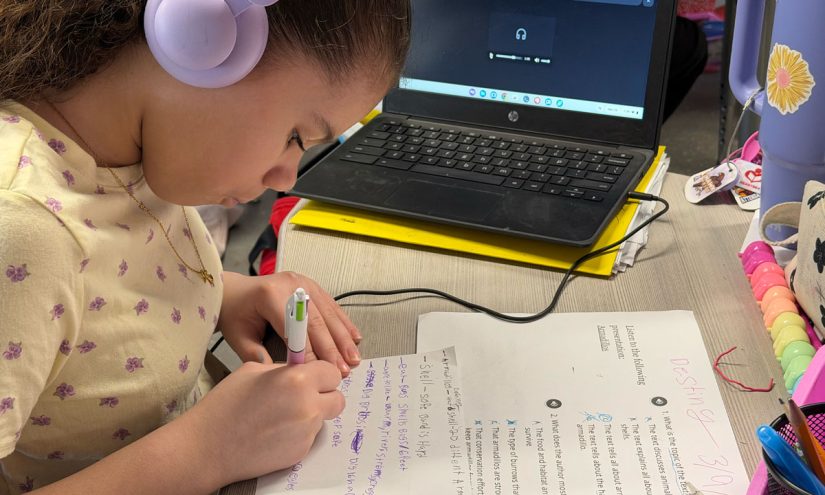
Scattered across the classroom, students would be working alone with a loose leaf piece of paper, called “evidence paper” and taking notes and analyzing stories about komodragons, the galaxy or Harriet Tubman. Pairs also worked on poster boards or white boards figuring out vocabulary, grammar, main ideas or comparing and contrasting two texts.
Third grade students at Thomas Hooker worked in partners during their reading period. They took notes across the room while their teacher read a text aloud about galaxies and stars. (Jessika Harkay)
After 20 minutes, it was time to rotate, and every student knew what to do without being asked twice.
The scenes were a direct mirror of how everyone’s “speaking the same language,” as Crispino would say, in every elementary building across the district.
“The coaching, the admin, the feedback, the curriculum that’s easily accessible, these emails, … eliminated a lot of excuses, and when we did that, we created this high standard of excellence,” Crispino said. The alignment “built independence. It built accountability. It built engagement. It built a vibrant learning environment.”
A printed worksheet about astronauts where third grade students at Pulaski Elementary were asked to find the main idea of the text and find supporting evidence. (Jessika Harkay)
Innovation and scalability
Last year, Angilleta, Timek and Silluzio came into a meeting with administrators rehearsed and prepared to propose a departmentalized approach to third grade, where every student would rotate among the three educators for different subjects, similar to a middle and high school model.
The presentation wasn’t even needed, Crispino and the school’s principal Kimberly Goldbach said, laughing. It was an automatic yes.
“Part of me was like ‘You’d be an idiot to change what’s working,’ but then I said, ‘You’d be an idiot to not be innovative and creative enough to know when there’s a time to think outside the box,’” Crispino said.
It’s paying off. Their third grade class “had the highest scores they ever had,” Crispino said. “I think our scores are going to get even better because we’re being creative and innovative at the elementary level with departmentalizing.”
138 NYC Schools That Are Defying Expectations When it Comes to Reading
Beyond the academic piece, Timek also said she’s hopeful the approach will give children, particularly those with high-needs, more resources.
“It gives these kids another chance to have a teacher that they’re not stuck with all day long. You might have a closer relationship with one kid versus the other, but the other kid can go to another class and be closer with that teacher,” she said. “They have more adults in their corner that they trust and they know that’s providing them a good education and that they can go to if they have a problem.”
The district is working to add nearly two dozen more educators into the departmentalized approach.
A small group of students works with their teacher at Nathan Hale Elementary School during a reading rotation. (Jessika Harkay)
When asked about the scalability of Meriden’s success in other schools across the state and country, Crispino, the district superintendent Mark Benigni and various principals said it was possible, but with a few caveats.
“Can districts have a schedule like we do? Yes, but you have to make sure you’re consistent with it. Can you have instructional coaches do the work we’re doing? Yes. Should admin be in rooms? Yes. Should the central office support and understand the work happening in the trenches? Yes,” Crispino said. “You have to push [your staff and kids] to an uncomfortable place, … to challenge each other, have professional dialog and have high expectations, but then give them the resources to be successful.”
Did you use this article in your work?
We’d love to hear how The 74’s reporting is helping educators, researchers, and policymakers. Tell us how
